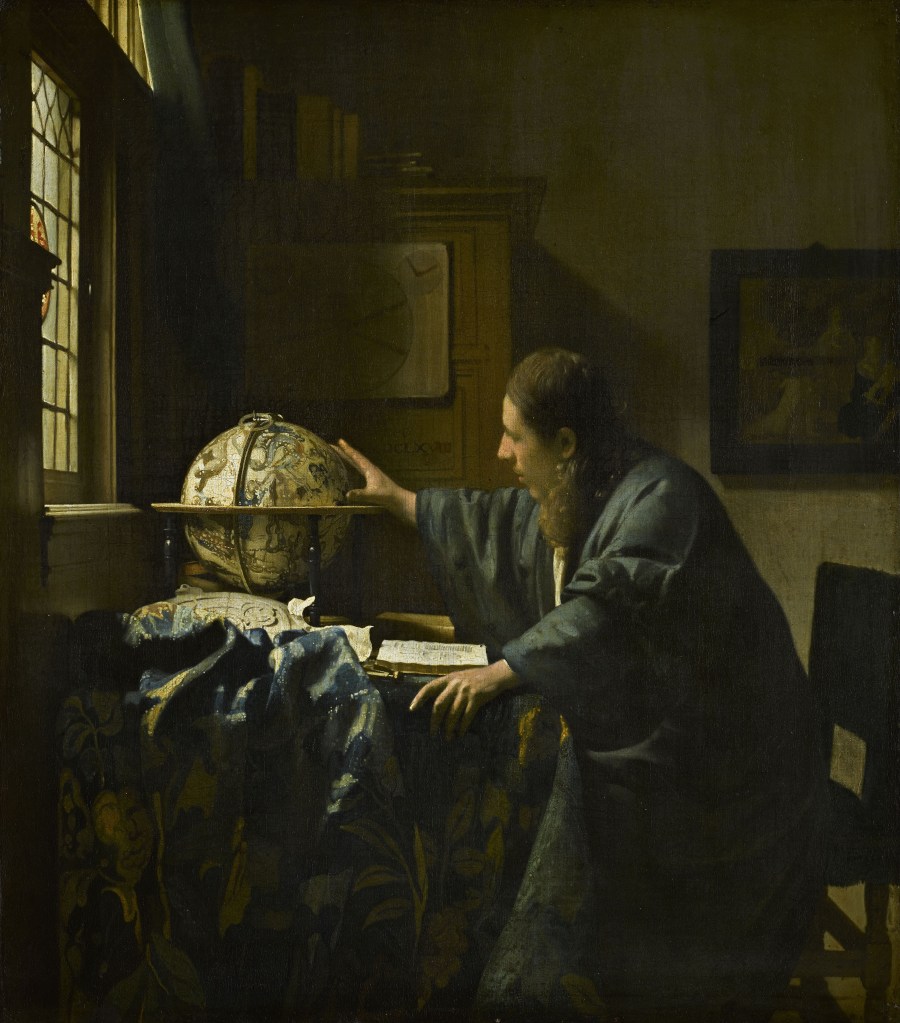
In doing some research on Baruch Spinoza (1632 – 1677) I became aware of a remarkable constellation of rationalistic thinkers who flourished during the 17th century in and around Amsterdam. Some preceded, others were contemporaneous and some followed that influential philosopher of Portuguese-Sephardic origin, who was born in the Dutch Republic.
The roster of intellectuals whose common denominator was to question established beliefs in the divine includes philosophers of Sephardic origin like Spinoza, as well as those of Dutch ancestry. Here is a partial listing of these precursors of the Enlightenment, by birth year chronology:
- Uriel da Costa (1585 – 1640)
- Franciscus van den Enden (1602 – 1674)
- Juan de Prado (1612 – 1670)
- Jan Rieuwertsz (1616 – 1686)
- Pieter de la Court (1618 – 1685)
- Jan Hendriksz Glazemaker (1620 – 1682)
- Johan de la Court (1622 – 1660)
- Pieter Corneliszoon Plockoy (1625 – 1670)
- Lodewijk Meyer (1629 – 1681)
- Adriaan Koerbagh (1632 – 1669)
- Johannes Bouwmeester (1634 – 1680)
It is of interest to note that the 1600s have been labeled as the Dutch Golden Age. It refers to a number of notable accomplishment during that period in the fields of painting, science, commerce, economy, and overall social and cultural freedom. That label, however, has recently come under scrutiny and rejection in view of the deplorable role that the Dutch played in their practice of slavery. That questioning is certainly justified and their participation in that abhorrent human commerce cannot be excused.
That stain, nevertheless, should not detract from admiring the culture that spawned the roster of radical thinkers in the midst of a largely conservative bourgeois culture (see below the masterful depiction by Rembrandt of a typical group of Dutch burgers). Awareness of this intellectual flourishing, however, is frequently lacking as I found, to my surprise, that under the otherwise exhaustive Wikipedia rubric of “Dutch Golden Age” there is no mention of the radical enlightenment movement that emerged and flourished in the Dutch realm throughout the 17th century.
Baruch Spinoza (1632 – 1677)
I will start discussing the most famous and influential of all the philosophers of the period and place that concerns us: Baruch Spinoza.
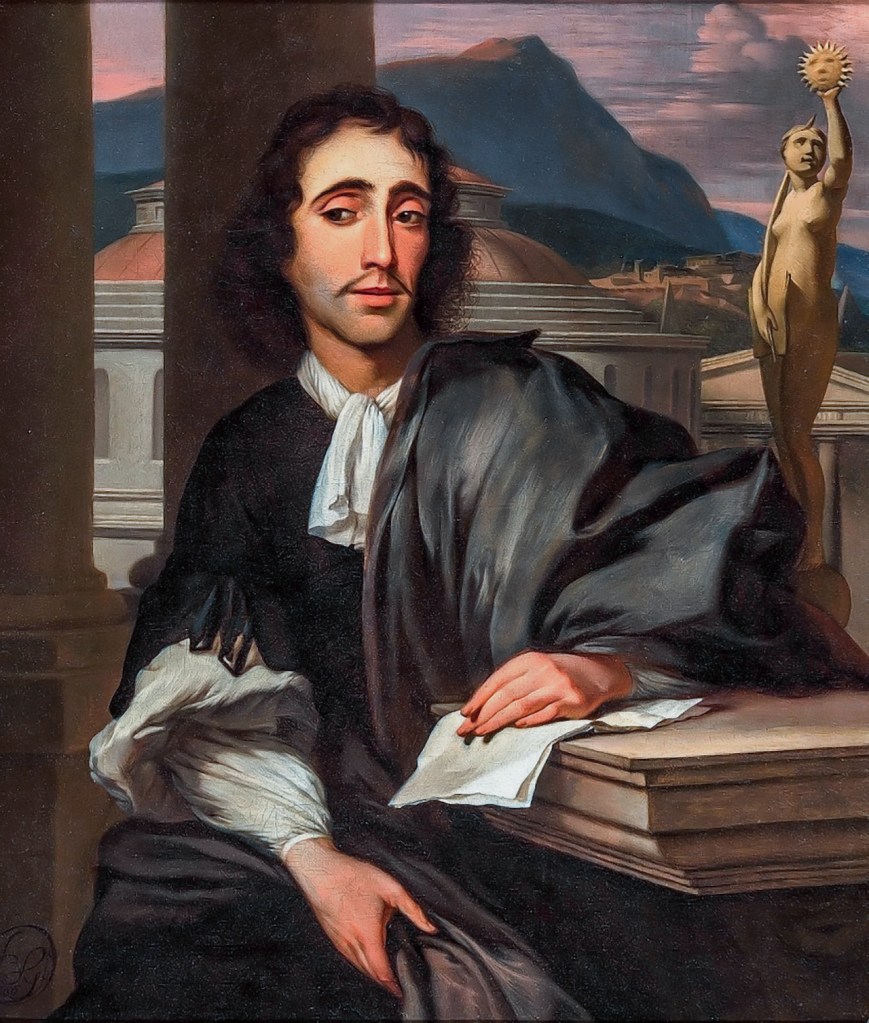
As the corresponding Wikipedia entry describes, Spinoza was born in Amsterdam to a Marrano family that fled Portugal for the more tolerant Dutch Republic. He received a traditional Jewish education, learning Hebrew and studying sacred texts within the Portuguese Jewish community, where his father was a prominent merchant.
As a young man, Spinoza challenged rabbinic authority and questioned Jewish doctrines, leading to his permanent expulsion from his Jewish community in 1656. Following that expulsion, he distanced himself from all religious affiliations and devoted himself to philosophical inquiry and lens grinding. In this latter context, it should be remembered that both the telescope and the microscope were invented in the Netherlands around the turn of the 16th to the 17th centuries.
Spinoza attracted a dedicated circle of followers who gathered to discuss his writings and joined him in the intellectual pursuit of truth.
Paraphrasing the Wikipedia entry, Spinoza published sparingly during his lifetime to circumvent persecution and the suppression of his works. In his Tractatus Theologico-Politicus, which has been described as “one of the most important books of Western thought”, Spinoza questioned the divine origin of the Hebrew Bible and the nature of God while arguing that ecclesiastic authority should have no role in a secular, democratic state. In his Ethics he argues for a view of God that scholars interpret variously as pantheistic, panentheistic, or atheistic, and it explores the place of human freedom in a world devoid of theological, cosmological, and political moorings. Rejecting messianism and the emphasis on the afterlife, Spinoza emphasized appreciating and valuing life for oneself and others. Spinoza advocated for individual liberty in its moral, psychological, and metaphysical dimensions.
Spinoza’s philosophy addresses multiple areas of philosophical discourse, including metaphysics, epistemology, political philosophy, ethics, and philosophy of science. Spinoza is celebrated as one of the most original and influential thinkers of the seventeenth century. He has been described as “the renegade Jew who gave us modernity”.
It is of interest that Albert Einstein named Spinoza as the philosopher who exerted the most influence on his world view (Weltanschauung). Spinoza equated God (infinite substance) with Nature, consistent with Einstein’s belief in an impersonal deity. In 1929, Einstein stated “I believe in Spinoza’s God who reveals himself in the orderly harmony of what exists, not in a God who concerns himself with the fates and actions of human beings”.
Uriel da Costa (1585 – 1640)
Costa was a colorful and yet tragic early figure of the roster of philosophers who flourished in the Dutch realm of the 1600s. Again, citing Wikipedia, “Uriel da Costa (c.1585 – April 1640) was a Portuguese Sephardi philosopher who was born a New Christian but returned to Judaism, who questioned the Catholic and rabbinic orthodoxies of his time. This led him into conflict with both Christian and Jewish institutions: his books were placed on the Index Librorum Prohibitorum and several Jewish authorities excommunicated him. His iconoclastic life culminated in suicide in c. 1640.”
He studied Catholic canon law at the University of Coimbra, in Portugal, intermittently between 1600 and 1608, and began to read the Hebrew Bible and contemplate it seriously. The family had been the subject of several investigations by the Portuguese Inquisition, suggesting they were crypto-Jews, and they subsequently relocated to Hamburg in 1614 where da Costa quickly became disenchanted with the kind of Judaism he saw in practice. He came to believe that the rabbinic leadership was obsessed with ritualism and legal posturing. At this time, he composed his earliest known written work, Propostas contra a Tradição (Propositions against the Tradition). In eleven short theses he called into question the disparity between Jewish customs and a literal reading of the Torah, and more generally tried to prove from reason and scripture that this system of law is sufficient.
In 1616, the text of this early work was forwarded to the leaders of the prominent Jewish community in Venice. The Venetian rabbinic council ruled against it, prompting the Hamburg community to excommunicate da Costa.
In 1623 he moved to Amsterdam, however, the leaders of that city’s Sephardic community, troubled by the arrival of a known heretic, staged a hearing and sanctioned the excommunication previously set in place against da Costa.
In 1623, da Costa published a book, again in Portuguese, under the title of Exame das tradições phariseas (Examination of Pharisaic Traditions). Therein, he states that the Hebrew Bible, especially the Torah, does not support the idea of immortality of the soul. The work also pointed to supposed discrepancies between biblical Judaism and Rabbinic Judaism. He declared the latter an accumulation of mechanical ceremonies and ritual practices. He believed it was thoroughly devoid of spiritual and philosophical concepts. The book sparked a controversy among Jews in Amsterdam, whose leaders reported to the Christian city authorities that this was an attack on Christianity as well as on Judaism. The work was then burned publicly, and da Costa was fined a significant sum.
Eventually, seeking reconciliation, he first suffered punishment for his heretical views: he was publicly given 39 lashes at the Portuguese synagogue in Amsterdam, then forced to lie on the floor while the congregation trampled over him. An extreme example of doctrinal intolerance, indeed.
The Wikipedia entry describes that “in a document entitled Exemplar Humanae Vitae (Example of a Human Life), da Costa tells the story of his life, intellectual development, and experiences as a victim of intolerance. Translated to Latin some decades after his death and only a few pages long, it also expresses rationalistic and skeptical views, including doubts about whether biblical law was divinely sanctioned or whether Moses simply wrote it down. Da Costa suggests that all religion is a human invention, and specifically rejects formalized, ritualized religion. He proposes an idealized religion to be based only on natural law, as God has no use for empty ceremony, nor for violence and strife.”
It is believed that Uriel da Costa committed suicide by shooting himself.
Franciscus van den Enden (1602 – 1674)
Franciscus van den Enden, was a Flemish poet, physician, art dealer, philosopher, and finally plotter against Louis XIV of France. Born in Antwerp, where initially he had career as a Jesuit and an art dealer, he moved later to the Dutch Republic where he became part of a group of radical thinkers, the Amsterdam Circle, who challenged prevailing views on politics and religion.
Van den Enden was the Latin teacher of Spinoza, with whom Spinoza boarded for a period. He preceded Spinoza in writing radical philosophical texts with a combination of democratic republicanism, rejection of religious authority, and advocacy for basic equality.
In his Vrije Politieke Stellingen (Some Free Political Theses’), Van den Enden advocates for freedom of speech and the general right to develop. He further develops the idea of popular sovereignty. He is convinced that the people, by the practice of democracy in popular assemblies, will gain experience and insight.
Van den Enden’s later writings are of great interest. It is clear, for instance, that together with Johan de la Court, he should be counted among the earliest Dutch-writing and Early-Modern promoters of democracy. His defense of religious toleration, a secular state, public education and less cruel forms of justice situate him within the Early Enlightenment. Moreover, his radical rejection of slavery is unique, even within his circle of Amsterdam freethinkers. Finally, Van den Enden’s concern for social problems and his proposals for organized forms of solidarity, must be considered original for his time.
Van den Enden can be considered one of the forerunners of the French Revolution where the concepts of liberty, equality and fraternity became the yardstick of a new model for society.
Tragically, he participated in a plot against Louis XIV, but the conspirators were caught before they could execute their plans, which included the establishment of a republic in Normandy. Franciscus van den Enden was condemned to death and on 27 November 1674, he was hanged in Paris in front of the Bastille.
Juan de Prado (1612 – 1670)
Information about Juan de Prado is very limited. Here is what I have been able the ascertain: Juan de Prado got a doctoral degree in Medicine from Toledo University (1638). He returned to Judaism, and settled in Amsterdam around 1655. He was sentenced (14 February 1657) by the Amsterdam Mahamad (Sephardic council of elders) to repent in the synagogue for publicly disseminating heterodox ideas and inciting others to start a riot against the rabbis. The case dragged on until 4 February 1658, when the official document of his banishment was signed and the ceremony of absolute severance was held. De Prado had adopted some of these heretical stands on the Scriptures from La Peyrère, a French Calvinist suspected to have been a Sephardic Marrano, and argued in favor of deism. After his expulsion, De Prado left Amsterdam around 1660 and went to live in Antwerp.
Jan Rieuwertsz (1616 – 1686)
Jan Rieuwertsz was a bookbinder, printer, publisher, and bookseller active in Amsterdam during the period 1640–1686.
Jan Rieuwertsz. although a bookbinder himself, became best known as a publisher. In his career, he brought more than 230 titles to market. Much of the printed matter that Rieuwertsz. brought to market was written by Mennonites and Collegiants. Rieuwertsz was part of Baruch Spinoza’s close circle of friends. Jan Rieuwertsz is famous as the publisher of the works of Descartes and Spinoza. He published quite a few controversial works, how many is difficult to determine, as in the case of Spinoza’s “Tractatus theologico-politicus”, for instance, he took care to use a fictitious imprint.
A close friend of Spinoza, Rieuwertsz’ shop was a notorious meeting place for freethinkers, who came there to take part in ‘strange discourses’, according to the Calvinist clergymen who complained to the city authorities in 1669. Evidence that bookshops were monitored as centers of potentially seditious information appears from a curious request to the booksellers made by Franciscus van den Enden. He asked them not to display a work of his too prominently. “Be careful, he advised, not to post it on the door, or leave it on the counter, as it was not written ‘for Everyman’.
Pieter de la Court (1618 – 1685)
De la Court came from an altogether different background than the personages treated heretofore. His family was wealthy and successfully engaged in cloth manufacturing.
De la Court studied at Leiden University and completed his education with a Grand Tour through Europe in 1641 – 1643. Among other destinations he went to London, Saumur (France), Geneva and Basel. The diary he kept during his journey has been preserved and was recently published in 1928. After returning to Leiden, he entered his father’s profession and set up a cloth trading firm with his brother Johan. By 1650 the firm of the two brothers had evolved into one of the leading cloth operations in the city.
As mentioned in Wikipedia, De la Court “became the leader of a consortium of Amsterdam merchants who sought to break the monopoly of the Dutch East India Company on all trade with the Dutch East Indies. The group filed petitions which claimed that the monopoly was limited to the trade route around Africa’s Cape of Good Hope. In 1668 they sent an exploratory vessel to the Arctic to find a shipping route around Siberia. The endeavor failed but shows De la Court was an advocate of free trade in theory and practice.”
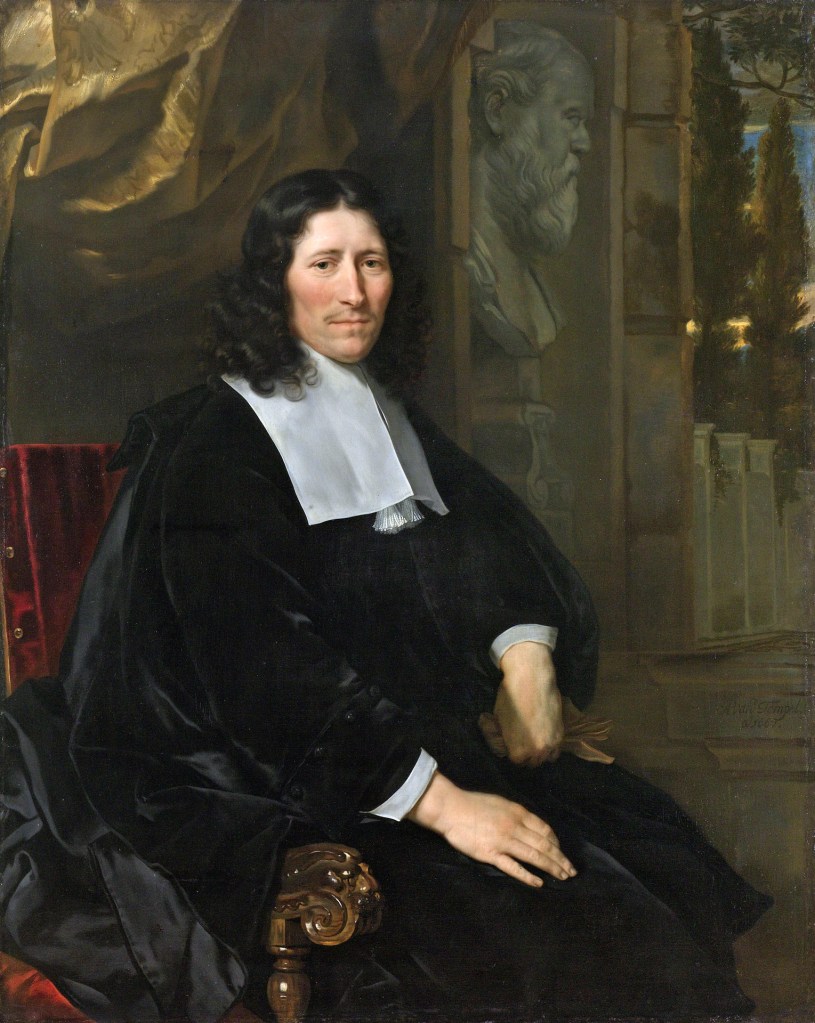
De la Court’s publishing activity had made him a well known protagonist of the republican “party” in contemporary Dutch politics.
His book entitled Interest van Holland was published in 1662 and immediately became a bestseller in Holland and later also elsewhere. The book contained an analysis of the miraculous economic success of Holland, the leading province of the Dutch Republic, and then set out to establish the economic and political principles on which that success was based. De la Court identified free competition and the republican form of government as the leading factors contributing to the wealth and power of his home country. The book was written in an outspoken and polemic style and went through eight editions in 1662.
In 1660 De la Court published the Consideratien van Staet (Considerations of State), followed in 1662 by the Politike Discoursen. Both titles seek to establish a theoretical basis for the superiority of the republican form of government. The third and most extensive part of De la Court’s work is the series of republican and anti-monarchist pamphlets he published in 1662 and 1663. The most well-known are the Historie der gravelike regering in Holland (History of the counts of Holland) and De stadthouderlijcke regeeringe in Hollandt ende West-Vrieslandt (History of the stade holders of Holland and West-Friesland).
Jan Hendriksz Glazemaker (1620 – 1682)
Jan Hendriksz Glazemaker was a Mennonite Dutch translator of almost 70 books, mostly from Latin and from French. Glazemaker probably lived and worked in Amsterdam, where most of his translations were published. He may have been the first person in history to make a living primarily by translating into Dutch. While much of his output was of the Latin classics, he was particularly noted for his translations of the writings of René Descartes from both French and Latin, and for his translations of Spinoza’s works from Latin.
In 1657 Jan Hendriksz Glazemaker translated the Koran from French to Dutch. He sold it through a bookstore owned by fellow Mennonite Jan Rieuwertsz called “At the Sign of the Martyr Book.” It was the first Dutch translation of the Koran and sold so well that it went through a second printing the following year.
Glazemaker had a deep interest in theology and philosophy. He translated nearly 70 works during his career, including books by Seneca, Homer, Marco Polo and Descartes.
In the 17th and 18th centuries the Netherlands experienced a flourishing of culture known as the Dutch Golden Age. During this time many Mennonites became actively involved in the culture as merchants, engineers, historians, artists and doctors. Dutch Mennonites also had a keen interest in books and book printing and were open to dialogue with a wide range of diverse perspectives. Though aware of differences, Dutch Mennonites showed an openness to and eagerness towards other ways of thought. They were open to talking to people who were non-trinitarians. Some were closely connected to the Jewish philosopher Baruch Spinoza.
Johan de la Court (1622 – 1660)
Pieter de la Court’s (see entry above) works were published anonymously, but contemporaries immediately identified Pieter de la Court as the author of most of them. It is now generally believed that some of these books were actually written by his brother, Johan, and that at least one other title was the work of his business friend Johan Uytenhage de Mist. It has been established as a fact that Johan de Witt and a number of other officials contributed to the Interest van Holland. Johan de la Court collaborated with his brother Pieter on many of their publications and will not be treated here separately.
For a thorough treatment of the of the lives and oeuvres of the De la Court brothers the following publication is recommended: Commercial Republicanism in the Dutch Golden Age: The Political Thought of Johan & Pieter de la Court by Arthur Weststeijn (2021).
Pieter Corneliszoon Plockoy (1625 – 1670)
As described in its Wikipedia entry, Pieter Corneliszoon Plockhoy “was a Dutch Mennonite and Collegiant utopist who founded a settlement in 1663 near Horekill (Lewes Creek) on the banks of Godyn’s Bay (Delaware Bay), near present-day Lewes, Delaware. The settlement was sacked during the English conquest of New Netherland in 1664. He was a longstanding advocate of equality and unrestricted religious toleration, and influenced Franciscus van den Enden (see entry above), who taught Spinoza Latin. He is now considered a kind of proto-socialist.”
Before embarking for the New World, Plockhoy unsuccessfully petitioned English statesman Oliver Cromwell in 1658 for support in establishing various ideal settlements in England. Plockhoy published political pamphlets addressing contemporary social problems in 1658 and collaborated with Franciscus van den Enden in plans for founding a new society in New Netherland. Some contemporary writers that were critical of his views alleged that Plockhoy defended polygamy.
Lodewijk Meyer (1629 – 1681)
As per Wikipedia, Lodewijk Meyer “was a Dutch physician, classical scholar, translator, lexicographer, and playwright. He was a radical intellectual and one of the more prominent members of the circle around the philosopher Baruch Spinoza.”
He is generally considered the author of an anonymous work, the Philosophia S. Scripturae Interpres. It was initially attributed to Spinoza, and caused a furor among preachers and theologians, with its claims that the Bible was in many places opaque and ambiguous; and that philosophy was the only criterion for interpretation of the most salient points in such passages. Just after the death of Meyer his friends revealed that he was the author of the work, which had been banned by the Court of Holland together with Spinoza’s Tractatus Theologico-Politicus in 1674.
Lodewijk Meyer achieved fame in his own time as the author of the first dictionary of the Dutch language, the director of the Amsterdam Theatre, and one of the co-founders of the literary society, Nil Volentibus arduum. A personal friend of Baruch Spinoza, Meyer was the editor of the latter’s Principles of Cartesian Philosophy (for which he also provided an extensive introduction) and one of those who arranged for the publication of the philosopher’s works following his death in 1677.
The first edition of Philosophy as the Interpreter of Holy Scripture was published anonymously in Amsterdam in 1666, and created an immediate furor and series of condemnations by the ecclesiastical courts. The work was also reprinted twice as an appendix to Spinoza’sTheologico-Political Treatise, and in those editions was attributed to Spinoza. An anonymous Dutch edition appeared in 1667, and new Latin editions in 1673 and 1674. Evidence for the staying power of the work and the controversies which surrounded it is found in the fact that it underwent a fourth edition long after Meyer’s death in 1776.
Because of the relation between Meyer and Spinoza, and the particular relation which Meyer’s study of Scripture bears to Spinoza’s own Theologico-Political Treatise, Philosophy as the Interpreter of Holy Scripture is an invaluable resource for the development of post-cartesian philosophy and its impact upon both theological and political debates at the end of the seventeenth century.
According to most biographies of Spinoza, Lodewijk Meyer was the physician alone with him at his death in The Hague in 1677.
Adriaan Koerbagh (1632 – 1669)
Adriaan Koerbagh and his younger brother Johannes (1634–1672) were sons of a ceramics maker, who died young leaving them funds allowing them to pursue extended schooling. Adriaan studied at the universities of Utrecht, Franeker and Leiden, becoming a doctor in medicine in 1659 and master in jurisprudence in 1661. He was one of the most radical figures of the Age of Enlightenment, rejecting and reviling the church and state as unreliable institutions and exposing theologians’ and lawyers’ language as vague and opaque tools to blind the people in order to maintain their own power. Koerbagh put the authority of reason above that of dogmas and was thus seen as a true freethinker.
Koerbagh described the Bible and dogmas like the Trinity and the divine nature of Christ as only the work of men. Also, like Baruch de Spinoza, he argued that God is identical with nature and that nothing exists outside of nature. Therefore, he argued, natural science, not theology, was the real theology of the world. In his views about the secularization of the Republic of the Netherlands and the limitation of ecclesiastical powers, he argued that religion is irrational and only maintains its position through deception and violence.
He wrote in books ‘t Nieuw Woorden-Boeck der Regten (The New Dictionary of Rights, 1664), and in Een Bloemhof van allerley lieflijkheyd (A Flower Garden of All Sorts of Delights, 1668), under the pseudonym Vreederijk Waarmond. This book explained various technical terms and foreign words. The Church authorities were offended by the dictionary’s articles on religious and political topics, forcing Koerbagh to flee to Culemborg, a legally autonomous town in another province that would not extradite him, and then to Leiden.
Adriaan Koerbagh fiercely opposed the Dutch Reformed Church in his third work, “Een Ligt schynende in duystere plaatsen, om te verligten de voornaamste saaken der Godsgeleerdtheyd en Godsdienst” (A Light Shining In Dark Places, To Shed Light On Matters Of Theology and Religion). He was betrayed by his printer, who knew the contents of his work, and arrested by the authorities. His brother Johannes was also arrested.
In 1668, he was found guilty of blasphemy and was sentenced to 10 years in the Rasphuis jail at Amsterdam, where he had to do forced labour, followed by exile and a 4000 guilder fine. He died a few months later in 1669 in the Rasphuis due to the pressures of prison life. His publications were largely destroyed by the authorities of the Republic. His brother Johannes was released because of lack of evidence against him, but he never published again. He died three years later, in 1672.
Johannes Bouwmeester (1634 – 1680)
Johannes Bouwmeester was one of Spinoza’s closest friends and associates. Though he played a vital part in disseminating Spinoza’s philosophy, Bouwmeester’s preferred position was in the background.
Bouwmeester was a Dutch physician, philosopher, and a founding member of the literary society Nil volentibus arduum. He enrolled at Leiden University in 1651, and in 1658, graduated there in medicine.
He was a close friend of Lodewijk Meyer (see above entry), co-founder of Nil volentibus arduum, and acquainted with Benedictus de Spinoza and Adriaen Koerbagh (see above entries). His father, Claes Bouwmeester, was tailor by trade, and several family members were builders of musical instruments. He was born in Amsterdam.
Summary and Discussion
An important factor in the growth of the Netherlands in the 17th century as an economic power was the influx of groups seeking religious toleration of the Dutch Republic. In particular, it became the destination of Portuguese and Spanish Jews fleeing the Inquisitions in the Iberian peninsula in the sixteenth and seventeenth centuries and, later, poorer German Jews. The Portuguese Jewish community had many wealthy merchants who, both lived openly as Jews and participated in the thriving economy on a par with wealthy Dutch merchants. The Netherlands became home to many other notable refugees, including Protestants from Antwerp and Flanders, which remained under Spanish Catholic rule; French Huguenots; and English Dissenters, including the Pilgrim Fathers. Many immigrants came to the cities of Holland from the Protestant parts of Germany and elsewhere.
Amsterdam, which was a hub of the Atlantic world, had a population primarily of immigrants and others not considered Dutch, if one includes second and third generation immigrants. There were also migrants from the Dutch countryside. People in most parts of Europe were poor and many were unemployed. But in Amsterdam there was always work.
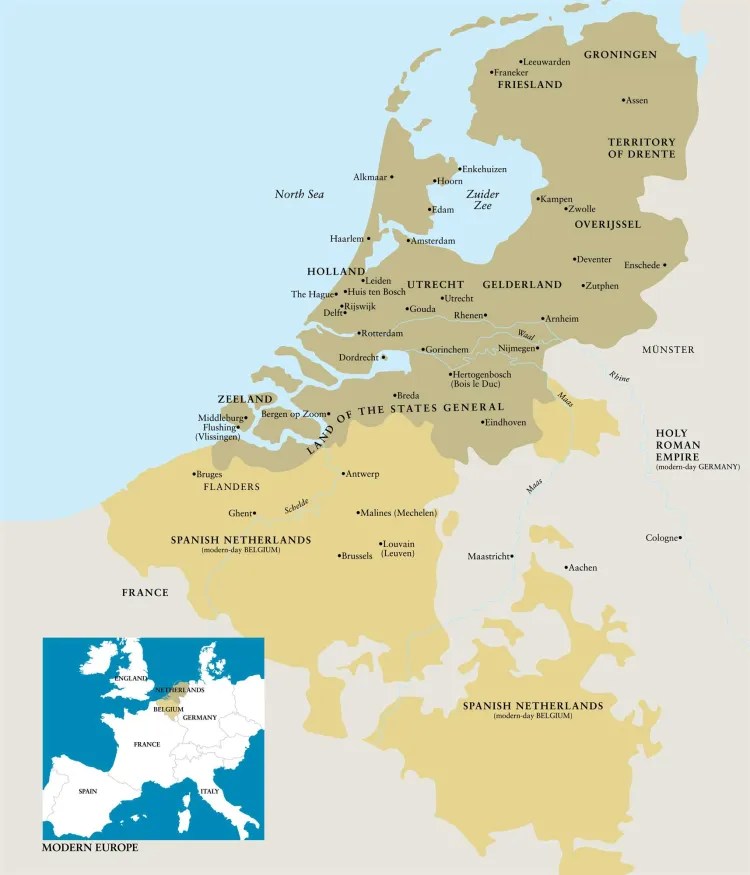
Religious toleration was important, because a continuous influx of immigrants was necessary for the economy. Travellers visiting Amsterdam reported their surprise at the lack of control over the influx (modified Wikipedia entry, possible source here).
Commonly known as an intellectual movement of the late 17th and 18th centuries, the Enlightenment was to place the emphasis on reason and individualism rather than tradition. A study of Dutch philosophy in the preceding period treated above, reveals how rationalistic thought in the Low Countries was already in full bloom before the Age of Reason.
Many of the dissenter philosophers, thinkers and authors discussed in the preceding sections were inspired by and gravitated towards the writings and teachings of the most central figure of the early Dutch Enlightenment, Baruch Spinoza whose ideas continued to exert profound influence for centuries thereafter.
The reader interested about this period and their salient intellects is referred to the following publication: “True Freedom and the Dutch Tradition of Republicanism” by Catherine Secretan, published in Republics of Letters, Vol. 2, Issue 1 (December 1, 2010).


Leave a Reply