Background
This essay is the sequel to the one entitled “From Aristarchus to Hubble, Humanity’s Quest to Comprehend the Cosmos” and will attempt to cover the century from the 1920s to today in the fields of astronomy, space exploration, astrobiology, astrophysics and cosmology.
We will start by reviewing the state of affairs at the waning of the 19th century and the first two decades of the 20th.
An attempt was performed to measure the motion of the Earth relative to the luminiferous aether, a supposed medium permeating space that was thought to be the carrier of light waves. An optical experiment was performed between April and July 1887 by American physicists Albert A. Michelson and Edward W. Morley. As stated in its Wikipedia entry: “The experiment compared the speed of light in perpendicular directions in an attempt to detect the relative motion of matter, including their laboratory, through the luminiferous aether, or “aether wind” as it was sometimes called. The result was negative, in that Michelson and Morley found no significant difference between the speed of light in the direction of movement through the presumed aether, and the speed at right angles. This result is generally considered to be the first strong evidence against some aether theories, as well as initiating a line of research that eventually led to special relativity, which rules out motion against an aether. Of this experiment, Albert Einstein wrote, “if the Michelson–Morley experiment had not brought us into serious embarrassment, no one would have regarded the relativity theory as a (halfway) redemption”.
In 1919 the gravitational deflection of light, predicted by the general theory of relativity of Albert Einstein, was confirmed by observation during a solar eclipse.
William Thompson, Lord Kelvin, was an eminent British thermodynamicist who flourished in the late 19th century. He calculated the age of the Sun to no more than 20 million years. At the time, the only known source for solar energy was gravitational collapse. Without sunlight, however, there could be no explanation for the age of the Earth estimated by both geologists and evolutionary biologists to be, at least, one billion years. This paradox was not resolved until the equivalence of mass and energy, one of the conclusions of Einstein’s special theory of relativity, was found, embodied in the iconic E = mc2 equation, thus providing the enormous source of energy underlying the multibillion year existence of the Sun and, consequently, of the Earth.
Edwin Hubble (1889 — 1953), an American astronomer published in 1924 his momentous discovery that the so-called nebulae, such as the one in Andromeda, were distant galaxies external and similar to the Milky Way which until then had been believed to be the entirety of the universe. Hubble had reached that conclusion based on the detection of Cepheid variable stars (see discussion about Cepheids further on) in what is now known as Barnard’s galaxy, a nearby neighbor of our Milky Way galaxy. Hubble then confirmed his observations by establishing that the Andromeda galaxy was also a separate and even more distant galaxy.
This crucial discovery settled The Great Debate, also called the Shapley-Curtis Debate, which was was held on 26 April 1920 at the U.S. National Museum in Washington, D.C. between the astronomers Harlow Shapley and Heber Curtis. It concerned the nature of so-called spiral nebulae and the size of the Universe. Shapley believed that these nebulae were relatively small and lay within the outskirts of the Milky Way galaxy (then thought to be the center or entirety of the universe), while Curtis held that they were in fact independent galaxies, implying that they were exceedingly large and distant.
As described in Wikipedia: “Georges Henri Joseph Édouard Lemaître (1894 – 1966) was a Belgian Catholic priest, theoretical physicist, and mathematician who made major contributions to cosmology and astrophysics. He was the first to argue that the observed recession of galaxies is evidence of an expanding universe and to connect the observational Hubble–Lemaître law with the solution to the Einstein field equations in the general theory of relativity for a homogenous and isotropic universe. That work led Lemaître to propose what he called the “hypothesis of the primeval atom”, now regarded as the first formulation of the Big Bang theory of the origin of the universe”. Lemaître published these conclusions in 1927.
We must give due credit to a notable woman astronomer in the context of the Cepheid variable stars mentioned above: Henrietta Swan Leavitt (1868 — 1921). She was a graduate of Radcliffe College and subsequently worked at Harvard College Observatory as a human “computer” analyzing photographic records of astronomical observations. This work led her to discover the relation between intrinsic luminosity and period of Cepheid variable stars, what is now know as Leavitt’s Law. She made it possible for Edwin Hubble to make his crucial discoveries. Leavitt’s discovery became a standard candle to measure distance to other galaxies. The Cepheid method became the second rung (parallax being the first) in the cosmic distance ladder in the multi-step method astronomers use to measure vast distances in space by building upon different techniques for increasingly distant objects, with each rung confirming the one below it.
Full recognition for her important contribution to astronomy and astrophysics must go to Cecilia Payne-Gaposchkin (1900 – 1979) who, being a woman, was denied a PhD at Cambridge and Harvard Universities but received a PhD from Radcliffe. Her thesis revealed the groundbreaking discovery that, in addition to elements commonly found on Earth, hydrogen and helium were the main constituents of stars. Her discovery led to the understanding of the thermonuclear processes within stars wherein their main sequence source of energy is generated by fusion of hydrogen into helium in their core.
Astronomy was the catalyst in the elucidation of other related questions in the physical sciences. Some of the salient ones are listed here:
- Ole Roemer and the finite speed of light
- Newton’s law of universal gravitation and its role in space exploration
- The discovery of the greenhouse effect and heating of the atmosphere
- The Kelvin Paradox and the equivalence of energy and matter bearing on the age of the Solar System
- The Michelson-Morley experiment: aether’s absence and the nature of light
- Gravitation and its effect on light and all electromagnetic radiation
All the preceding progress that we have attempted to delineate, over the period of 2200 years, from 300 BCE to about 1930, led to a truly stupendous expansion of humanity’s comprehension of the universe we inhabit. It involves a remarkable cast of characters that was involved in this quest of knowledge. Further, that remarkable — although not always linear — progression thereafter ushered in the spectacular advances that we have been witnessing over the last 100 years, which are the subject of the present class.
This endeavor at summarizing the progress of astronomy from about 300 BCE to the 1920s was bracketed by two remarkable figures: Aristarchus of Samos and Edwin Hubble. When we now endeavor to proceed forward to the present, it will become increasingly difficult to identify single individual scientists —although we will mention a few — who merit a similar distinction. The lofty as well as increasingly complex undertaking of comprehending the cosmos is generally no longer the province of individuals. Increasingly, it requires the convergence of a multitude of scientists, organizations and observatories scattered worldwide. It would be very improbable that a single astronomer, cosmologist or astrophysicist would now be responsible of a major breakthrough in humanity’s understanding of our universe. I can cite a current extreme example of the collectivization of the cosmological endeavor: a paper published in 2024 on the results of observations of gravitational wave events, with the arcane title: “GWTC-3: Compact Binary Coalescences Observed by LIGO and Virgo During the Second Part of the Third Observing Run”. The paper is 82 pages long (nothing earthshaking about that), the contributing authors, however, belong to 297 different research organizations in 22 countries. But here is the truly mind boggling statistic: the total number of listed authors of this paper is…. over 1,500!
Technological Advances
The 20th century saw the transition from the era of large refractor telescopes to reflecting telescopes like the Mount Wilson Hooker telescope and the Palomar Hale telescope. It also marked the birth of radio astronomy by means of radio telescopes, and ended with the launch of space telescopes like the Hubble which, by bypassing spectral atmospheric absorption and removing distortion by the atmosphere, revolutionized astronomical observation. Key developments included the invention of the Schmidt telescope, advancements in optics, and the application of computer control and active optics to create even larger telescopes at the end of the century.
21st-century telescopes are characterized by the development of advanced space-based observatories like the James Webb Space Telescope (JWST) and the construction of massive next-generation ground-based telescopes such as the Extremely Large Telescope and the Giant Magellan Telescope. These telescopes utilize larger mirrors, advanced adaptive optics, and are capable of observations beyond visible light to provide unprecedented views of the universe, studying everything from the earliest galaxies to exoplanets.
The Leviathan of Parsonstown, or Rosse six-foot telescope, was a historic reflecting telescope of 72 inches (1.83 m) aperture, which was the largest telescope in the world from 1845 until the construction of the Hooker Telescope in California in 1917. The Rosse six-foot telescope was built by William Parsons, 3rd Earl of Rosse on his estate, Birr Castle, at Parsonstown (now Birr) in Ireland.
Otherwise, the era of refracting telescopes for research purposes ended with the inception of the Mt. Wilson (near Pasadena, California) observatory’s 60-inch telescope in 1908 followed by the the 100-inch Hooker telescope that remained the largest in the world from 1917 to 1949. Both these instruments were of the Cassegrain reflecting configuration. The Hooker telescope was used by Edwin Hubble to make his crucial identification of the nature of nebula as being remote galactic formations.
The Hooker telescope was displaced in 1949 from its predominance by the Hale telescope on Mt. Palomar (San Diego county, California) with a mirror of 200 inches in diameter. It remained he largest in the world until 1975.
The transition from refracting to reflecting research telescopes was based on the weight and size limitations of the former type; lenses could not be made, transported and supported beyond a certain dimension. Reflecting telescopes are now being made with growing size by means of mirror segmentation which is then combined with adaptive optics capability.
At present, some of the largest reflecting telescopes are located in the Atacama region of northern Chile because of the optimal observing conditions of that altiplano: extreme dryness, high altitude and low light pollution.
Among the largest reflecting telescopes operating today are the following:
- Very Large Telescope, with 4 mirrors of 8.2 m each (Cerro Paranal, Chile)
- Gran Telescopio Canarias, with a 10.4-m mirror (La Palma, Canary Is.)
- Keck Telescopes, with two 10-m mirrors (Mauna Kea, Hawaii).
The figure below illustrates the relative sizes of the principal reflecting telescopes of the 20th and 21st centuries as well as the two largest refracting telescopes of the late 19th. The relative dimensions of two sports courts are also shown in comparison.
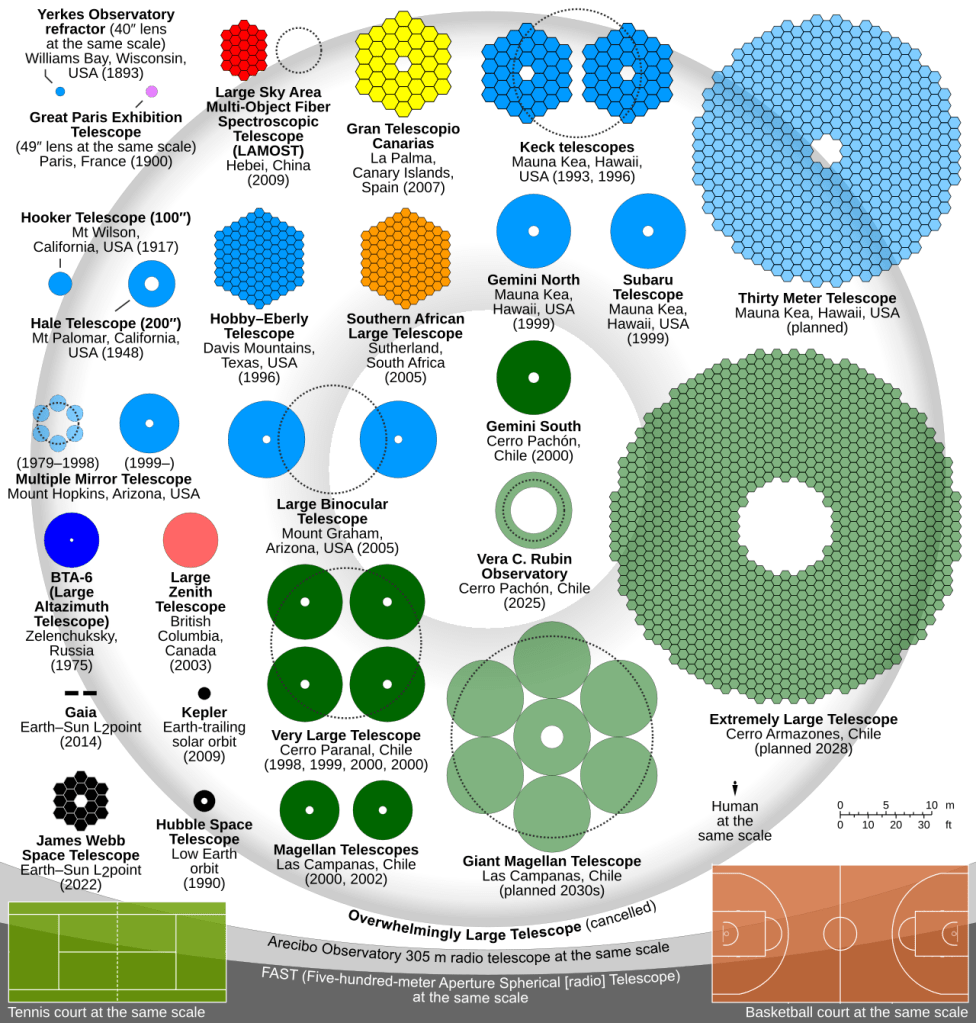
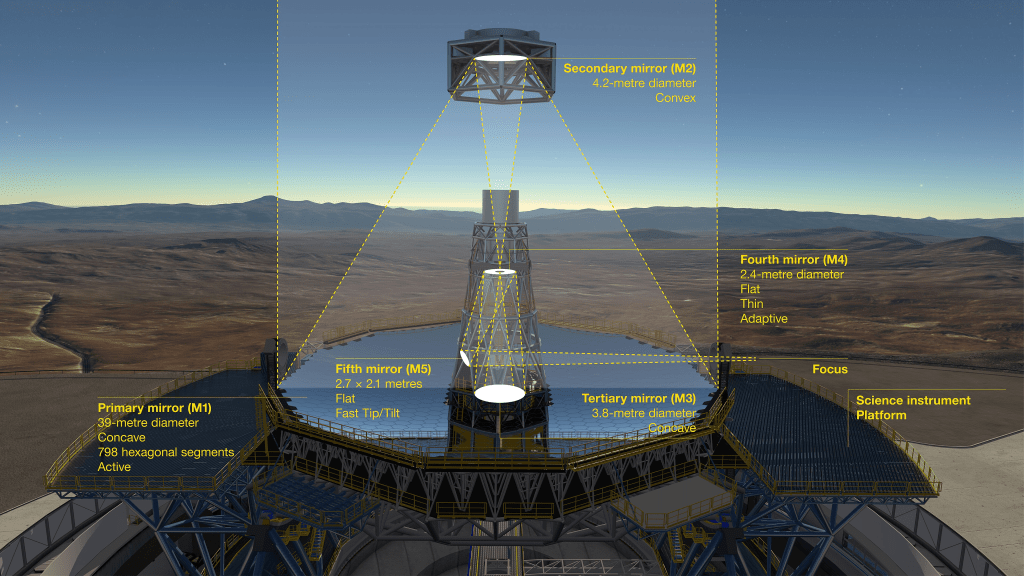
The largest optical telescope, presently under construction by the European Southern Observatory, and slated to be completed by March 2029 is the Extremely Large Telescope (ELT), which is being assembled on Cerro Amazones, in the Atacama desert of northern Chile. It will consist of a reflecting telescope with a 39.3-metre-diameter (130-foot) primary mirror composed of 798 hexagonal segments, each approximately 1.45 meters (4.8 ft) across and with a thickness of 50 mm (2.0 in) followed by a 4.25 m (14 ft) diameter secondary mirror. The telescope is equipped with adaptive optics including six laser guide star units (see description below), and various large-scale scientific instruments.
The illustration below shows the optical configuration of the ELT.
Adaptive optics (AO) is a technology that enhances the performance of optical systems by measuring and correcting distorted light waves in real-time, primarily to counteract atmospheric turbulence. By using wavefront sensors and deformable mirrors that adjust hundreds of times per second, AO allows ground-based telescopes to achieve near-space-quality, diffraction-limited imaging. In the case of telescopes with multiple segmented mirrors such as the ELT described above, the real-time adjustment of the primary mirror is achieved by modulation of each individual segment.
New Ideas, More Debates, As Well as Failed Conjectures
Sir James Jeans (1877 – 1946) was a highly respect British astronomer whose analysis of rotating bodies led him to conclude that Pierre-Simon Laplace‘s (1749 – 1827) theory that the Solar System formed from a cloud of gas was incorrect, proposing instead that the planets condensed from material drawn out of the Sun by a hypothetical catastrophic near-collision with a passing star. This theory is not accepted today.
The most widely accepted model of planetary formation is known as the nebular hypothesis. This model posits that 4.6 billion years ago, the Solar System was formed by the gravitational collapse of a giant molecular cloud spanning several light-years. Many stars, including the Sun, were formed within this collapsing cloud. The gas that formed the Solar System was slightly more massive than the Sun itself. Most of the mass concentrated in the center, forming the Sun, and the rest of the mass flattened into a protoplanetary disk, out of which all of the current planets, moons, asteroids, and other celestial bodies in the Solar System formed. That is now believed to be the predominant process of formation of all stellar systems as first postulated by Laplace over two centuries ago.
In 1926, a brilliant young Indian astrophysicist, Subrahmanyan Chandrasekhar, derived the maximum mass a white dwarf star — a star that had exhausted its hydrogen to helium conversion — could have before collapsing under its own gravity, and published his conclusions a few years later. On giving his lecture at the Royal Astronomical Society in London, Chandrasekhar’s conclusion was contemptuously dismissed by, the most revered British astronomer, Sir Arthur Eddington who had headed the expedition in 1919 to observe the solar eclipse that had proved the deflection of light predicted by Einstein’s general theory of relativity. Eddington refused to accept the possibility that stars could collapse into was later recognized as neutron stars and black holes.
I was 16 years old, listening to the BBC on shortwave (I was living in Ecuador at the time) when I was made aware of a new theory about the cosmos. Shortly after, an extensive article on it appeared in the November 20, 1950 edition of TIME magazine, entitled “Science: According to Hoyle”. Fascinated by that new concepts, I endeavored to translate the article into Spanish for the benefit of my schoolmates. The article covered two aspects of cosmology: the formation of elements and the very structure of the universe. The originating scientists were two young Cambridge University cosmologists: Fred Hoyle and Arthur Lyttleton.
To set the stage for a summarized presentation of this work, here is the introduction of the TIME magazine piece: “Last week and extraordinary theory of the universe, developed chiefly by the Hoyle and Lyttleton team, ranked as a leading conversation piece in British intellectual circles. It was more than that; broadcast by radio, spread by a bestselling book, debated in learned societies, it was bidding for a place among Britain’s most striking contributions to modern scientific philosophy.”
The first part of the article dealt with what later would be named the theory of nucleosynthesis, now recognized as a crucial breakthrough in the understanding of the mechanism underlying the generation of all naturally occurring elements beyond the primary components of the universe, i.e. hydrogen and helium. The second part addresses a revolutionary view of the very structure and dynamics of the cosmos based on continuous creation of matter throughout the universe. This theory, now rejected by scientific consensus, resulted in a steady state wherein the observed expansion of the universe was continuously replenished by hydrogen atoms such that the overall cosmic density remains constant. Consequently, the universe would have always existed and would continue to exist without end.
As we will discuss, Hoyle’s continuous creation cosmos was to be proven incorrect upon the discovery of the background microwave emission which provided observational support to Lemaître’s primeval atom conjecture, mentioned previously, and which is now embodied in the concept of the Big Bang — a derogatory term bestowed by Hoyle itself — of the origin of our universe.
Returning to the successful theory of the process of nucleosynthesis propounded by Hoyle, it is based on the generation of elements as byproducts of the violent supernova demise of stars wherein the extreme energies are engendered required for the creation of elements with atomic weights higher than those resulting from the star’s thermonuclear phase. It is thus that the elements required for the formation of rocky planets are generated and, by extension, the organic building blocks underlying all life forms including ourselves. Further theoretical work during the second half of the 20th century provided the insight in the supernova end-of-life criterion: stars exceeding about three solar masses.
The Birth of Radio Astronomy and the Discovery of the Cosmic Microwave Background
Radio astronomy is a subfield of astronomy that studies celestial objects using radio waves. It started in 1933, when Karl Jansky (1905 – 1950) at Bell Telephone Laboratories discovered radiation coming from the Milky Way. Subsequent observations have identified a number of different sources of radio emission. The discovery of the cosmic microwave background radiation, regarded as evidence for the Big Bang theory, was then made through radio astronomy.
Radio astronomy is conducted using large radio antennas referred to as radio telescopes, that are either used alone, or with multiple linked telescopes linked by radio interferometry and aperture synthesis. The use of interferometry allows radio astronomy to achieve high angular resolution, as the resolving power of an interferometer is set by the distance between its components, rather than the size of its components.
Radio astronomy differs from radar astronomy in that the former is a passive observation technique (i.e., receiving only) and the latter an active one (transmitting followed by receiving of the reflected signal).
At this point it is worth reviewing the main rationale for radio astronomy, namely the impediment created by the Earth’s atmosphere which limits ground-based observation of the cosmos to specific bands of the electromagnetic continuum. The figure below illustrates the openings in that spectrum through which these Earth based observations can be performed.
The vertical scale represents the atmospheric opacity or degree of blocking of electromagnetic radiation from outer space, and the horizontal scale is the wavelength of that radiation. At the low end of the spectrum the 100% opacity is caused by Rayleigh or molecular scattering. Between 0.4 and 0.8 μm there is a narrow and almost total window corresponding to the visible spectrum, i.e., from the violet to the red. This band is then followed by the near infrared with several molecular absorption bands specific to components in the atmosphere (e.g., water vapor, carbon dioxide, etc.), with a window centered on about 10 μm, followed by the mid- and far infrared up to the radio window extending from about 3 cm to about 10 m followed by the long-wavelength radio waves which are blocked by the ionosphere.
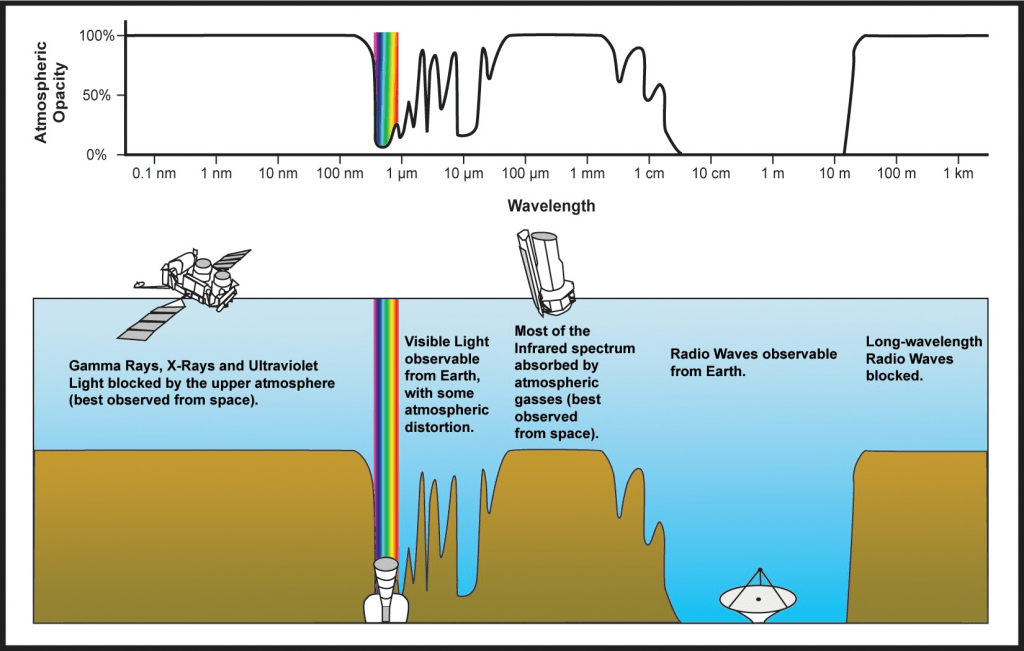
Thus, ground-based optical astronomy is — and had been for centuries — restricted to the visible band, and radio astronomy became an important complementary technique starting in mid-20th century. It yielded the accidental but crucial discovery, mentioned above, of the cosmic microwave background radiation (CMBR) in 1964, by American radio astronomers Arno Allan Penzias and Robert Woodrow Wilson.
As explained in the website of the Center for Astrophysics | Harvard & Smithsonian: “For the first 380,000 years or so after the Big Bang, the entire universe was a hot soup of particles and photons, too dense for light to travel very far. However, as the cosmos expanded, it cooled and became transparent. Light from that transition could now travel freely, and we see a lot of it today. This light carries information about the very early universe. Astronomers use the patterns in CMBR light to determine the total contents of the universe, understand the origins of galaxies, and look for signs of the very first moments after the Big Bang.”
No stable atoms existed in the early universe, because collisions between particles of light called photons and matter kept knocking electrons away. Those collisions also meant the cosmos was opaque, because photons couldn’t travel far.
But about 380,000 years after the Big Bang, the expansion of the universe allowed the first stable atoms to form. That event is called “recombination”, and it made the cosmos transparent. The joining of electrons to nuclei produced a lot of light, which could now travel through the less soupy universe and even reach us, 13.8 billion years later. Light from recombination was very energetic, but it cooled off with the rest of the universe, until it reached the microwave portion of the spectrum. This light corresponds to a temperature today of 2.7 Kelvin: 2.7º C above absolute zero, or -455º F.
Today, we see this light as the cosmic microwave background. Because recombination happened everywhere in the universe, we see CMBR light coming from all directions. The CMBR provides the best data we have on the early universe, and the structure of the cosmos on the largest scales.”
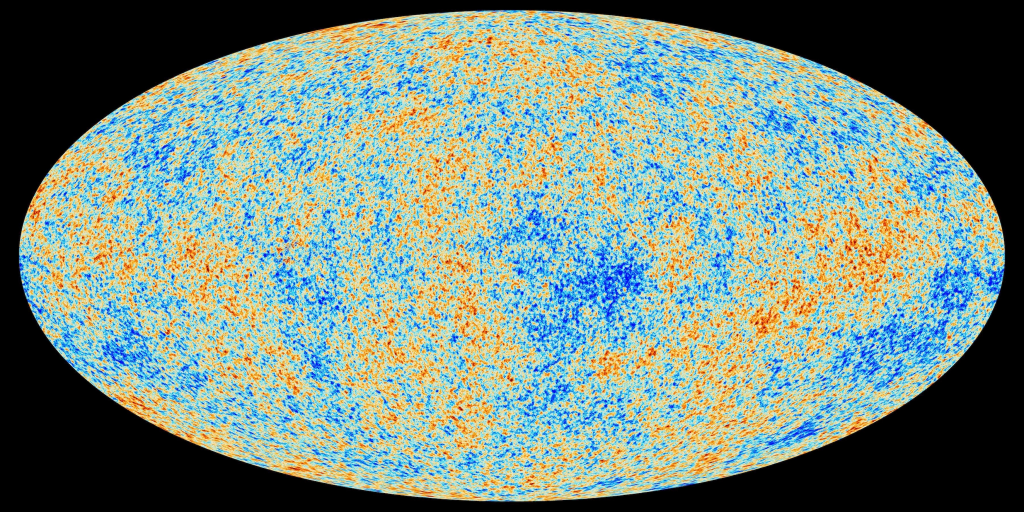
The CMBR exhibits an anisotropic structure, i.e., a fine granularity (see map of the CMBR above) which is believed to underlie the subsequent formation of stars and galaxies. The spectrum of that anisotropy agrees with theoretical models and provides strong support for the overall Big Bang model.
Stars and Their Fate
After a star’s supply of hydrogen has been depleted, its fate again exhibits a sensitive dependence of its mass. Smaller stars will then become red giants — i.e., the fate of our Sun, whereas larger mass stars will explode as supernovas and become either neutron stars or, for the largest mass stars, they will collapse into black holes.
In 1967, Jocelyn Bell, of Cambridge University, detected highly repetitive radio pulses with a period of just over one second which were at first interpreted as being from an extraterrestrial intelligent source and labelled as LGM (Little Green Men). Subsequently, the source of this signal was found to be a pulsar, a type of star of which numerous others with differing pulse rates, were eventually identified.
Pulsars are highly magnetized, rapidly rotating neutron stars—the city-sized, ultra-dense cores left behind by supernova explosions—that emit beams of electromagnetic radiation from their magnetic poles. Detected by radio telescopes as precise, lighthouse-like pulses ranging from seconds to milliseconds, they serve as crucial cosmic tools. Stars with an initial mass exceeding about three times that of our Sun tend to collapse into pulsars, i.e., neutron stars.
As far back as the end of the 18th century English astronomical pioneer and clergyman John Michell and, independently, French scientist Pierre-Simon Laplace hypothesized the existence of black holes, i.e., stars whose surface gravity would be so high that their escape velocity equalled or exceeded the velocity of light. Both astronomers, however, assumed that these were very large stars with densities equal to that of the Sun.
Theoretical work performed after the 1920s, based principally on Einstein’s general theory of relativity, predicted that the collapse of stars at the end their lifespan could result in ultra-dense black holes.
The modern concept of black holes was formulated by Robert Oppenheimer and his student Hartland Snyder in 1939. They solved Einstein’s equations for an idealized imploding star, in a model later called the Oppenheimer–Snyder model, then described the results from far outside the star. The implosion starts as one might expect: the star material rapidly collapses inward. But as density of the star increases, gravitational time dilation increases and the collapse, viewed from afar, seems to slow down. Once the star reached a critical radius faraway viewers would no longer see the implosion. The light from the implosion would be infinitely redshifted and time dilation would be so extreme that it would appear frozen in time.
Black holes can only be seen indirectly but their effect on their immediate surroundings which is the accretion region wherein radiation emerges as matter, i.e., stars are accreted by the black hole.
It is believed that stars with an initial mass exceeding about 10 solar masses end their lives as black holes. These are labeled as stellar black holes to distinguish them from supermassive black holes whose mass exceeds one million solar masses and constitute the core of most large galaxies. Sagittarius A* (Sgr A*) is the supermassive black hole at the center of the Milky Way, located roughly 26,000 light-years from Earth in the constellation Sagittarius. With a mass of approximately 4 million suns, it acts as the gravitational anchor for the entire galaxy. Its first direct image, released in 2022, shows a ring-like structure caused by light bending around its immense gravity.
The radius R of a black hole can be calculated from the following equation:
R = (2 G M) / c2
For a star with a mass equal to 3 Suns, the radius of its black hole would be about 8.8 km or about 5.5 miles, i.e., the size of a major city.
Starting in the 1950s, astronomers were faced with an apparent mystery. Pinpoint radio and optical sources were observed that exhibited spectra of unknown nature. These sources varied in intensity and spectrum over short periods of time, i.e., of the order of days or less. Such short time scales implied small dimensions which could only be explained if these sources were at small distances. The spectra, however, eventually were interpreted as being highly red-shifted which implied enormous distances. That contradiction was only resolved in the 1970s once the existence of supermassive black holes was confirmed. These unknown sources are now known as Quasars (quasi-stellar radio sources) which are extremely bright, distant, and energetic cores of galaxies, powered by supermassive black holes consuming vast amounts of matter. These objects can outshine entire galaxies, emitting intense radiation across the spectrum due to friction in the swirling accretion disk, making them some of the most luminous entities in the universe. Quasars are observed only in very distant galaxies which were in the early phases of their formation during which vast amounts of matter was being accreted by their core black holes.
Space Exploration
Since the late 1950s, some 200 craft have been sent from Earth into space to encounter celestial bodies. The Moon, asteroids, comets and every planet in the solar system except Pluto, have been visited by space probes.
There are three types of space probes: 1. Interplanetary probes which simply fly by celestial bodies. This was the case for the Voyager 2 probe, which passed about 34 million kilometers away from Saturn, and then continued its path through the solar system. 2. Orbiters, which are placed in orbit around a planet in order to examine for an extended period of time, up to a number of years. The Magellan probe spent four years in orbit around Venus mapping its surface. An orbiter generally carries a camera that takes thousands of images, as well as other instruments that study particular aspects of the planet, such as its gravitational field. A transmission antenna then sends these data to Earth. Finally, 3. Landers are probes designed to land on the surface of a celestial body to study a particular place on it. On Mars, some of these landers have included ground rovers and a drone to explore the planet in more detail. The next generation of probes is expected bring back to Earth samples taken from comets, asteroids, and eventually Mars.
One of the principal motivations for the lander explorations of Mars and some of the large satellites of Jupiter and Saturn is the search for life forms either extant or fossil.
Exoplanets by the Thousands
Summary
- What is an exoplanet? It is a planet that orbits a star other than the Sun
- Exoplanets were discovered starting in 1995 by two Swiss astronomers
- As of January 2026 a total of 6,100 exoplanets have been confirmed
- There are a total of over 1,000 known multi-planet systems with at least two planets
- Habitability criteria:
- Rocky structure
- Presence on an atmosphere compatible with life
- Surface temperature compatible with liquid water based on temperature of host star, distance from host star, and green-house effect
- Types of exoplanets: Gas giants, hot Jupiters, Neptune-like, mini-Neptunes, super-Earths, terrestrial (rocky) planets, and rogue planets.
- No exoplanetary system has been discovered to date that resembles the Solar system
Discussion
Let us step back about four and a half centuries to a unlikely persona, Giordano Bruno (1548 – 1600), an Italian Dominican priest, philosopher, poet, alchemist, astronomer, cosmological theorist and esotericist who, accused of heresy, was burned at the stake following a trial by the Roman Catholic Inquisition.
Giordano Bruno in his 1584 book entitled “De L’Infinito Universo et Mondi” (Of the Infinite Universe and Worlds), in a dialogue between two thinkers, Elpino and Philotheo, wrote:
“Elpino. There are then innumerable suns, and an infinite number of earths revolve around those suns, just as the seven we can observe revolve around this sun which is close to us.
Philotheo. So it is.
Elpino. Why then do we not see the other bright bodies which are earths circling around the bright bodies which are suns? For beyond these we can detect no motion whatever; and why do all other mundane bodies (except those known as comets) appear always in the same order and at the same distance?
Philotheo. The reason is that we discern only the largest suns, immense bodies. But we do not discern the earths because, being much smaller, they are invisible to us. Similarly it is not impossible that other earths revolve around our sun and are invisible to us on account either of greater distance or of smaller size….¨
Bruno was indisputably the first person to grasp that the Sun is a star and the stars are other suns with their own planets. That is arguably one of the greatest idea in the history of astronomy. Before Bruno, none of the other Copernicans ever imagined it.
For hundreds of years thereafter, belief in the existence of other planetary systems prevailed. If the Sun has a retinue of planets, so should many stars. This pluralistic view predominated starting in the 17th century. This expectation stimulated the observational search for extrasolar planets (now abbreviated as exoplanets) principally during the second half of the last century. This search, however, was a challenge to the observational tools of that period. The principal obstacle to the discovery of planets rotating around other stars than the Sun resides in the difficulty of detecting the minute amount of reflected light reaching us from such planets against the overwhelming glare of their host star.
The discovery of the first exoplanets was made possible by a combination of technological advances, principally in the areas of spectroscopy, electronic detection, signal analysis and computer processing. It was thus that the first exoplanet was discovered around a main-sequence star, such as the Sun, in 1995 by two Swiss astronomers – who thus obtained the Nobel prize in 2019 – using an indirect method of detection, the radial-velocity method. This method and others now being applied will be discussed further on.
As of 19 March 2026, there are 6,150 confirmed exoplanets in
4,575 planetary systems, with 1,043 systems having more than one planet.
Once such a plethora – largely unexpected – of exoplanets was discovered which statistically suggested that essentially every star in the Milky Way galaxy, at least in our vicinity, hosts a planetary system, the search has been concentrated on Earth-like planets likely to be the abodes of life, whether intelligent or not.
There have been already a number of surprising and unexpected discoveries about exoplanets during the initial two decades since the first one was identified in the mid-1990s. Principally, and against all expectations, exoplanetary systems do not resemble our Solar system. Sagan, in the aforementioned book, had presented five computer generated models of likely solar systems that clearly emulate our own planetary system. Prior to the discovery of exoplanets it was assumed that the processes of formation of any other system would follow that of the Solar system such as rocky, smaller planets would orbit closer to the host star, whereas gas giants would tend to occupy orbits farther out. Also, it was assumed that all planets of other systems would reside in orbits no closer to their suns than Mercury.
Exoplanet observations, however, have shown that our system is far from being typical and that there exists an enormous variety of planetary systems. For example, a large number of them contain hot-Jupiter planets in exceedingly tight orbits (e.g., NGTS-10b with a mass of 2.16 times greater than Jupiter, with a period of merely 0.7669 days (18.4 hours), as compared to our Jupiter whose period of rotation around the Sun is 4,333 days (11.9 years). Other idiosyncracies of exoplanets are the frequent presence of super-Earths (rocky planets larger than the Earth), small-Neptunes, etc. Some systems have only rocky planets, some only gaseous ones. For example, the Trappist system consists of an ultra-cool red dwarf star accompanied by 7 rocky planets all of which reside in orbits that would fit inside that of Mercury around the Sun. The Trappist planets range in mass from 0.3 Earths to 1.16 Earths. Such systems were not predicted theoretically and illustrate the complexity and variability of the formation process of solar systems.
It is sad to reflect on the premature passing of Carl Sagan in 1996, at the dawn of the exoplanet era. He would have been both thrilled by the discoveries that followed while also surprised about the unexpected variety of systems with planets of sizes and orbits differing radically from those of our Solar system. Although Sagan had predicted that many stars are accompanied by planets he would also have been surprised by their abundance.
As mentioned above, exoplanets are detected predominantly by indirect methods, because direct optical detection is generally precluded because the amount of reflected light reaching us from such planets is totally swamped by the glare of their host star. Initially, the only successful method was based of the detection of the minute Doppler effect shifting the spectral signature of the star light due to the gravitational tugging associated with a planet orbiting the star. This is the radial velocity method alluded to previously.
Subsequently, since 2004, and using the Kepler space telescope, the transit method of detection has become the preferred one. It consists of detecting the small decrease of the light received from the star as a planet passes between the star and the Earth, i.e., a mini-eclipse. This latter method is obviously limited to those cases where the exoplanet orbits its star in or near a plane containing the star-Earth line of sight. Other techniques of detection, such as gravitational lensing and direct photometric detection, are used more rarely.
The transit method provides information about the size of the exoplanet and its orbital period whereas the radial velocity method yields the mass and orbital period. Combining the data from these two methods yields exoplanet density (which distinguishes between rocky and gaseous planets), orbital eccentricity, orbital angle, and related parameters.
Spectral analysis of the star’s light as an exoplanet passes in front of and behind the star can provide information on the presence and composition of an exoplanet’s atmosphere. Eventually, it is believed that such spectroscopic characterization may yield information on the possible presence of life forms by detecting the presence of oxygen, ozone and methane in more than trace amounts, the signatures of biological modification of the environment.
At present (2026), the study of exoplanets is one of the most active and fruitful pursuits of astronomy driven, principally, by the search of habitable planets, i.e., Earth-like exoplanets on which to concentrate our search for potential biological presence. The principal criterion for such habitability is the surface conditions — atmospheric temperature and pressure — on such exoplanets should be compatible with the presence of liquid water.
Gravitational Lensing – Nature’s Telescope
In the Background section of this essay it was mentioned that during a solar eclipse in 1919 the gravitational deflection of light predicted by Einstein’s General Theory of Relativity had been confirmed. This phenomenon then led to the concept of gravitational lensing whereby a forefront star could concentrate the light from an in-line more distant star.
Einstein was requested to write a short analysis of such effect which he did in a brief publication in the journal Science in 1936 concluding, however: “Therefore, there is no great chance of observing this phenomenon, even if dazzling by the light of the much nearer star B is disregarded”.
It took many years thereafter for an actual observational confirmation of the gravitational lensing effect. The first gravitational lens was found in 1979 by Dennis Walsh, Robert F. Carswell and Ray J. Weymann, who identified the double quasar Q0957+561 as a double image of one and the same distant quasar, produced by a gravitational lens.
In the twenty-first century, gravitational lensing is a highly active field of astrophysical research. Since the first conference exclusively devoted to gravitational lensing was held in Liège, France, in 1983, there have been similar international conferences every year.
If the light source, the massive lensing object, and the observer lie in a straight line, the original light source will appear as a ring around the massive lensing object (provided the lens has circular symmetry). If there is any misalignment, the observer will see an arc segment instead. Such a ring is usually referred to in the literature as an Einstein ring.
The reason for the field’s growth is that, today, gravitational lenses are much more than just an interesting general relativistic phenomenon. Now that a significant number of lens systems has been identified, lensing is used more and more as an observation tool, allowing astronomers to answer astrophysical as well as cosmological questions, from estimates of the amount of dark matter contained in the lens mass to the determination of fundamental parameters of the big bang models.
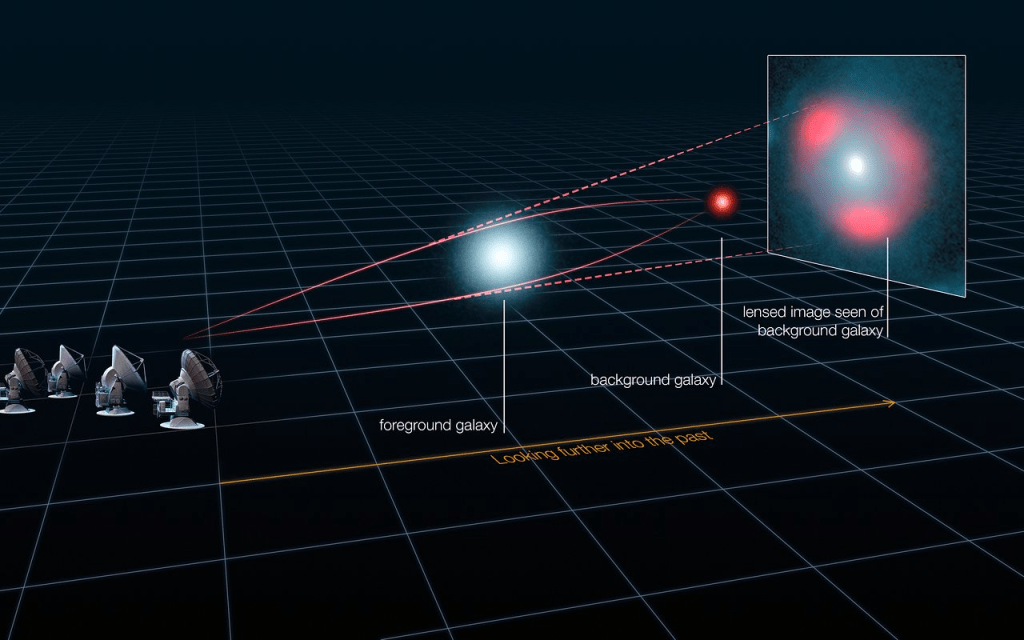
Gravitational lensing can be observed when two stars are aligned with the observer on Earth. If the forefront star has a planet orbiting it, this exoplanet can be detected by an additional enhancement of the light.
A large scale gravitational lensing is observed when a forefront cluster of galaxies concentrates the light of a background galaxy or a quasar. Very distant and faint objects can thus be detected and characterized.
In some cases concentric rings can be observed around the foreground gravitational lensing mass which are caused by differing light paths representing different epochs of the background object. Thus it is possible to study the temporal evolution of distant galaxies.
Gravitational microlensing individual stars is being applied to the detection of isolated exoplanets, i.e., exoplanets that are not part of stellar systems.
The Long and Finally Successful Search for Gravitational Waves
Some of the following is extracted from Wikipedia. Gravitational waves are waves of spacetime distortion and curvature produced by the relative motion of gravitating masses and which propagate away at the speed of light. They were proposed by Oliver Heaviside in 1893 and then later by Henri Poincaré in 1905 as the gravitational equivalent of electromagnetic waves. In 1916, Albert Einstein demonstrated that gravitational waves result from his general theory of relativity as “ripples in spacetime”.
Gravitational waves transport energy as gravitational radiation, a form of radiant energy similar to electromagnetic radiation. Newton’s law of universal gravitation, part of classical mechanics, does not provide for their existence, instead asserting that gravity has instantaneous effect everywhere. Gravitational waves therefore stand as an important relativistic phenomenon that is absent from Newtonian physics.
Gravitational-wave astronomy has the advantage that, unlike electromagnetic radiation, gravitational waves are not affected by intervening matter. Sources that can be studied this way include binary star systems composed of white dwarfs, neutron stars, and black holes; events such as supernovae; and the formation of the early universe shortly after the Big Bang.
The detection of gravitational waves, however, posed a daunting challenge. Although Einstein had predicted their existence, he did not believe that they could be detected. In fact, it took a century from their original postulation until such waves were actually observed. Remarkably advanced technology was required to achieve that objective because of the typically ephemeral magnitude of these waves.
The successful system is called Laser Interferometer Gravitational-Wave Observatory (LIGO) which is a large-scale physics experiment and observatory designed to detect cosmic gravitational waves. Prior to LIGO, all data about the universe had come in the form of light and other forms of electromagnetic radiation. Initially, two large observatories were built in the United States with the aim of detecting gravitational waves by laser interferometry. Two additional, gravitational wave observatories are now operational in Japan (KAGRA) and Italy (Virgo). The two LIGO observatories in the U.S. use mirrors spaced 4 km (13,000 ft) apart to measure changes in length of less than one ten-thousandth the charge diameter of a proton.
On September 14, 2015, the first gravitational wave signal was detected by the LIGO system of two ~30 solar mass black holes merging about 1.3 billion light-years from Earth. Over the last 10 years, about 300 gravitational wave events have been observed. These signals were caused by collisions of binary black holes, binary neutron stars and neutron star collisions with black holes.
According to the relativistic equations, roughly 5 percent of a merging pair’s combined mass converts to gravitational waves in that final moment. That conversion is governed by Einstein’s famous equation, E = mc2, where m is the mass of the black holes lost to energy and c is the speed of light. For example, for two merging five-solar-mass black holes, the amount of energy blasted out in less than a second by such a merger would be roughly the same as the sun will emit in seven trillion years. That is, for a brief moment those black holes emit more energy than the light from a billion galaxies full of stars. For supermassive black holes — those at the core of most galaxies — the final cosmos-quaking blast of gravitational-wave radiation they emit is far, far larger. Repeating the math above with a pair of black holes that are, say, 100 million solar masses each, the numbers become unimaginable. The energy they emit in that last second is thousands of times the combined energy emitted by all the stars in the visible universe over that same amount of time.
To date, no gravitational wave events from the collision of two supermassive black holes have been detected. Such events are likely to be rare.
The Distance Ladder
Beginning with the Ancient Greeks brilliant triumvirate of Aristarchus of Samos, Eratosthenes and Hipparchus, astronomical science has been directed at measuring the cosmos, specifically at determining the distance that separates us from the Moon, the planets of the Solar System, the stars and beyond to the limits of the universe itself. The solution of this challenge has thus lasted over two millennia and has informed our perception and understanding of the cosmos.
Measuring cosmic distances has required a multiplicity of methods in order to cover the enormous range involved. The overall solution has resulted in a ladder of overlapping methods each of which covers a specific range of distances. In some cases, these methods are used to calibrate subsequent ones.
In general, there are two classes of distance measurement methods: direct and indirect. Direct methods cover shorter distances and serve to calibrate the indirect ones which in turn calibrate others.
Direct Methods
Parallax. Although the Ancient Greek astronomers had applied that basic method, their approach was not sufficiently rigorous to yield accurate results.
Scientists considered the Venus transits in the eighteenth century in order to calculate the distance to the Sun, and to the other planets in our solar system. This was one of the most important scientific questions of the age because, by means of Kepler’s third law, only the relative distance of each planet from the Sun was known.
In 1716, the English astronomer Edmund Halley described a method for using a Venus transit to measure the solar system. Observers on two different locations on the Earth would see Venus appear to travel across the front of the Sun along two different paths, and could measure the angle between the two locations. Using the distance between the observers, and the angle to Venus, trigonometry can determine the distance to Venus. The angle, however proved to be too small to accurately measure at the time. Halley anticipated this problem and proposed that, instead of measuring Venus’ position on the Sun directly, each observer would time the duration of the transit. Because some observers would see Venus cutting across a longer path on the Sun, their times would be longer than others. These times might differ by only a few minutes out of the several hour duration of the transit, but each transit time could be measured with an sufficient accuracy.
Once the average distance of the Earth from the Sun had thus been determined, that distance could be used as the base of trigonometric parallax measurements of the distance to stars. As the resolution of telescopes has improved over the centuries, smaller and smaller parallax angles have been measured but ultimately atmospheric blurring has set a distance limit of tens of light years. However, using space telescopes such as the Hubble that distance has been extended to about 30,000 light years.
Radar and Lidar Ranging. Starting in the 1940s it has become possible to measure — at first — the distance to the Moon, and later, to Venus and Mars by radar ranging, i.e., by the timing of the return reflection of radar pulses. A similar method has been used for Moon ranging using laser pulses reflected off a corner-cube reflector array set up on the Moon by Apollo mission astronauts. This latter Lunar Laser Ranging (LLR) is one of the most precise distance determinations ever made, measuring the Earth-Moon distance with a median accuracy of about 2 millimeters.
Indirect Methods
Cepheid Method. We must now give due credit to a notable woman astronomer in the context of the Cepheid variable stars mentioned above: Henrietta Swan Leavitt (1868 – 1921). She was a graduate of Radcliffe College and subsequently worked at Harvard College Observatory as a human “computer” analyzing photographic records of astronomical observations. This work led her to discover the relation between luminosity and period of Cepheid variable stars, what is now know as Leavitt’s Law. She made it possible for Edwin Hubble (see above) to make his crucial discoveries. Leavitt’s discovery became a standard candle to measure distance to other galaxies. The Cepheid method became the second rung (parallax being the first) in the cosmic distance ladder in the multi-step method astronomers use to measure vast distances in space by building upon different techniques for increasingly distant objects, with each rung confirming the one below it.
Cepheid variable is a type of variable star that pulsates radially, varying in both diameter and temperature. It changes in brightness, with a well-defined stable period (typically 1–100 days) and amplitude. A relationship between the period and luminosity for classical Cepheids was discovered in 1908 by Henrietta Swan Leavitt in an investigation of thousands of variable stars in the Magellanic Clouds. Once a star’s luminosity is known its distance can be determined by measuring its brightness based on the inverse square law of dimming with distance.
The maximum distance that can be measured by the cepheid method is about 100 million light years thus been applicable to distance determination of thousands of galaxies.
Red Shift. The expansion of the universe causes a red shift in the spectrum of galaxies. The degree of red shift as a function of distance is called the Hubble constant which can be determined using cepheid distance measurements which is equivalent to using the cepheid method to calibrate the red shift method.
Supernova method. For measurements of cosmic distances and independent determination of the Hubble constant mentioned above, the supernova type 1A method is used. This type of supernova generates a know and repeatable luminosity from which distance can be inferred. These supernovas are caused when a white dwarf star (a star that has exhausted its hydrogen) of a binary system accretes mass from the companion star until the white dwarf reaches a critical mass of 1.44 solar masses called the Chandrasekhar limit at which point the white dwarf explodes as a supernova with a predictable and repeatable luminosity thus providing a “standard candle” from which distance can be derived.
Standard Siren. Gravitational waves (see section above) encode the distance to its source. The rate of change of frequency of the detected “chirp” is a function of that distance. If the source of the gravitational wave can be identified, i.e., if the event can be detected electromagnetically (by gamma rays or optical detection), and the red shift of the source can thus be determined, the gravitational wave can then provide an independent value of the Hubble constant.
Dark Matter – Mystery No. 1
Spectroscopic observations in the 1970s by Vera Rubin and others indicated that the velocity distribution of stars in the Milky Way and the Andromeda galaxies suggested the presence of invisible matter, especially towards the periphery of these galaxies. Kepler’s laws predicted that the velocity of stars around the center of the galaxies should diminish as a function of distance from the galactic center. However, these observations, which were confirmed by radio-astronomy, indicated that the stellar velocity distribution appeared essentially flat, i.e., these velocities did not decrease with radial position, stars moved as fast on the galactic periphery as those near the galactic center.
Further, the existence of dark matter has been confirmed from observations of gravitational lensing (see preceding section) indicating that galaxies and galactic clusters were often surrounded by dark matter contributing to the lensing effect.
As of this writing (May 2026), all efforts of identifying the nature of dark matter have been unsuccessful. Cosmological studies suggest that as much as 85% of all matter in the universe is constituted by dark matter, and only 15% by ordinary or baryonic matter.
Dark Energy – Mystery No. 2
The first observational evidence for dark energy’s existence came from measurements of supernovae. Type Ia supernovae have constant luminosity, which means they can be used to accurately measure distances. Comparing this distance to the redshift (which measures the speed at which the supernova is receding) has shown that the universe’s expansion is accelerating.
The discovery of dark energy was made in 1998 by astrophysicists Saul Perlmutter, Brian Schmidt, and Adam Riess, who later shared the 2011 Nobel Prize in Physics for this work.
At this time (May 2026) the nature and source of the dark energy are unknown although this energy represents approximately 70% of the total universe mass-energy.
The Universe at Large
As was mentioned previously, the Hubble constant expresses the rate of expansion of the universe. In reality, this value is not constant but has been found to vary with time. Furthermore, cosmologists have been faced with a discrepancy between the determinations of the present Hubble constant by two general methods: a) ”Late universe” measurements using calibrated distance ladder techniques have converged on a value of approximately 73 (km/s)/Mpc, and b) since 2000, “early universe” techniques based on measurements of the cosmic microwave background have become available, and these converge on a value near 67.7 (km/s)/Mpc. This disagreement has become known as the “Hubble Tension”. Mpc or Megaparsec equals 3.262 million light years and is a unit of distance used preferentially by cosmologists.
The reciprocal of the Hubble constant equals the age of the universe, i.e. the time elapsed since the Big Bang. For the two differing values of the Hubble constant mentioned above, the age of the universe would range from 13.4 billion years to 14.5 billion years, respectively. At this time, the generally accepted age is 13.8 billion years.
As to the size of the universe, considering its expansion over its lifetime, we have to introduce the concept of “observable universe”, a spherical region of the universe consisting of all matter that can be observed from Earth. It refers to the physical limit created by the speed of light itself. No signal can travel faster than light and the universe has only existed for about 14 billion years. Objects which emit light but which exist too far away for that light to have reached Earth are beyond the particle horizon, outside the observable universe. Based on the preceding criterion, the radius of the observable universe is estimated to be about 46.5 billion light-years.
 Pedro Lilienfeld