In my autobiography entitled Pétain’s Praise and Other Incongruities written jointly with my father, Erich Lilienfeld, I described in detail my family’s and my perilous life in France during World War II. Here I complement that narrative inserting the historical background affecting our lives during that period while we resided in two small French towns, Châteaubriant in Brittany and Sète in the Languedoc.
Its Paris, July 1939. The drums of war are resounding in Europe. My father, Erich Lilienfeld, electrical engineering graduate from the prestigious Berliner Technische Hochschule, had decided to volunteer for the French Army at the War Ministry in early 1939 after having obtained an unlimited permit de séjours (resident permit). He is, however, not being inducted into the army, since after all, in the eyes of the French authorities, he is a German citizen, potentially an enemy combatant.
Preceding these steps, my father had attempted, for the second time — after his first one at the inception of the Spanish Civil War — for us to immigrate to the U.S. which was refused by the American Embassy in Paris.
My family decides to estivate in a pleasant, laid back, Atlantic coast resort town, Saint-Brevin-les Pins, which at the time had merely about 4000 inhabitants. It is situated south of Saint Nazaire, near the estuary of the Loire river.
We stayed in a pleasant rented home near the water where the only nuisance were the swarms of ravenous mosquitoes that necessitated slipper-against-wall violent execution. As I mentioned in my autobiography, my parents enrolled me in a play group of children orchestrated by an athletic taskmaster and centered on a gigantic beach ball. I was five years old and deeply allergic to any involvement with children of my age. We had to avoid any contact with an infestation of poisonous jelly fish that covered the beach.
Notwithstanding the apparent imminence of international conflict, life still seemed to navigate in calm waters. The Spanish Civil War, which had caused us the abandon Madrid in 1936, had concluded months before, on March 8, 1939, with the triumph of the fascist Falange headed by general Francisco Franco whose side had been supported by Nazi Germany and fascist Italy. As my father related: “a return to Madrid was not yet a good idea in view of the chaotic living conditions in all parts of Spain”.
Meanwhile, Germany and Italy were becoming more aggressive. In March 1938, Germany had annexed Austria, without provoking other European powers. Encouraged, Hitler began pressing German claims on the Sudetenland, an area of Czechoslovakia with a predominantly ethnic German population. United Kingdom and France had then followed the appeasement policy of British Prime Minister Neville Chamberlain and conceded this territory to Germany in the infamous Munich Agreement, which was made against the wishes of the Czechoslovak government, in exchange for a promise of no further territorial demands by Germany.
A this point the United Kingdom and France guaranteed their support for Polish independence. In response, Hitler accused both nations of trying to encircle Germany.
German Foreign Minister Joachim von Ribbentrop and the Soviet leader Joseph Stalin signed the Molotov–Ribbentrop Pact on 23 August 1939. The situation then became a crisis in late August as Germany concentrated its forces near the Polish border. The pact had a secret protocol that defined German and Soviet spheres of influence: Lithuania for Germany; Finland, Estonia, Latvia, and Bessarabia for the Soviet Union; and Poland to be partitioned between the two powers. The pact ensured that Germany would not face a war with the Soviet Union when it invaded Poland. Immediately afterwards, Hitler ordered the attack to proceed on 26 August, but upon hearing that the United Kingdom had concluded a formal mutual assistance pact with Poland and that Italy would maintain neutrality, he decided to delay it.
Nevertheless, on 1 September 1939, Germany invaded Poland after having staged several false border incidents as a pretext to initiate the invasion. The United Kingdom responded with an ultimatum for Germany to cease those military operations, but on 3 September, after the ultimatum was ignored, Britain and France declared war on Germany, and World War II was underway.
My father had brought a radio to our resort in Saint Brevin and we were thus appraised of the shocking news. Little did we know what consequences the start of the war signified for us. Within days, the French government ordered all able bodied men, aged 18 to 64, originating from what was labelled as “Greater Germany” (comprising of Germany, Austria and Czechoslovakia) and labelled as étrangers indésirables (undesirable foreigners) to gather in selected internment camps. Some of these camps had been previously set up to contain the throng of Spanish republican fugitives from the vengeful Franco’s Falange forces. Thus, my father, my uncle Herbert and my mother’s cousin Gerhard were rounded up and eventually incarcerated at a camp in Les Sables d’Olonne, a town on the Atlantic coast about 100 km south of Saint Brevin. My father describes in detail the first week or two at that internment camp (see my joint autobiography entitled Pétain’s Praise and Other Incongruities), after which he, unfortunately, ceased his memoirs.
In performing my research on French WWII internment camps I found to my surprise and disappointment that none of the camps in which my father was interned, both before and after the armistice of 1940, is mentioned in any listing or publication on that subject. Only the most notorious ones such as Gurs, Le Vernet, Drancy and a host of others are cited. That omission is, to me, inexplicable.
Now, to the rest of my family. My mother and her parents were immediately classified as potentially subversive on account of their German citizenship. I, for one, did not count on consideration of my age (five years) and Spanish citizenship. As a consequence, we were ordered to relocate to one of government selected locations in the French countryside where we could be monitored and be under surveillance, i.e., a so called centre de séjour surveillé (center of guarded stay). Yet, here again, the pertinent internet information fails to mention the condition under which we were to remain in our assigned village of Châteaubriant (see map further on). The existing information mentions the internment camp of Choisel in that location. However, we were never confined in any internment camp during our stay in Châteaubriant and were free to move around that village. We were, nevertheless, forbidden to travel out of that town during the period of September 1939 until June 1940, trapped without being able to return to our home in Paris.
Our stay in Châteaubriant coincided mostly with the duration of the so-called Phoney War that started with the declaration of war on September 3, 1939 by Great Britain and France in response to the invasion of Poland by Nazi Germany and ends with the blitzkrieg attack on May 10, 1940 by Germany on Belgium, the Netherlands and France. During that interval, little or no overt military engagements occurred between the belligerent parties, except for a limited excursion into the Saarland by French forces. Paradoxically, I had my sixth birthday only five days after this latter momentous date and unpacked my newly arrived spanking bicycle that my paternal grandparents had sent me from Paris.
As I described in my autobiography, we were anxiously listening to the news on the radio at the house belonging to the Coteux family as the German forces overran the French defenses and advanced relentlessly through France. By June 14 the Germans had conquered Paris. Four days later they rolled through Châteaubriant while we were sitting in the living room of the Coteux home. Then came the knock at the entrance door and the dramatic scene I described in my autobiography ensued. We were now under Nazi German occupation in the French countryside with two teutonic soldiers billeted to our house. Its French owners had escaped, presumably, to the south of France.
The two German soldiers, Bucholz and Horn, perhaps naively, felt free to
reveal to us that they were preparing for their invasion of Britain which was to be undertaken within a few weeks, implementing Unternehmen Seelöwe (Operation Sea Lion). For those readers interested in the details about that intended invasion operation I suggest reading an exhaustive Wikipedia entry with that title. Obviously, history was to obliterate those nefarious plans.
A crucial decision crossroad arose for us at this point. The German occupation immediately raised the threat of Gestapo detention and eventual deportation and death while, however, dissolving the French travel interdiction. This created a quandary for us: should we return home to Paris or try to escape, but where to? After all the borders of France had been locked close by the Germans following the armistice which was signed on June 22. This is when my mother’s smarts came into play. She surmised, correctly, that the village’s mayoral office may be able to provide useful guidance. She volunteered to serve as a translator between the occupier’s german and the occupied’s french languages. A sympathetic mayor informed my mother of the newly created unoccupied southern sector of France governed from Vichy by Marshal Pétain as a (remotely) possible objective to escape from the Gestapo bloodhounds.
On the basis of Châteaubriant mayor’s advice we leave the town and travel to Bordeaux, near the demarcation line between the Nazi occupied and the Vichy controlled sectors (see map further on). Had we decided to return to Paris we would have been, in all likelihood, eventually rounded up with thousands of other Jews and shipped to Auschwitz. One of my father’s Saarland acquaintances, Wally Steinthal, committed suicide in Paris to avoid capture.
Unbeknownst to us, we had escaped our village in time. Within a few days after our departure, the concentration camp of Choisel opened in town. Some 45,000 war prisoners, mainly French but also British, were interned there. In 1941, the prisoners were sent to Germany, and replaced by Gypsies, black market traffickers, prostitutes, and finally political activists, mostly Communists, treated as hostages. Following the death of the Nazi Karl Hotz, Feldkommandant of the Feldgericht (Field commander of the Field-Court) of Nantes, killed by French Resistants, 27 hostages were shot in a stone-pit outside the town on 22 October 1941. Among the executed Châteaubriant hostages was Guy Môquet, a 17-year-old boy who became a symbol of the French Resistance.
Again, our perilous escape into the southern Vichy sector is described in my autobiography, as well as the harrowing one undertaken by my father shortly after his brief employment at the French Companie Electro Méchanique submarine factory in the port city of Le Havre that had been terminated on May 20, 1940.
We were, almost miraculously, reunited in our second French village, Sète, on the Mediterranean coast, a temporary but precarious haven from Nazi persecution.
To be fair, our eight-month stay at Châteaubriant had been relatively pleasant until the arrival of the Nazis. The French population treated us well, there were no manifestation of any antisemitism or any other form of discrimination. I remember with fondness the two teenage sisters Germaine and Marcelle (whose photo is included in my autobiography) of the country farm where we stayed initially after arriving from St. Brevin. Of course our command of the French language provided a useful cultural bridge complemented by our Parisian link to Louis Fourestier.
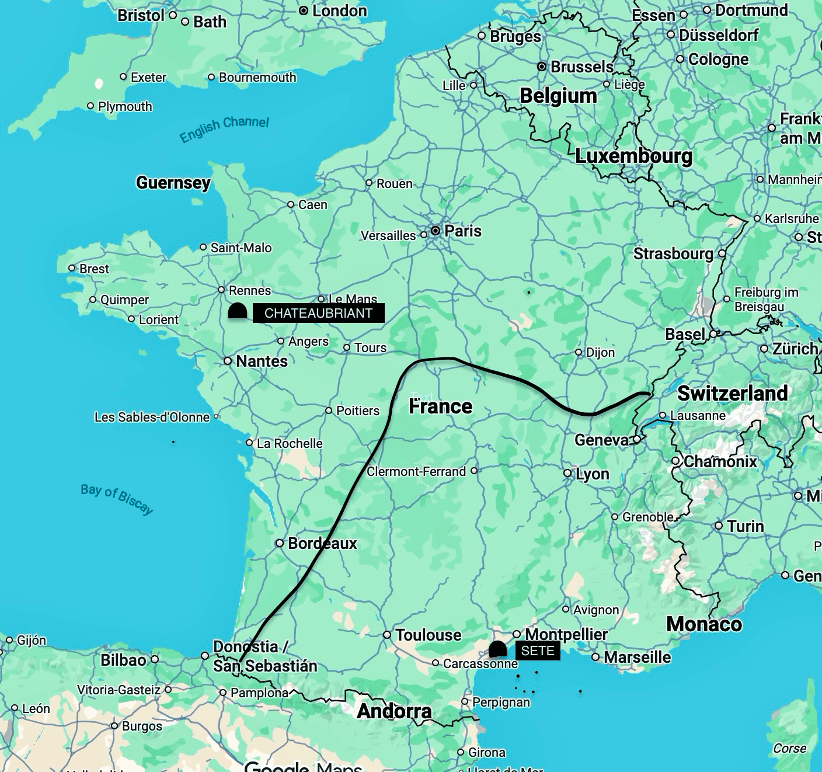
The map of France above shows the locations of the two villages in which we resided during the war. Also, it depicts the demarcation border between the northern Nazi occupied sector and the southern Vichy administered zone as established by the victorious Germans by the armistice of June 22, 1040 and which we crossed just southeast of Bordeaux on our way to Sète.
In Sète we rented a summer cottage near the coast in the Corniche neighborhood of the village. We had arrived around the July 1st of 1940 and I started first grade school about three months later at the École Élémentaire Paul Bert in the center of town. Our lives in Sète are described in detail in my autobiography, including the unlikely letter of praise I received from Marshall Pétain, and will not be repeated here. As far as I can recall, I was the only non-Languedocian in my first grade class of about forty boys but experienced no discrimination or any intolerance on the part of students or teachers. In general, the environment in Sète remained pleasant and beautiful until the inception of winter to which our summer cottage abode was ill-fitted and serious food shortages became pervasive.
By the time we left Sète, I had acquired the Languedoc vernacular with its Spanish sounding intonation. It is amazing how readily languages and their subtleties are learned in early childhood. I believe that I lost that French accent soon after I was enrolled in the French Lycée in Madrid, after we were able to leave Sète.
My parents explored any possible means and directions to escape from our momentary place of respite realizing full well the precariousness of the situation. At the same time, our efforts had to be guarded and cautious as Nazi spies and their Vichy sympathizers were on the lookout for hiding Jews and other opponents to fascism. We were, to a large extent, isolated from the community of refugees gathered elsewhere in the south of France, especially in Marseille where they were supported in their escape endeavors by such heroic figures as Varian Fry, an American journalist who ran a rescue network in Vichy France from August 1940 to September 1941 that helped 2,000 anti-Nazi and Jewish refugees, mostly artists and intellectuals, escape from persecution by Nazi Germany.
Paradoxically, as long as Germany was ahead in the war, the temporary division of France was expected to continue as well as our status quo. Indeed, with the German defeat on the North African front and the Allied invasion of Sicily the Germans occupied the Vichy sector in November of 1942. If we had not managed to escape from Sète by then it would have resulted in our demise.
Our situation did become dire, however, when my father was denounced by a Vichy sympathizer and re-interned in a Vichy controlled foreigner camp near the city of Albi from where eventually he could have been deported to Germany and beyond. His travails were then compounded by my mother’s life-threatening illness following ingestion of contaminated shellfish, requiring her urgent hospitalization in nearby Montpellier. As I have described elsewhere, we were saved by the decisive intervention of my father’s erstwhile boss in Madrid, Spain, Jaime Schwab, who was able to provide us with Spanish entry visas. On that basis, my father was freed from his internment camp on January 12, 1941 and shortly after we departed Sète and returned to the relative safety of Spain where, however, we were faced with the third and final rejection from access to the U.S., presumably, courtesy of Samuel Breckinridge Long’s (then assistant secretary of state) antisemitic immigration policies. Previously, Long had been U.S. ambassador to Mussolini’s Italy and had referred to Italian fascism as “the most interesting experiment in government to come above the horizon since the formulation of our Constitution”. In 1938, he wrote in his diary:
“Have just finished Hitler’s Mein Kampf. It is eloquent in opposition to Jewry and to Jews as exponents of Communism & chaos. … My estimate of Hitler as a man rises with the reading of his book”.
As related in my memoirs, the closure of America’s doors led us to seek refuge from the European hell in distant Ecuador.
Summarizing, my childhood recollections, though removed by many decades, of our life in the two French villages are largely pleasant. We were fully accepted by the local population, lived as comfortably as the circumstances allowed, and were free to move around within the confines of each town. My awareness of the dangers to which my family and I were constantly threatened remained inevitably inchoate. My full understanding of that tension had to await until we reached the ultimate safety in far away Ecuador where I listened to the frequent reminiscences exchanged among my family members. My mother, more than once, was to entertain us with her recollection of the amusing — very French — incongruity of the serious admonition to her by our Châteaubriant homeowner to properly baste the chicken she was roasting, all the while the German forces were about to overrun the town and from where he was to flee forthwith.
 Pedro Lilienfeld
Leave a comment