The acceptance of the heliocentric model of the Solar system proposed by Copernicus in the 16th century involved a long and contentious intellectual battle extending over nearly three centuries. We should, however, also consider and review the even far longer and convoluted path that preceded Copernicus’s breakthrough. That process lasted almost two millennia.
Antiquity
We will ignore the mystical and fanciful concepts of the cosmos before the astounding flourishing of Ancient Greece. Thus our point of departure is around the year 500 BCE and the school of Pythagoras (570 – 495 BCE). The origin of the concept of the sphericity of the Earth has been attributed to this polymath although that claim has been disputed as no written record of his thoughts has survived. The first documented concept of the Solar System is attributed to a Pythagorean disciple, Philolaus (470 – 385 BCE) which, surprisingly, is not geocentric. In Philolaus’s system, the heavenly bodies, namely the Earth and planets, revolve around a central point. This could not be called a heliocentric Solar System because, in his concept, the central point that the Earth and the planets revolved around was not the Sun, but the so-called Central Fire. He postulated that this Central Fire was not visible from the surface of Earth—at least not from Greece.
Heraclides of Pontus (4th century BCE) said that the rotation of the Earth explained the apparent daily motion of the celestial sphere. He seems to have believed that Mercury and Venus revolve around the Sun, which in turn (along with the other planets) revolves around the Earth.
The first scientist known to have proposed a heliocentric system was Aristarchus of Samos (c. 270 BCE). Like Eratosthenes (276 – 194 BCE) Aristarchus calculated the size of the Earth and measured the sizes and distances of the Sun and Moon. From his estimates, he concluded that the Sun was six to seven times wider than Earth, and thought that the larger object would have the most attractive force. Aristarchus’s writings on his heliocentric system are lost, but some information about them is known from a brief description by his famous contemporary, Archimedes, and from scattered references by later writers.
All these early systems, however, were displaced by Plato’s (428-347 BCE) geocentric Solar System of concentric spheres which, with the support by his pupil Aristotle (384 – 322 BCE), was to predominate with some variations over nearly the next two millennia. The view that the entire cosmos is centered on the Earth proved to be irresistible and was subsequently reinforced within the ever-growing Christian realm as a direct consequence of biblical narratives, that of the Old and New Testaments.
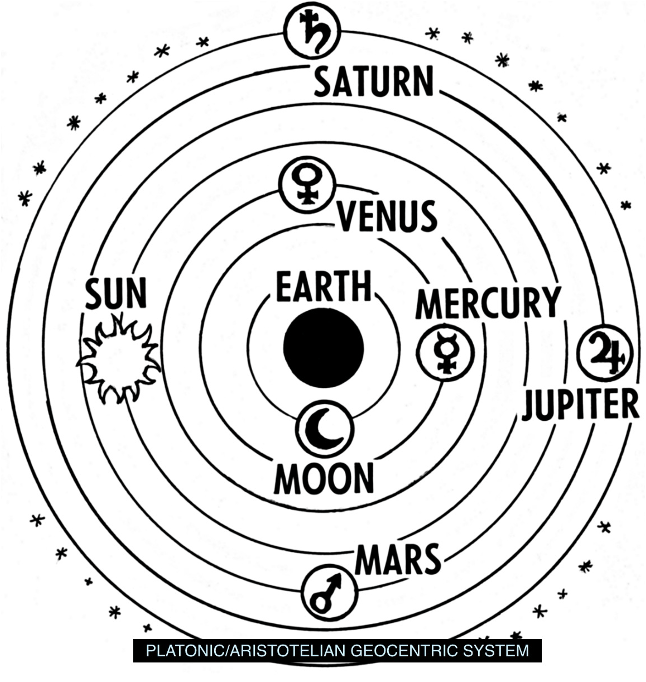
The simplistic and incorrect model of a central Earth and concentric orbits of the Moon, Sun, the planets and the outer sphere of the stars soon ran into problems when careful observations of planetary motions in the third century BCE revealed apparent changes of direction, i.e., retrograde motion. These observations became the perennial Achilles heal of the geocentric model until the Copernican revolution of the 16th century AD.
The first attempt to resolve the conundrum of the apparent retrograde motion may be attributed to Eudoxus of Cnidus (390 – 340 BCE), another student of Plato, who introduced a technique to describe the motion of the planets called the method of exhaustion. Eudoxus reasoned that since the distances of the stars, the Moon, the Sun and all known planets do not appear to be changing over time, they are fixed in a sphere in which the bodies move around the sphere but with a constant radius and the Earth is at the centre of that sphere. Eudoxus thought the planets move as if they were attached to a number of concentrical, invisible spheres, every one of them rotating around its own and different axis and at different paces.
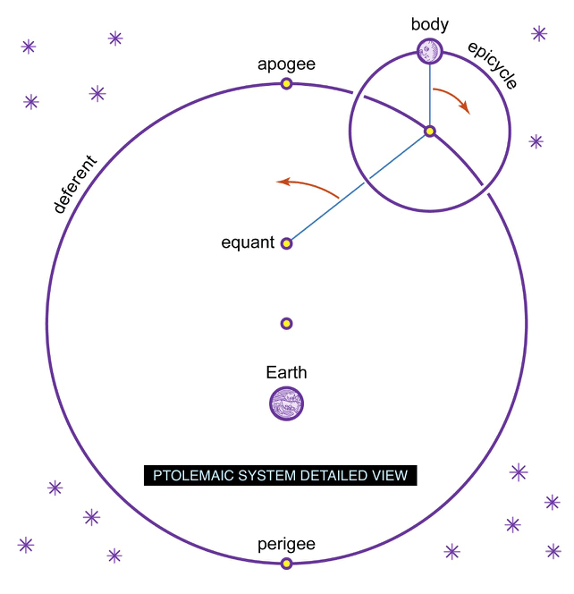
Next came Apollonius of Perga (240 – 190 BCE) who explained the apparent retrograde planet motions — always assuming the geocentric model — by deferent and epicycles which will be a key feature for future models. The epicycle is described as a small orbit within a greater one, called the deferent: as a planet orbits the Earth, it also orbits the original orbit. This model could explain how a planet seems to move as viewed from Earth.
Ptolemy (100 – 160/170 AD) adopted the Apollonius’ epicycles as solution. Ptolemy emphasized that the epicycle motion does not apply to the Sun. His main contribution to the model was the equant points. He also re-arranged the heavenly spheres in a different order than Plato did (from Earth outward): Moon, Mercury, Venus, Sun, Mars, Jupiter, Saturn and fixed stars, following a long astrological tradition and the decreasing orbital periods.
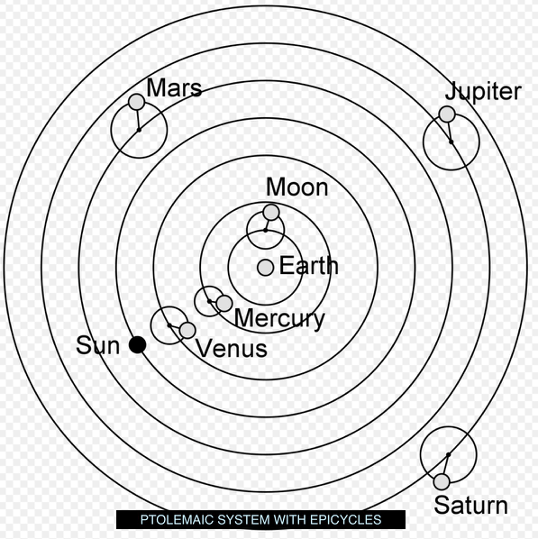
Ptolemy’s work Almagest cemented the geocentric model in the West, and it remained the most authoritative text on astronomy for more than 1,500 years. His methods appeared to be sufficiently accurate to maintain them largely undisputed over that long period. It is worth mentioning, however, that Martianus Minneus Felix Capella (fl. c. 410–420) a late Antiquity Roman polymath describes a modified geocentric model, in which the Earth is at rest in the center of the cosmos and is circled by the Moon, the Sun, three of the planets and the stars, while Mercury and Venus orbit the Sun. This latter view was singled out by Copernicus in Book I of his De revolutionibus orbium coelestium. It resembles Tycho Brahe’s 1588 system which will be discussed later on.
Middle Ages and Renaissance
After the half millennium hiatus of the Dark Ages that followed the fall of the Western Roman Empire and with it resulted in the demise of the Greco-Roman scientific enterprise, in the tenth century, the scepter of astronomical pursuits shifted to the Islamic world. What endured and was to persist until the 16th century, however, is the set of dual false paradigms of geocentricity and orbital circularity.
During the Islamic Golden Age, several astronomers, centered principally in Bagdad, developed modified versions of the Ptolemaic system of epicycles. Citing from Wikipedia, in 1021 A.D, Ibn Al Haytham adjusted Ptolemy’s geocentric model to his specialty in optics in his book Al-shukuk ‘ata Batlamyus which translates to “Doubts about Ptolemy”. Ibn al-Haytham claimed that the epicycles Ptolemy introduced are inclined planes, not in a flat motion which settled further conflicting disputes. However, Ibn Al Haytham agreed with the Earth being in the centre of the Solar System at a fixed position.
Nasir al-Din, during the 13th century, was able to combine two possible methods for a planet to orbit and as a result, derived a rotational aspect of planets within their orbits. Copernicus arrived to the same conclusion in the 16th century. Ibn al-Shatir, during the 14th century, in an attempt to resolve Ptolemy’s inconsistent lunar theory, applied a double epicycle model to the Moon which reduced the predicted displacement of the Moon from the Earth.
With the waning of the Islamic Golden Age we have reached a pivotal point in this narrative: the dawning of the European Renaissance. This rebirth, in my view, was principally embodied by Nicolas de Cusa (1401 – 1464), a German polymath and Catholic bishop (he became a cardinal in 1448), who was the first proponent of Renaissance Humanism. His works cover a wide range of subjects but in what pertains to astronomy, he affirmed that the Earth is a star like other stars, is not the centre of the universe, is not at rest, nor are its poles fixed, the celestial bodies are not strictly spherical, nor are their orbits circular, and also wrote about the possibility of the plurality of worlds. These ideas would probably have been labelled as heretical a century later but, apparently, were not considered as such in mid-15th century. My view is that the expansion of the influence of the Inquisition and the advent of the Reformation subsequently hardened the attitude of the Vatican which became thoroughly intolerant of such heterodox ideas.
The next momentous step was achieved by Nicolaus Copernicus 1473 – 1543). It was the first crucial inroad destined to displace and replace the Aristotelian/Ptolemaic geocentric universe that had reigned in various incarnations for hundreds of years. A Polish polyglot and polymath, Copernicus obtained a doctorate in canon law and was a mathematician, astronomer, physician, classics scholar, translator, governor, diplomat, and economist.
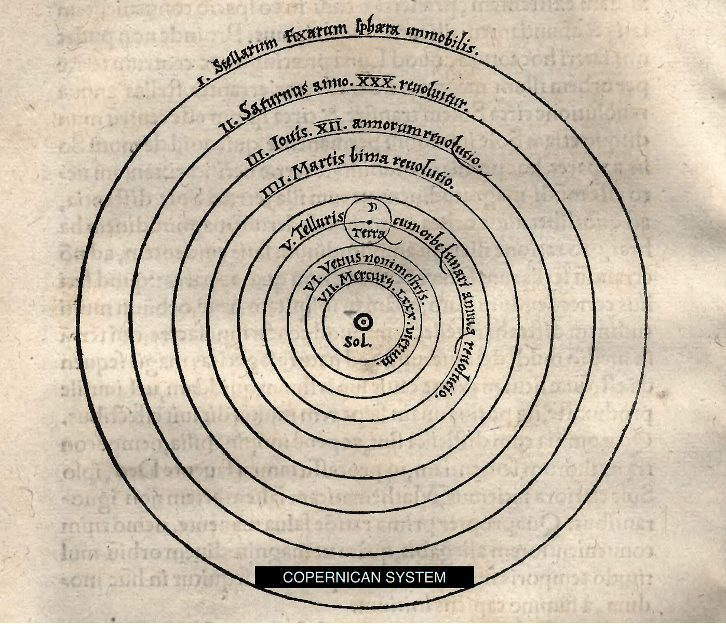
Copernicus initiated his analysis of the logical contradictions in the two “official” systems of astronomy, Aristotle’s theory of homocentric spheres, and Ptolemy’s mechanism of eccentrics and epicycles, the surmounting and discarding of which would be the first step toward the creation of Copernicus’s own heliocentric doctrine of the structure of the universe. Some time before 1514, Copernicus wrote an initial outline of his heliocentric theory, known only from later transcripts, by the title commonly referred to as the Commentariolus.
It was not until just before his death in 1543 that his momentous book De revolutionibus orbium coelestium (On the Revolutions of the Celestial Spheres) was published. It has been speculated that he wanted to forestall any negative and potentially dangerous Church reaction to his “deviant” theory. First published in Nuremberg in 1543, the book proposed that the Earth, Mars and the other planets orbit the Sun.
On March 5th 1616 the Vatican’s Sacred Congregation of the Index added Nicolaus Copernicus’s book to its list of banned books.. The Church also chastised Galileo Galilei (1564 – 1642) for defending heliocentrism in his book entitled Dialog Concerning the Two Chief World Systems: Ptolemaic and Copernican for which he had to stand trial before the Inquisition for heresy in 1533 and for which he was sentenced to life imprisonment.
However, rejection of Copernicus’s heliocentric system was not confined to the Catholic Church. Rumors of his research reached Martin Luther (1483 – 1546) before the book was published. In 1539 the Protestant reformer was quoted as saying: “People gave ear to an upstart astrologer who strove to show that the Earth revolves, not the heavens or the firmament, the Sun and the Moon. . . . This fool wishes to reverse the entire science of astronomy; but sacred Scripture tells us that Joshua commanded the Sun to stand still, and not the Earth”. His colleague Melanchthon (1497 – 1560) also urged governments to repress the “absurd” theory. Calvin (1509 – 1564), as well, warns against those who say, “that the sun does not move and that it is the earth that moves”. He describes those who hold this view as “stark raving mad” and as “possessed” by the devil. In contrast, in addition to Galileo, Copernicus’s heliocentrism was embraced but Giordano Bruno (1548 – 1600), and in some Protestant realms such as Germany by Johannes Kepler 1571 – 1630) and in England by Thomas Digges (1546 – 1595).
We must mention at this point a tragic figure in the history of astronomy: Giordano Bruno, ordained a priest in 1572 at age 24. Italian philosopher, poet, alchemist, astrologer, cosmological theorist, Bruno is known for his cosmological theories, which included his support of the Copernican model. He practiced Hermeticism and gave a mystical stance to exploring the universe. He proposed that the stars were distant suns surrounded by their own planets (now called exoplanets), and he raised the possibility that these planets might foster life of their own, a cosmological position known as cosmic pluralism. He also insisted that the universe is infinite and could have no centre. These advanced ideas and his theological views such as denial of several core Catholic doctrines led the Inquisition to find him guilty of heresy, and he was burned at the stake in Rome’s Campo de’ Fiori in 1600.
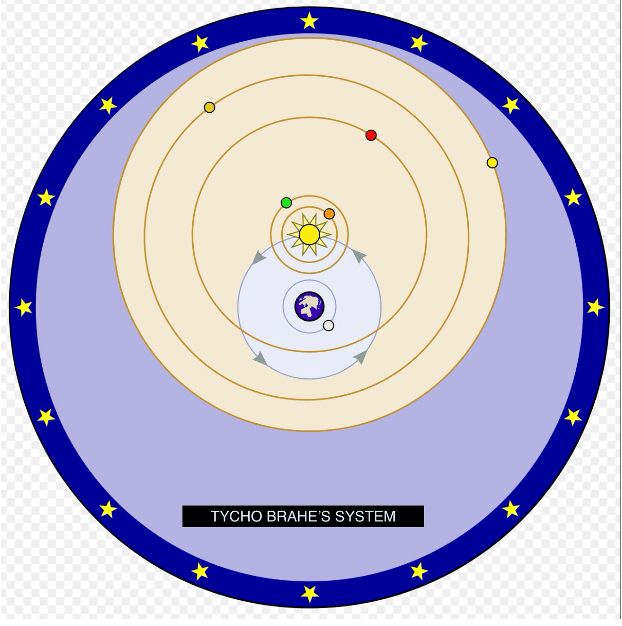
In the aftermath of the publication of Copernicus’s book, a gradual resistance to the acceptance of his heliocentric system arose. The dethroning of the Earth from its centrality was opposed and resisted by the established institutions, especially but not only by the Catholic Church. Towards the end of the 16th century a notable Danish astronomer, Tycho Brahe (1546 – 1601), expounded a new version of the solar system that attempted to solve the inconsistencies and complications of the ptolemaic system while preserving the centrality of the Earth (see above).
Brahe’s solution consisted of the planets, except the Earth, orbiting the Sun and the Sun orbiting the Earth. Tycho Brahe, however, made solid contributions to observational astronomy. He built the most advanced instruments and performed the most precise pre-telescopic positional measurements to date, providing invaluable data for the crucial subsequent advances by his student, Johannes Kepler who resolved all remaining imperfections of the Copernican heliocentrism by postulating the ellipticity of planetary orbits.
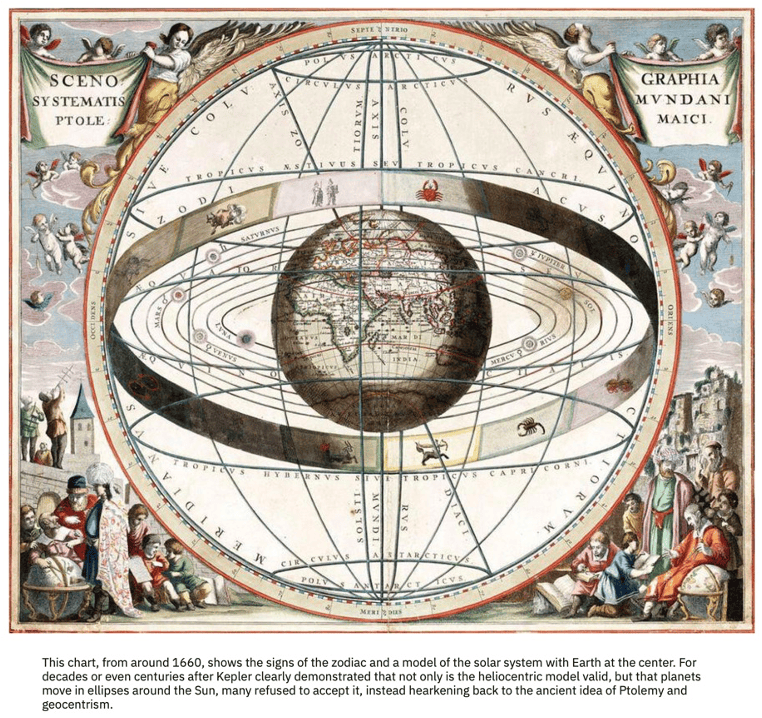
The protracted battle against accepting the heliocentricity of the Solar System is exemplified by a map published in about 1660 that depicts the Earth at the center (see above) still adhering to the Ptolemaic system.
Modern times
In 1758, Pope Benedict XIV removed the blanket prohibition against books advocating the Earth’s motion from the Index of The Books. Although endorsed by the European countries that had embraced the Enlightenment, holdouts such as Spain still resisted Copernicanism. This latter cultural incongruity is illustrated by the following episode. At the end of the 17th century a debate arose at the French Academy of Sciences as to the true shape of the Earth. Is our planet an oblate spheroid or a prolate spheroid?, i.e., either flattened at the poles and bulging at the equator or, alternatively, bulging at the poles and flattened at the equator. Oblate spheroidal shape would adhere to Newton’s prediction to be the result of of the centrifugal force imparted by the Earth rotation on its axis, further proof of the heliocentric configuration of the Solar System.
The Academy sponsored two expeditions in the 1730s to elucidate the question: one to Lapland in northern Sweden — as close to the North Pole as feasible at the time — and the other to the equator, to what is now Ecuador in South America. For the latter expedition, by arrangement with the Spanish Crown to which the region belonged, the French scientists were to be accompanied by two young Spanish naval officers, Antonio de Ulloa and Jorge Juan y Santacilia. After years of vicissitudes described in numerous books, the members of this equatorial expedition returned to Europe providing unequivocal proof that the Earth is of oblate shape, bulging at the equator, as Newton had predicted. Jorge Juan, one of the two naval officers became a notable scientist in Spain and saw the need to enlighten his compatriots as pertains to the validity of heliocentrism by penning an essay in 1774 entitled: “Estado de la Astronomia en Europa y juicio de los fundamentos sobre que se erigieron los Systemas del Mundo, para que sirva de guia al método en que debe recibirlos la Nacion, sin riesgo de su opinion, y de su religiosidad” which translates to: “State of Astronomy in Europe and judgement of the fundamentals on which the World Sytems are based, to provide a guide for the method for its adoption by the Nation, without risks of its opinion and religiosity”.
Jorge Juan begins his essay reviewing the history of astronomy from Antiquity on and introduces the Aristotelian, Ptolemaic, Tychonic, and Copernican systems as well as the contributions of Galileo and his condemnation by the Inquisition. He introduces Kepler’s laws followed by a extensive and laudatory exegesis of Newton and his work as it pertains to the laws that govern the movement of the planets and the dynamics of all bodies resulting from gravity. In quaint 19th century manner he characterizes Newton as the “greatest of the philosophers” who “tired of judgements by appearances and passions, motivated him to compose his Principles of Natural Philosophy…based only on geometry (which never deceives)”. Jorge Juan concludes his essay stating that “there is no kingdom that is not Newtonian and consequently Copernican… Even those who condemned Galileo are now repentant of their actions”.
Between 1820 and 1822 Canon Giuseppe Settele was allowed to treat Earth’s motion as a physical fact in a Rome astronomy textbook, and Pope Pius VII approved a formal decree in 1822 from the Inquisition permitting general publication of heliocentric astronomy.
In 1835 the Vatican published a new Index of Forbidden Books that officially omitted both Copernicus’s and Galileo’s previously banned works. Finally, in 1992 Pope John Paul II formally concluded a papal commission’s investigation into the Vatican Observatory, officially acknowledging the theological errors and unfair treatment faced by Galileo during the 17th-century trials because of his support of Copernicanism.
Notwithstanding Pope John Paul II’s position, the Catholic Church’s engrained regressivity was manifested in the following (citation from the Wikipedia entry entitled “Galileo affair”): On February 15, 1990, in a speech delivered at La Sapienza — the University of Rome — Cardinal Ratzinger (later Pope Benedict XVI) cited some current views on the Galileo affair as forming what he called “a symptomatic case that illustrates the extent to which modernity’s doubts about itself have grown today in science and technology”. As evidence, he presented the views of a few prominent philosophers including Ernst Bloch and Carl Friedrich von Weizsäcker, as well as Paul Feyerabend, whom he quoted as saying:
“The Church at the time of Galileo kept much more closely to reason than did Galileo himself, and she took into consideration the ethical and social consequences of Galileo’s teaching too. Her verdict against Galileo was rational and just, and the revision of this verdict can be justified only on the grounds of what is politically opportune”.
As far as Giordano Bruno is concerned, the Catholic Church has persisted to be even more regressive. The Vatican has published a few official statements about Bruno’s trial and execution. In 1942, Cardinal Giovanni Mercati, who discovered a number of lost documents relating to Bruno’s trial, stated that the Church was perfectly justified in condemning him. On the 400th anniversary of Bruno’s execution in 2000, Cardinal Sodano declared Bruno’s death to be a “sad episode” but, despite his regret, he defended Bruno’s prosecutors, maintaining that the Inquisitors “had the desire to serve freedom and promote the common good and did everything possible to save his life”. No official doctrinal position has insofar been taken that recants the charges made to Bruno, nor the horrendous means by which he was executed for those charges.
Finally, I wish to cite the words of praise by the famous German Enlightenment writer and poet Johann Wolfgang von Goethe, as mentioned in Stephen Hawking’s compendium “On the Shoulders of Giants”:
“Of all discoveries and opinions, none may have exerted a greater effect on the human spirit than the doctrine of Copernicus. The world had scarcely become known as round and complete in itself when it was asked to waive the tremendous privilege of being the center of the universe. Never, perhaps, was a greater demand made on mankind — for by this admission so many things vanished in mist and smoke! What became of Eden, our world of innocence, piety and poetry; the testimony of the senses; the conviction of a poetic-religious faith? No wonder his contemporaries did not wish to let all this go and offered every possible resistance to a doctrine which in its converts authorized and demanded a freedom of view and greatness of thought so far unknown, indeed not even dreamed of”.
Coda
I will take the liberty to restate herein what I wrote several years ago in my essay entitled “Where Are They? Are we Alone?”:
Among a certain number of astrophysicists and astrobiologists, questioning the existence of extraterrestrial advanced intelligence is being labelled as presumptuous. This opinion is a reflection of the “politically correct” so-called “mediocrity” to which many scientists attempt to relegate the Earth and its inhabitants. It is purported to be the modern version of Copernicanism, the dethroning of the Earth from its Aristotelian centrality and uniqueness within the universe that occurred with the inception of heliocentrism spearheaded by the publication of De Revolutionibus Orbium Coelestium (On the Revolutions of the Celestial Spheres) by Nicolaus Copernicus in 1543, the year of his death. This momentous dethroning of the Ptolemaic model of the universe which, in itself, was a manifestation of the Aristotelian view, represented a fundamental break from what — so cogently — Steven Weinberg in his outstanding book To Explain the World characterized as “what ought to be”, replacing it with a “what is.
Paradoxically, those who are advocating — almost vociferously — that we are surrounded by untold millions of advanced civilizations are reverting to that ancient mind set of what ought to be simply because of the mediocrity to which the Earth should be consigned because it is purported to be a planet like so many others. This view, then, is used to more than justify SETI, the search of extraterrestrial intelligence. To me, this type of logic mirrors Kepler’s opinion that just because there are Earth-like mountains on the Moon there must be inhabitants on it.
In essence, I find it naive to believe that the 16th century “demotion” of the Earth from being the center of the universe equates to a denial in being the abode of a uniquely intelligent life form. The two are entirely unrelated. Also, the concept of mediocrity does not constitute a rule justified a priori. The Earth location in our universe is surely not preferential but this mediocrity need not be extended to all other planetary properties such as the history of life on our planet”.


Leave a Reply