I have a problem with Islam, actually, several problems. It would appear that these are predominantly associated and caused by the total dependence on religious dominance of all Muslim societal facets. I became aware of this pervasive influence during our (my spouse and I) travels thorough several Muslim countries: Morocco, Egypt, and Jordan. I will add here experiences in Morocco, restate those related in my essay #18 in Aleatory Cogitations about the latter two countries, as well as any omitted in that essay. I then intend to further address this subject mainly from the point of view of the pursuit of science and knowledge.
Religion in most of the Muslim world is not restricted to the personal realm. What people believe is not of my concern in this context. My rejection is elicited when religion becomes a controlling factor in the dynamics of the society at large and its modus vivendi collides with my tolerance and comfort.
Our first exposure to an objectionable costume was during our first dinner in Amman at the nice modern hotel were our travel agency had lodged us.
The dining room was almost empty but there was a couple of what appeared as “locals”. The man was dressed in smart European style clothes, what seemed to be his female companion, however, was covered from head to toe in black with nary a fraction of her face in the open. I observed her out of the corner of my eye and saw that she had to lift a small flap of her face covering every time she opened her mouth to eat.
I was mesmerized and disgusted at the same time. This was, to me, one of the disturbing manifestations of Islamic misogyny.
Referring to our Jordanian guide, Mohammed, I stated in my above mentioned essay: “He was an obviously gentle and relatively educated man, and yet he was also an uncompromisingly devout Muslim. I felt that biblical accounts, and the Muslim – and some of the Christian – mythology were as real and true to him as any fact can be. There was little or no room for rational explanations, doubts or any modern views. I saw him prostrate on a mat during a brief halt during our Petra excursion, although he could not have prayed the five times a day, prescribed by his religion, while he was our guide. At some point I mentioned my puzzlement about the Sunni-Shiite conflict to which he responded that it was a political matter, however, he expressed emphatically his strongly held opinion about the Shiites: ‘They are bad people’…What is disturbing to me is that if a Jordanian in his relatively privileged position holds such intolerant and rigid views as he did, what can be expect from the less “enlightened” majority? It struck me that he represented the Muslim counterpart of an American Evangelical fundamentalist – the difference being that he may well represent the majority of Jordanians against a, mercifully still, minority of Americans”.
Another evidence of the pervasiveness of the Muslim religion was the following: “As our airplane was still parked at the gate in preparation of our departure from Amman, I observed that the cabin TV screens were showing an odd image: the outline of the plane with an arrow at whose tip the word Kaaba was indicated. When the plane started taxying and turning, that arrow moved around as well. I suddenly had the ‘Eureka’ moment: this display was showing to the Muslim passengers the direction of Mecca so that they could face it, as required, during airborne prayers. This screen was then shown occasionally during the flight”.
Here is another vignette of our Islamic religious experience: “As in Jordan and during our Nile cruise, one sound is utterly pervasive: the call to prayers of the muezzin. This occurs five times a day, issued from horn-shaped loudspeakers protruding from the sides of all minarets. It is a rather unmelodious, grating call. On Fridays, the equivalent of western Sundays, the chant – if that bellyaching howling qualifies as such – continues for excessively long stretches. No sign of heartwarming European bells”.
Finally, as far as our Jordan/Egypt sojourn is concerned, we had the following experience: “Our archeological guide was the knowledgeable, pleasant and soft spoken Tamer Farouk who made his presence known lifting his ever present bottle of water over the heads of other visiting groups. But there was a darker side to this otherwise engaging young man and it became apparent after an on-board slide show. The eerie similarity of his socio-religious convictions to those of our Jordanian guide Mohammed surfaced as he saw fit to expound briefly on his views about women and the concept of jihad. On the former subject he justified polygamy with a sophistic reasoning: it is designed to protect women from the apparent inevitability of masculine adultery (!). About the idea of jihad he affirmed that the word had no intrinsic connotations of aggression but that it merely signified a noble quest. His thoroughly earnest discourse drew a stony silence from the gathered cruise passengers, mostly Britons, Aussies, Dutch, and the Euro-American Lilienfelds. I was left with the unsettling and disturbing impression that the great European Enlightenment never shone on the Muslim world, and that our two civilizations are more than ever like ships passing in the night. We had encountered two, in all appearances, warm and intelligent human beings whose mode of thinking had been thoroughly molded by a religion whose orthodoxy left no room for any deviation from a set of medieval rules. Such complete brain conditioning can, under ‘appropriate’ conditions, lead to the justification of essentially any action be it beneficial or abhorrent”.
In Morocco, we encountered evidence of Muslim antisemitism. Our guide throughout the entire trip to that otherwise enchanting country, volunteered the surprising conviction, apparently wide spread there, that there were no Jews among the nearly 3,000 deaths in New York City on 9/11/2001, implying that the Jews had orchestrated that wanton attack on the Trade Center and other targets. I quickly disabused our guide of such slander informing him that about 400 Jews had perished in that attack. He expressed genuine surprise.
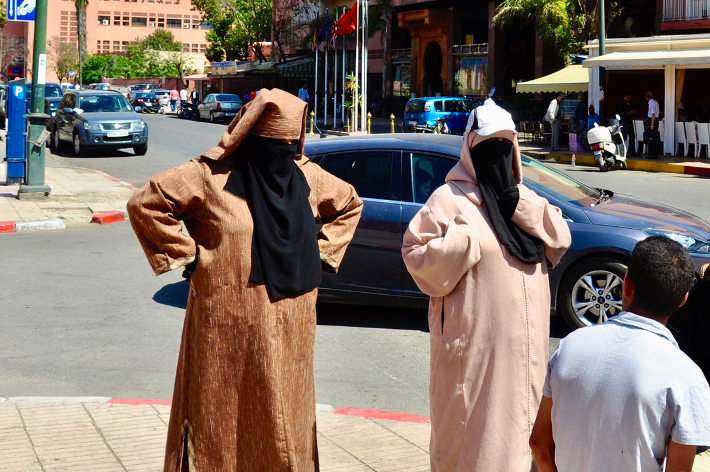
Surreptitiously, I managed to take the photo shown below of two women on a street in Marrakesh that epitomizes the more absurd sartorial impositions on women of that world. I find that the contrast against the backdrop of 21st century modernity is particularly jarring.
Let me engage in a brief review of the course of Islamic history bearing on the effect of that religion on its contribution, or lack of it, to scientific progress.
Some of what follows is freely extracted and redacted from Wikipedia.
The religion of Islam originated in Mecca c. 610 CE. Muslims believe this is when their prophet Muhammad received his first revelation. By the time of his death in 632 CE, most of the Arabian Peninsula had converted to Islam. Muslim rule then expanded outside Arabia under the Rashidun Caliphate and the subsequent Umayyad Caliphate ruled from the Iberian Peninsula (8th century) to the Indus Valley. In the Islamic Golden Age, specifically during the reign of the Abbasid Caliphate, most of the Muslim world experienced a scientific, economic, and cultural flourishing. I will expand on the Islamic Golden Age which is, traditionally, thought to extend from the 8th to the 13th centuries. I will concentrate on the scientific aspects of that period.
During this period, the Muslims showed a strong interest in assimilating the scientific knowledge of the civilizations that had preceded them or had been conquered. Many classic works of antiquity that might otherwise have been lost were translated from Greek, Syriac, Middle Persian, and Sanskrit into Syriac and Arabic, some of which were later in turn translated into other languages like Hebrew and Latin.
The various Quranic injunctions, which place values on education and emphasize the importance of acquiring knowledge, played a vital role in influencing the Muslims of that age in their search for knowledge and the development of the body of science.
During the Islamic Golden Age that culture contributed significantly to many scientific fields, such as algebra, calculus, geometry, trigonometry, statistics and astronomy. For example, within the latter, in about 964 CE, the Persian astronomer Abd al-Rahman al-Sufi, writing in his Book of Fixed Stars, described a “nebulous spot” in the Andromeda constellation, the first definitive reference to what is now known to be the Andromeda Galaxy, the nearest spiral galaxy to the Milky Way. Also, names for some of the stars, including Betelgeuse, Rigel, Vega, Aldebaran, and Fomalhaut are several of the names that come directly from Arabic origins or are the translations of Ptolemy’s Greek descriptions which are still in use today.
It is well beyond the scope of this essay to name all the members of the distinguished rostrum of Islamic scholars of that period. Some of the most important scientists during the Islamic Golden Age include Al-Khwarizmi, who is considered the father of algebra; Ibn al-Haytham (Alhazen), the father of modern optics; Ibn Sina (Avicenna), a renowned physician and philosopher; Jabir ibn Hayyan, a pioneer in chemistry and alchemy; and Al-Razi, a highly influential physician. Other key figures include Al-Biruni in astronomy and mathematics and Nasir al-Din al-Tusi in astronomy and trigonometry as well as Ibn Kathir al-Farghani (Alfraganus) and Al-Battani (Albatenius) in astronomy. Their contributions to science were introduced during a period when Europe was mainly a backwater of obscurantism.
And then came the Islamic Dark Ages. Starting in the 1300s and lasting until the present, the Islamic world has reveled predominantly in scientific backwardness.
The decline of the Islamic Golden Age was a complex process with multiple factors, including the devastating Mongol invasions (culminating in the 1258 Siege of Baghdad), which destroyed cities and infrastructure. Other contributing causes included geopolitical shifts like Crusader conflicts, a decline in institutional support for science and education, internal political fragmentation, and a growing focus on tradition over innovation, particularly in later centuries.
Fundamentally, a backlash against rationalism in favor of a more traditionalist interpretation of Islam played and continues to play a crucial role in stifling intellectual inquiry.
The Renaissance followed by the Scientific Revolution, in turn followed by the Enlightenment have all been eluded by the Islamic world during the last eight centuries, or so. Where are the Muslim Copernicus, Galileo, DaVinci, Vesalius, Newton, Laplace, Lavoisier, Euler, Darwin, Maxwell, Einstein, etc., etc.?
Symptomatically, here is a damning statistic: The Muslim community consists of at least 2 billion people worldwide (almost a fourth of humanity), and yet in the 122-year history of the Nobel Prize award only three laureates in the sciences have been of Muslim lineage (two in chemistry, one in physics and none in medicine or economics). In 1974, the notable physicist Abdus Salam, the lone Nobel physics laureate, departed from his country in protest after the Parliament of Pakistan unanimously passed a parliamentary bill declaring members of the Ahmadiyya Muslim community, to which Salam belonged, to be non Muslim.
To compare, there have been 154 Jewish Nobel laureates in the sciences (not counting economics). The pre-Holocaust world population of Jews was 16.6 million (there are about 15.8 million at present).
Governments of several predominantly Muslim countries have criticized the Universal Declaration of Human Rights (UDHR) for its perceived failure to take into account the cultural and religious context of non-Western countries. Iran declared in the UN assembly that UDHR was “a secular understanding of the Judeo-Christian tradition”, which could not be implemented by Muslims without trespassing the Islamic law. Islamic scholars and Islamist political parties consider ‘universal human rights’ arguments as the imposition of a non-Muslim culture on Muslim people, a disrespect of customary cultural practices and Islam. In 1990, the Organisation of Islamic Cooperation, a group representing all Muslim-majority nations, met in Cairo to respond to the UDHR, then adopted the Cairo Declaration on Human Rights in Islam.
Notable absences from this Cairo Declaration: provisions for democratic principles, protection for religious freedom, freedom of association, and freedom of the press, as well as equality in rights and equal protection under the law. Article 24 of the Cairo declaration states that “all the rights and freedoms stipulated in this Declaration are subject to the Islamic Sharia law”.
In 2009, the journal Free Inquiry summarized the criticism of the Cairo Declaration in an editorial: “We are deeply concerned with the changes to the Universal Declaration of Human Rights by a coalition of Islamic states within the United Nations that wishes to prohibit any criticism of religion and would thus protect Islam’s limited view of human rights. In view of the conditions inside the Islamic Republic of Iran, Egypt, Pakistan, Saudi Arabia, Sudan, Syria, Bangladesh, Iraq, and Afghanistan, we should expect that at the top of their human rights agenda would be to rectify the legal inequality of women, the suppression of political dissent, the curtailment of free expression, the persecution of ethnic minorities and religious dissenters—in short, protecting their citizens from egregious human rights violations. Instead, they are worrying about protecting Islam.”
Sharia is structured around the concept of mutual obligations of a collective, and it considers individual human rights as potentially disruptive and unnecessary to its revealed code of mutual obligations. In giving priority to this religious collective rather than individual liberty, Islamic law justifies the formal inequality of individuals (women and non-Islamic people). It has been stated that the Sharia framework and human rights are incompatible.
For me, a benchmark for rationality is an unquestioning acceptance of Darwinian evolution. Rejection of that theory is unscientific and irrational. How does Islam fare in that respect? Not well, in my opinion. Even contemporaneous Islamic scholars are notoriously ambiguous about evolution. It appears that, although many accept Darwinism when applied to living beings other than Homo sapiens, the prevailing view among Muslims is that humankind is exceptional, i.e., we do not descend from other species of animals.
Fundamentalist views about evolution do seem to predominate, even at present. For example, in 2017, Turkey announced plans to end the teaching of evolution before the university level, with the government claiming it is too complicated and “controversial” a topic to be understood by young minds. The evasiveness of Muslims on this subject is typified by a research paper published in 2016 by the Yaqeen Institute for Islamic Research, an independent American research institute and think tank founded in 2016, mainly interested in the advanced study of modernity, Islam and Muslim societies, stating that there is not a consensus among Islamic scholars on how to respond to the theory of evolution, and it is not clear whether the scholars are even qualified scientifically to give a response. Such waffling, even from a western infused society, is more than symptomatic of the views of the Islamic world at large.
The Islamic world of today consists principally of an array of paternalistic theocracies and autocracies where women, most frequently, remain second class citizens, and where the concept of separation of church, or rather mosque and state is mostly an alien idea. Most recently, that world’s contribution to humanity has consisted of an array of extremist and terrorist organizations such as Al-Qaeda, Taliban, Islamic State, Al-Shabaab, Boko-Haram, Hezbollah, Hamas, and others.
The preceding fulmination should not be construed as being exclusively aimed at Islam. It should be understood as my crusade against the irrationality embodied in a religious dominance of thought. My criticism and opposition to the Islamic predominance of religion applies to all such cultural capitulations. Although I am of Jewish ancestry and I am thus considered a Jew, I equally loath and reject the Haredi Jewish ultraorthodox movement. It is a regression to medieval obscurantism and a denial of reality. The Haredi are an intellectual virus that should be extirpated from Jewish society. Its Halakha rules correspond to a Jewish version of Muslim Sharia law, if not worse.
 Pedro Lilienfeld
Leave a comment