If you wear an analog watch (one with hands and a dial with 12 segments), and you are able to discern where the Sun is, you have a nearly perfect compass, in fact, likely to be more accurate than a magnetic compass.
Here is the procedure, a very simple one, indeed:
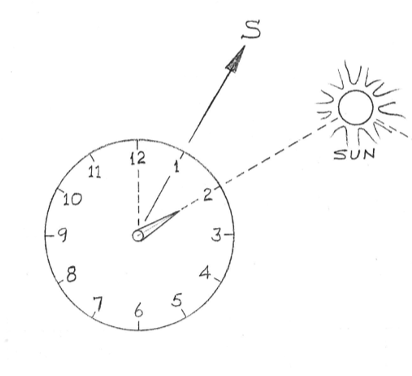
- Hold the watch so that its face is horizontal
- Point the watch so that the hour hand points in the direction straight under the Sun
- Look at the angle between the hour hand and the 12 on the watch
- Bisect that angle. That is the direction of the geographical south
The example illustrated below assumes it is 2 p.m. local time.
This method, however, can only be used at latitudes above 230 27’ north, or above the Tropic of Cancer (sorry, most people don’t have any idea what that is).
Now, how did I learn about this method of orientation? It goes all the way back to elementary school in Quito, Ecuador. We were being indoctrinated as boy scouts — presumably in the U.S. tradition — and as part of that training we were taught about this watch procedure. Little did our instructor, and much less the children, know that this method, most of the time, does not work in the equatorial region wherein Quito is located. For this to work, the Sun needs to always be in the southern half of our visual field which is not the case near or south of the equator. And how did I find out about that limitation? While cruising in the Beagle channel, south of Tierra del Fuego, I tried to use the boy scout method and came up with an entirely erroneous direction, and that elicited my questioning and the search for an explanation.
Furthermore, this leads me into another interesting observation. Why do all watches and clocks work “clockwise” and not the other way around? The reason is obvious. Clocks with rotating hands were invented in the northern hemisphere, likely in 13th century northern Italy. In northern latitudes, the Sun in its apparent daily motion across the sky, rotates “clockwise” when facing that trajectory.
As a coda to the above described method, I worked it out for use in the southern hemisphere, again for latitudes farther south than the Tropic of Capricorn (230 27’ south), as shown below, and proceed as follows:
- Subtract the present time from 12 and point that time in the direction of the Sun; e.g., as shown, if it is 2 p.m., subtract 2 from 12 = 10, point the 10 on the watch in the direction of the Sun
- Form the angle between the above obtained time and the 12
- Bisect this angle. That is the direction of the geographical north

 Pedro Lilienfeld
Leave a comment