Starting November 25, 2020, I issued a series of science tidbits under the rubric of the above title, in honor and memory of a notable man: Tom Urban, father of my daughter in law, Nina Urban. He had passed a few months earlier. The following was his obituary:
“Des Moines – Tom was born on May 26, 1934 in Des Moines, Iowa to Helen Jones Urban and Thomas Nelson Urban. He succumbed to cancer on July 10, 2020 at Kavanagh House hospice in Des Moines surrounded by his family.
After an education that included Hanawalt Elementary, Roosevelt High, and Harvard University, Tom became the youngest Mayor of Des Moines in 1968, at age 33, and led the city in tumultuous times that echo even today. He dedicated his business life to Pioneer Hi-Bred, a company that was an anchor of the Des Moines community. As CEO and Chairman, he led Pioneer to become a leading force in agricultural progress in the country and the world, landing him in the Iowa Business Hall of Fame. Tom always believed Des Moines could set the standard for progress and be a city of continual renewal and rejuvenation. Most recently, he was one of the key drivers behind the renaissance of the Des Moines Botanical Garden. He showed his unfailing support of education through his board service at Simpson College and Concord Academy, and the establishment of the Urban Research Award at the Iowa Academy of Education. Tom contributed on a national scale, serving as the Chairman of the Carnegie Institution for Science and the National Tropical Botanical Garden and was a valued member of many other corporate and non-profit boards. His tireless public service and personal generosity resulted in much recognition by many organizations and individuals too numerous to list. While Tom was proud of his achievements, he was most at peace when reading, writing poetry and working in his beloved garden.
He is survived by his wife, Mary Bright Urban; his children, Vikki Broer, Nina Urban, Tom Urban III and Bill Urban, their spouses, and nine grandchildren, as well as his three younger brothers, Tim Urban, Ted Urban and David Urban and their spouses, and many nieces and nephews. His younger sister, Susan Horsey, predeceased him. He will be sorely missed by the many people whose lives he impacted during his 86 years.”

I sent out, by email, short descriptions of recent scientific advances, observations, discoveries as well as facts, ideas, discussions and miscellaneous information of general interest in various fields of the scientific endeavor.
These brief mini-essays were issued, sometimes weekly, sometimes less frequently, to a cohort of more than 50 subscribers that I had inherited from Tom Urban himself as he had been distributing his thoughts to a community of his relatives, friends, colleagues and acquaintances during several years prior to his passing.
The Series covers a myriad of subjects, some were taken almost verbatim from certain scientific publications, which I state to foreclose accusations of plagiarism, and others were penned by myself. I ended this effort with its 41st issue on July 15, 2022 for two reasons: Evelyn’s escalating needs for attention and an apparently diminished readers interest.

Covid-19 shut downs have had some unforeseen environmental effects:
- Urban bird songs have changed because of the decreased noise level; for example, white-crowned sparrows in the San Francisco Bay Area have exhibited song loudness decrease and increased song complexity.
- 2. After cities, states and countries implemented lockdowns this past spring, the volume of human ground noise fell up to 50% in various regions; the decline, evident for months was recorded by seismometers as deep as 400 meters underground.
—————————————————————————————————-
2020 brings the stormiest Atlantic Ocean on record. As of November 13, 29 named storms have surpassed a high set in 2005. Unusually warm Atlantic waters and a La Niña event in the Pacific contributed to the stormy season.
Though it’s unclear whether global warming is leading to higher incidence of tropical cyclones, climate change is boosting rains and flooding left in the storm’s wake, and likely increasing their strength and destructiveness.
—————————————————————————————————-
In Ethiopia paleoanthropologists have unearthed a 1.4-million-year-old hand ax made from a hippo’s leg bone. Together with recently discovered stone tools, the ax indicates that Homo Erectus, considered a likely predecessor of Homo Sapiens, had a diverse tool kit several hundred thousand years earlier than scientists had heretofore suspected.
—————————————————————————————————-
Thought for food: To have any hope of meeting the central goal of the Paris Agreement, which is to limit global warming to 2 0C or less, our carbon emissions must be reduced considerably, including those coming from agriculture. Even if fossil fuel emissions were eliminated immediately, emissions from the global food (principally livestock) system alone would make it impossible to limit warming to 1.5 0C and difficult to realize the 2 0C target.
—————————————————————————————————-
Food for thought: “Your AAA Daily” issue of November 12, 2020 included the following entry: “Travel Horoscope: Where To Go Based on Your Sign. Let the stars guide you to your next getaway. Read your travel horoscope to find the ideal vacation from your astrological sign”. That a prestigious organization such as the American Automobile Association could endorse such a pseudo-scientific nonsense is truly unfortunate. I want to strongly emphasize that astrology has no base on scientific fact and its practice should be discouraged as an anachronistic and irrational waste of time.
—————————————————————————————————-
To the moon: It has been 44 years since samples have been taken from the moon. A Chinese mission that launched last week will try to send back pristine moon rocks that are younger than those taken by NASA’s Apollo astronauts and uncrewed Soviet missions. Scientists hope the samples will offer clues to the moon’s extended volcanic period, which shaped the fresher parts of the rocky surface we see today.
—————————————————————————————————-
To save energy and tackle pollution, the aviation industry is taking some surprising aerodynamic cues from birds. Aircraft manufacturing giant Airbus is developing a system, called fello’fly, in which two commercial planes mimic migrating birds by traveling in tandem with one close behind the other. The company says this arrangement could enable the follower aircraft to reduce its fuel requirements by as much as 10 percent per trip. Fello’fly was inspired by the way some birds, notably geese, often fly in formation to save energy. Like a bird, a moving airplane leaves a wake of disturbed air behind as its wings generate swirling vortices. These vortices move in a circular motion and expand outward until they dissipate, creating an updraft around the wake. If a second aircraft follows the leader at a specific distance and slightly away from the center of the wake, this updraft provides extra lift. Such a boost allows the follower to cut down on engine thrust, fuel use and emissions. But to reap these benefits, airliners have to position themselves carefully: if the follower gets too close to the center of the leader’s path, the vortices will actually push it downward instead of up. Planes also have to greatly reduce the distance they usually maintain. Fello’fly operations will reduce longitudinal ‘tail to tail’ separation from around 55 kilometers in oceanic airspace to three kilometers.
—————————————————————————————————-
In August 2019, Iceland held a funeral for the Okjökull Glacier, the first Icelandic glacier lost to climate change. The community commemorated the event with a plaque in recognition of this irreversible change and the grave impacts it represents. Globally, glacier melt rates have nearly doubled in the last five years, with an average loss of 832 mmw.e. (millimeters water equivalent) in 2015, increasing to 1,243 mmw.e. in 2020. This high rate of loss decreases glacial stores of freshwater and changes the structure of the surrounding ecosystem. In the last 10 years, warming in the Arctic has outpaced projections so rapidly that scientists are now suggesting that the poles are warming four times faster than the rest of the globe. This has led to glacier melt and permafrost thaw levels that weren’t forecast to happen until 2050 or later.
—————————————————————————————————-
Nearly a decade ago, a snippet of pinky bone found in Siberia introduced the world to a baffling new kind of ancient human. Called Denisovans, after the name of the cave in the Altai Mountains where the bone was found, these ancient relatives of the Neanderthals inhabited Asia for tens of thousands of years—yet no fossil trace of them has been found save that finger bone, a few teeth, and a scrap of skull, all from Denisova cave. A study published in Cell adds a surprising new twist to their mystery: DNA from a large sampling of living southeast Asians suggests that the ghostly Denisovans may be not one, but three distinct kinds of human, one of which is almost as different from other Denisovans as they are from Neanderthals. What’s more, while the Denisovans lived alongside humans for millennia, one group may have outlasted even the Neanderthals, who disappeared some 40,000 years ago. According to the study, these Denisovans co-existed and mixed with modern humans in New Guinea until at least 30,000 years ago—but perhaps as recently as 15,000 years ago—a date that, if confirmed, means Denisovans were the last known humans save ourselves to walk the Earth.
—————————————————————————————————
On the evening of December 21st[1], Jupiter and Saturn will have their closest conjunction in almost 400 years. That day, the two largest planets of our Solar System will appear separated by a mere 6 minutes of arc. Look southwest about 45 minutes after sunset. Through a small telescope you can fit both gas giants and their brightest satellites all together in a single view. I hope the weather will be favorable wherever you happen to be. Enjoy the view even without any telescope. During December, Mars appears high in sky after nightfall and long after Mars sets in the west, brilliant Venus rises at predawn in the southeast.
—————————————————————————————————-
Humanity has reached a new milestone in its dominance of the planet: human-made objects may now outweigh all of the living beings on Earth. Roads, houses, shopping malls, fishing vessels, printer paper, coffee mugs, smartphones and all the other infrastructure of daily life now weigh in at approximately 1.1 trillion metric tons—equal to the combined dry weight of all plants, animals, fungi, bacteria, archaea and protists on the planet. The creation of this human-made mass has rapidly accelerated over the past 120 years: Artificial objects have gone from just 3 percent of the world’s biomass in 1900 to on par with it today. And the amount of new stuff being produced every week is equivalent to the average body weight of all 7.7 billion people. The implications of these findings, published recently in Nature, are staggering. The world’s plastics alone now weigh twice as much as the planet’s marine and terrestrial animals. Buildings and infrastructure outweigh trees and shrubs. “We cannot hide behind the feeling that we’re just a small species, one out of many,” says study co-author Ron Milo, who researches plant and environmental sciences at the Weizmann Institute of Science in Israel. These numbers should be a wake-up call, he adds. They tell us “something about the responsibility that we have given that we have become a dominant force.
—————————————————————————————————-
An artificial intelligence (AI) network developed by Google AI offshoot DeepMind has made a gargantuan leap in solving one of biology’s grandest challenges — determining a protein’s 3D shape from its amino-acid sequence. DeepMind’s program, called AlphaFold, outperformed around 100 other teams in a biennial protein-structure prediction challenge called CASP, short for Critical Assessment of Structure Prediction. The results were announced on 30 November, at the start of the conference — held virtually this year — that takes stock of the exercise. “This is a big deal,” says John Moult, a computational biologist at the University of Maryland in College Park, who co-founded CASP in 1994 to improve computational methods for accurately predicting protein structures. In some sense the problem is solved. The ability to accurately predict protein structures from their amino-acid sequence would be a huge boon to life sciences and medicine. It would vastly accelerate efforts to understand the building blocks of cells and enable quicker and more advanced drug discovery. This year, the outfit’s deep-learning network was head-and-shoulders above other teams and, say scientists, performed so mind-bogglingly well that it could herald a revolution in biology. “It’s a game changer,” says Andrei Lupas, an evolutionary biologist at the Max Planck Institute for Developmental Biology in Tübingen, Germany, who assessed the performance of different teams in CASP. AlphaFold has already helped him find the structure of a protein that has vexed his lab for a decade, and he expects it will alter how he works and the questions he tackles. “This will change medicine. It will change research. It will change bioengineering. It will change everything,” Lupas adds.
—————————————————————————————————-
This week’s science tidbits are the utterances of two famous personages when addressing subjects outside their realm of fame.
The subject of extraterrestrial life has preoccupied many a scientist in the past but surprisingly also none other than a very famous politician. I am referring to Winston Churchill! Apparently he penned the initial draft of an essay entitled “Are We Alone in the Universe?” in 1939, when Britain was on the brink of World War II and completed it about a decade later, under more peaceful conditions, while he was vacationing in the south of France. This essay is truly remarkable because it reflects a thorough understanding of the question. Churchill approaches it with the logic and skepticism of a true scientist. He starts by stating that “all living things of the type we know require water”, very much in line with the present consensus. “We know there are millions of double stars, and if they could be formed, why not planetary systems?”. He then continues “I am not sufficiently conceited to think that my sun is the only one with a family of planets”. Churchill then considers that “some planets will be at the proper distance from their parent sun to maintain a suitable temperature” to ensure the presence of liquid water.
The essay concludes: “with hundreds of thousands of nebulae, each containing thousands of millions of suns, the odds are enormous that there must be immense numbers which possess planets whose circumstances would not render life impossible”. He also affirms that “I, for one, am not so immensely impressed by the success we are making of our civilization….or that we are the highest type of mental or physical development which has ever appeared in the vast compass of space and time”. Churchill was a fervent admirer of science and fully relied on scientists to advise him on such matters. One wishes that such an attitude would be espoused by our current political leaders.
—————————————————————————————————-
In 1946, Albert Einstein, after having lived in the U.S. for about 10 years wrote: “In the United States everyone feels assured of his worth as an individual. No one humbles himself before another person or class. There is, however, a somber point in the social outlook of Americans. Their sense of equality and human dignity is mainly limited to men of white skins. Even among these there are prejudices of which I as a Jew am clearly conscious; but they are unimportant in comparison with the attitude of the “Whites” toward their fellow-citizens of darker complexion, particularly toward Negroes. The more I feel an American, the more this situation pains me. I can escape the feeling of complicity in it only by speaking out. What, however, can the man of good will do to combat this deeply rooted prejudice? He must have the courage to set an example by word and deed, and must watch lest his children become influenced by this racial bias.” (Excerpted from an essay by Einstein entitled The Negro Question).
—————————————————————————————————-
Rutilius Taurus Aemilianus Palladius (c. 400 AD) listed twelve sunlit hours for every day, summer and winter. This meant that the length of each hour varied during the course of the year. In the summer, each of the twelve daytime hours would be rather longer than each of the twelve night-time hours; but in the winter the situation was reversed and the twelve daytime hours would fly by. These 12 + 12 unequal hours, invented in ancient Egypt and used in Christ’s time, were still common in medieval Europe. It made sense when there was far more work to do in the summertime fields, and the monks were well accustomed to adapting their canonical hours of prayer to the passing seasons. It was only in the 14th century that the equal hours with which we are all familiar, and which astronomers had preferred for centuries, came into common use. This was not because the monks or civil authorities found the unequal hours cumbersome or confusing. The change was simply spurred by the spread of mechanical clocks that beat out regular time without reference to the shifting seasons.
—————————————————————————————————-
Fingerprints are not the only biometric traits that set individuals apart. Each person’s walking gait is unique — and can serve not only as identifier but also as an indicator of mood and health. Remote sensing technology is being used to identify specific individuals walking through a building and to test a new method of hands-off wellness monitoring. Gait can reveal who you are, where you are, what kind of activities you’re doing, or even your cognitive state. The ability to conduct this kind of monitoring can help caregivers who need to know when elderly people might be likely to fall. They could also alert children’s hospitals to symptoms of chronic diseases, such as muscular dystrophy, as early as possible. The developers contend that in such cases, footstep sensors would preserve privacy better than, say, a camera.
—————————————————————————————————-
International demand for black rhinoceros horn has seen the animals killed relentlessly for decades in countries such as Namibia, Zimbabwe and South Africa. In 1960 there were an estimated 100,000 left, and by 1995 fewer than 2,500 remained. Conservation efforts have brought the number up to around 5,600 today—but the species is still critically endangered, and poaching is among its biggest threats. Scientists have worked to protect these rare creatures by tracking them with GPS devices strapped to their necks or ankles or implanted in their horns. The devices can fail, and drugging the animals to attach them may cause harm. A recent study describes a new tracking technology that uses smartphones to record rhino footprints. Called the footprint-identification technique (FIT), this system includes software that can analyze the animals’ movements from a distance to help keep them safe from poachers. The idea came from working with local trackers in Zimbabwe. These footprint-reading experts can identify individual black rhinos from the shape of their feet and, when visible, the impressions left by cracks in the animals’ heel pads, which are as distinctive as a human fingerprint. Researchers have now adapted the technology for diverse animals, including African lions, Bengal tigers and Eurasian otters.
—————————————————————————————————-
Global warming forecasts sharpen. More than 40 years ago, the world’s leading climate scientists gathered in Woods Hole, MA, to answer a simple question: How hot would Earth get if humans kept emitting greenhouse gases? Their answer, informed by rudimentary climate models, was broad: If atmospheric CO2 doubled from pre-industrial levels, the planet would eventually warm between 1.50C and 4.50C, from merely troubling to catastrophic. Narrowing those bounds has taken decades of scientific advancement. Understanding how clouds trap or reflect heat has been a particular challenge. Longer and better temperature records have also helped narrow the range. Studies of ancient climate suggest how greenhouse gases have driven previous episodes of warming. This year, these advances enabled 25 scientists affiliated with the World Climate Research Programme to narrow climate sensitivity to a range between 2.60C and 3.90C. The study rules out some of the worst-case scenarios—but it all but guarantees warming that will flood coastal cities, escalate extreme heat waves, and displace millions of people. Atmospheric CO2 is already at 415 ppm—halfway to the doubling point of 560 ppm. Barring more aggressive action on climate change, humanity could reach that threshold by 2060—and lock in the foreseen warming. (Science, 12/18/2020).
—————————————————————————————————
Room temperature superconductivity was finally achieved. Scientists have spent decades searching for materials that conduct electricity without resistance at room temperature. In 2020 they found the first one, a hydrogen- and carbon-containing compound squeezed to a pressure of 267 Gpa approaching that at the center of Earth. It conducted without resistance to 287 K, the temperature of a chilly room. So far, the new superconductors fall apart when pressure is released. Now, researchers hope to find a long-lasting gem similar to diamond that exhibits room-temperature superconductivity. (Science, 12/18/2020).
—————————————————————————————————-
Mars has attracted much attention because there is clear evidence it once had liquid water on its surface. The landing site for NASA’s new Perseverance rover, the Jezero Crater, was chosen in part because it seems to have once been a lake that could have hosted prebiotic chemistry. It will be two months before Perseverance reaches Mars—and years before the samples it collects are returned to Earth by an as-yet-unnamed future mission. So, there is still a long wait before we find out whether Mars harbors life, or if it did so billions of years ago. But even if it did not, it might reveal traces of prebiotic chemistry. The best case is that Perseverance finds complicated carbon-based molecules in the layers of Martian sediment, such as lipids or proteins, or their degraded remains. It is suspected that life didn’t get particularly far on Mars, because we haven’t seen any obvious signs of it, such as clear fossils or carbon-rich black shales. It could be that Mars took only the first few chemical steps towards life, and did not go all the way. In that case, we might find fossils—not of life, but of pre-life. (Nature, 12/16/2020).
—————————————————————————————————
Bioprinting—the 3D printing of human tissues—holds potential for producing tissues and organs for transplants. In this technology, a machine dispenses small segments of bioinks—materials made of cell aggregates or micro-tissues. When placed next to each other, the segments fuse and self-assemble into sturdier tissue structures. However, because the self-assembly process is slow, tissues assembled using a patient’s own cells cannot be printed in urgent clinical settings. Guided by a physics-based microscopic model, Ashkan Shafiee of Wake Forest School of Medicine, North Carolina, and colleagues have devised a new bioprinting method that accelerates tissue self-assembly. Their method, based on bioink fusion, is an iterative process in which cells in one printed microtissue break off to develop new chemical bonds with an adjacent tissue. From a macroscopic perspective, this microscopic bond formation resembles a closing zipper. The researchers designed their method by harnessing a model prediction—that the bioinks would fuse faster when subjected to an external force. The model allowed them to optimize the magnitude of the force to accelerate bioink fusion without damaging existing cells. The researchers are currently developing a bioprinter in which the forces on the bioinks can be finely tuned. (Physics, 1/5/2021).
—————————————————————————————————-
The stone tool styles that took Homo Sapiens out of Africa and across much of the world were gradually replaced with new implements, and were thought to have been abandoned entirely by 30,000 years ago. New discoveries reveal that in West Africa this transition was not made until long after the rest of the world, with replacements only appearing around 11,000 years ago. Long before H. Sapiens’ arrival on the scene other early human species had refined stone tool use to a fine art. The first bones of our own species are associated with the appearance of a distinctive style of flaking tools, scrapers, and grinding stones anthropologists refer to as the Middle Stone Age. As the name suggests, there was also a Later Stone Age, marked by much smaller tools and ostrich eggshell beads. These first appeared around 67,000 years ago, and by 30,000 years ago were thought to have replaced the larger tools that served humanity for almost 300,000 years everywhere in Africa.
The climate of Western Africa appears to have been more stable during the last Ice Age than the rest of the continent. Without the pressure of changing conditions people living in the region may have had little need to abandon the tools that served their ancestors so well. Not until the Holocene had nearly begun did greater humidity expand West Africa’s forests, possibly linking them to those in Central Africa and sparking a cultural exchange.
—————————————————————————————————-
Nobody believes it was ET phoning, but radio astronomers admit they don’t have an explanation yet for a beam of radio waves that apparently came from the direction of the star Proxima Centauri. “It’s some sort of technological signal. The question is whether it’s Earth technology or technology from somewhere out yonder,” said Sofia Sheikh, a graduate student at Pennsylvania State University leading a team studying the signal and trying to decipher its origin. She is part of Breakthrough Listen, a $100 million effort funded by Yuri Milner, a Russian billionaire investor, to find alien radio waves. The project has now stumbled on its most intriguing pay dirt yet. Proxima Centauri is the closest known star to the sun, only 4.24 light-years from Earth, part of a triple-star system known as Alpha Centauri. Proxima has at least two planets, one of which is a rocky world only slightly more massive than Earth that occupies the star’s so-called habitable zone, where temperatures should be conducive to water, the stuff of life, on its surface.The radio signal itself, detected in spring 2019, is in many ways the stuff of dreams for alien hunters. It was a narrow-band signal with a frequency of 982.02 MHz as recorded at the Parkes Observatory in Australia. Nature, whether an exploding star or a geomagnetic storm, tends to broadcast on a wide range of frequencies. The signal appears to only show up when looking in the direction of Proxima Centauri, which is exciting. In the end it is probable that it will be anthropogenic in origin, but so far we can’t yet fully explain it. (New York Times, 1/5/2021).
—————————————————————————————————-
Astronomers may be wrong about the total number of galaxies in our universe. The most recent estimate had been that there are about 2 trillion galaxies in the observable universe. But this may be an overestimate based on measurements of the background darkness of our universe performed by the Hubble Space Telescope. What if the universe is darker than expected meaning that the galaxy count should be reduced to “only” hundreds of billions, instead? The new determination is based on measurements performed by NASA’s New Horizons mission that recently flew beyond Pluto on the edge of our solar system. There, the sky was observed to be 10 times darker than in the vicinity of the Earth where Hubble is located. It is of interest to note that if the number of galaxies were to be infinite — as it had been believed in the past — the sky would be ablaze with sun-like light. The fact that this not the case is called Olbers’ paradox (after the German astronomer, Heinrich Wilhelm Olbers, 1758 – 1840). (Astrophysical Journal, 11/9/2020)
—————————————————————————————————-
We all know (or should know) about the remarkable achievements of the ancient Greeks. Who has not heard about Aristotle, Plato, Homer, Sophocles, Pythagoras, the magnificent temples, theaters and marble statues of that civilization? But what about scientific/technological advances? Here I want to introduce you to one that is far less known and at least as incredible: the Antikythera mechanism, most probably the first analog computer, a hand-powered, about 6 inches in diameter, multiple-geared device used to predict planetary, solar and lunar positions (even its irregular orbit), eclipses, and to track the cycle of ancient Olympic Games. The artifact (highly corroded) was retrieved from an ancient shipwreck (c. 100 BC) off the southern coast of Greece in 1902. It is a complex clockwork mechanism composed of 37 meshing bronze gears. No device of comparable complexity appeared until about 1500 years later in late medieval Europe. All extant fragments of this extraordinary mechanism are now kept at the National Archeological Museum in Athens, along with modern replicas of how it may have looked and worked.
—————————————————————————————————-
On a nice clear day you may see the crescent Moon in the afternoon, or the last quarter in the morning. You are viewing the Moon against the blue sky without realizing that you are looking at an optical illusion or rather, rigorously, at a physiologically induced illusion. And, Why is that? Because, without a doubt, the blue sky appears to be clearly behind the Moon! Now, we do know (and you should too) that the blue sky is Sun-light scattered right here by our Earth’s atmosphere and that the Moon is more than 200,000 miles away, way beyond our atmosphere. So, what is going on? Very simple, indeed. The sensitivity of our eyes peaks at the central wavelength of white light, i.e., the color yellow, and falls off quite drastically for blue light. The Moon appears white because it replicates the Sun’s color to which we are most sensitive (thanks to Darwinian evolution) and thus overwhelms the blue light from the atmosphere in front of it. Appearances can be rather deceptive, indeed.
—————————————————————————————————-
You set your home thermostat to, for example, 70 oF. Curiously, if it is wintertime, you still seem to need a warm sweater to be comfortable. In the summer, at that same room temperature, you would be very unlikely to require a sweater. Why is that? What is going on? It is just a physiological response to basic physics. In the winter, the room walls that face outdoors and, especially, windows (even when double-glazed), tend to be at a lower temperature that the room, i.e., that of the thermostat setting. Consequently, there is a greater net outflow of radiation from your body towards those walls and windows than in the summer. Ergo, you feel colder indoors when the outdoor temperature is low than when it is warmer outdoors, regardless of the indoor air temperature.
—————————————————————————————————-
Back in the spring of 1720, Sir Isaac Newton owned shares in the South Sea Company, the hottest stock in England at the time. Sensing that the market was getting out of hand, the great physicist muttered that he “could calculate the motions of the heavenly bodies, but not the madness of the people.” Newton dumped his South Sea shares, pocketing a 100% profit totaling £7,000. But just months later, swept up in the wild enthusiasm of the market, Newton jumped back in at a much higher price — and lost £20,000 (or more than $3 million in present day money. For the rest of his life, he forbade anyone to speak the words ‘South Sea’ in his presence. At the time of this investment failure, Newton was the Master of the Mint of England. This proves that even geniuses can’t prevail against the machinations of the financial markets (Physics Today, 07/01/2020).
—————————————————————————————————-
Wildfires over the past 3 years have resulted in lengthy episodes of smoke inundation in Australia, Brazil and the United States. Although the pulmonary and cardiovascular consequences of human exposure to smoke are extensively researched, there remains little recognition of a smoke component with potentially important health repercussions: microbes. Wild-land fire is a source of bioaerosols, composed of fungal and bacterial cells. However, the risk of infection of the respiratory tract, as well as inflammatory responses to wildfire smoke due to airborne microbial particulates and toxicants in that smoke have been frequently overlooked and addressing these unknowns will require a multidisciplinary approach representing expertise in fire ecology, environmental microbiology, public health and infectious disease and atmospheric sciences. (Science, 12/15/2020).
—————————————————————————————————-
Earth’s global average surface temperature in 2020 tied with 2016 as the warmest year on record, according to an analysis by NASA. Continuing the planet’s long-term warming trend, the year’s globally averaged temperature was 1.84 degrees Fahrenheit (1.02 degrees Celsius) warmer than the baseline 1951-1980 mean, according to scientists at NASA’s Goddard Institute for Space Studies (GISS) in New York. 2020 edged out 2016 by a very small amount, within the margin of error of the analysis, making the years effectively tied for the warmest year on record. “The last seven years have been the warmest seven years on record, typifying the ongoing and dramatic warming trend,” said GISS Director Gavin Schmidt. “Whether one year is a record or not is not really that important – the important things are long-term trends. With these trends, and as the human impact on the climate increases, we have to expect that records will continue to be broken.” (NASA News, 01/14/2021).
NOTE: I intend to write about global climate change on a regular basis.
—————————————————————————————————-
I doubt any of you has ever heard of Abu al Abbas Ahmad ibn Muhammad ibn Kathir al-Farghani (a.k.a. Alfraganus, his latinized name) and yet this medieval Persian astronomer/geographer is likely to have shaped the course of history of the Americas. In the 15th century, Christopher Columbus used al-Farghani’s estimate for the Earth’s circumference as the basis for his voyages to America. However, Columbus mistook al-Farghani’s 7091-foot Arabic mile to be a 4856-foot Roman mile. In addition, Columbus calculated that Japan was at 850 west longitude (rather than 1400 east). These errors caused him to underestimate the Earth’s circumference, leading him to sail to North America while he believed that he was taking a shortcut to Asia. Had he known the true distance, Columbus, who knew nothing about the Americas, would not have attempted his great voyage of discovery.
—————————————————————————————————-
Computer systems should adapt to the ways people—all people—use language. West Africans, for example, have spoken their languages for thousands of years, creating rich oral history traditions that have served communities by bringing alive ancestral stories and historical perspectives and passing down knowledge and morals. Computers could easily support this oral tradition. While computers are typically designed for use with written languages, speech-based technology does exist. Speech technology, however, does not “speak” any of the 2,000 languages and dialects spoken by Africans. Apple’s Siri, Google Assistant, and Amazon’s Alexa collectively service zero African languages.In fact, the benefits of mobile technology are not accessible to most of the 700 million illiterate people around the world who, beyond simple use cases such as answering a phone call, cannot access functionalities as simple as contact management or text messaging. Because illiteracy tends to correlate with lack of schooling and thus the inability to speak a common world language, speech technology is not available to those who need it the most. For them, speech recognition technology could help bridge the gap between illiteracy and access to valuable information and services from agricultural information to medical care. (Scientific American, 02/02/2021).
—————————————————————————————————-
Moon effects? Many species synchronize reproductive behavior with a particular phase of the lunar cycle in order to increase reproductive success. In humans, a lunar influence on reproductive behavior remains controversial, although the human menstrual cycle has a period close to that of the lunar cycle. Recent research shows that women’s menstrual cycles with a period longer than 27 days were intermittently synchronous with the Moon’s luminance and/or gravimetric cycles. With age and upon exposure to artificial nocturnal light, menstrual cycles shortened and lost this synchrony. It has been proposed that in ancient times, human reproductive behavior was synchronous with the Moon but that our modern lifestyles have changed reproductive physiology and behavior.
Further research has shown that sleep starts later and is shorter on the
nights before the full moon when moonlight is available during the hours
following dusk. This suggests that moonlight likely stimulated nocturnal
activity and inhibited sleeping in preindustrial communities and that
access to artificial light may emulate the ancestral effect of early-night
moonlight. (Science Advances, 01/27/2021).
NOTE: I hope that none of my readers interpret the above observations
as support for astrology.
—————————————————————————————————-
A few months ago, a team of astronomers announced that they had detected traces of the gas phosphine in the atmosphere of the planet Venus at an altitude of about 30 miles above its surface where the temperature is a relatively mild 85 0F (as compared with the hellish temperature of 800 to 900 0F at Venus’ surface). Phosphine is believed to be a product of biological processes and therefore the possibility of microbial life on our sister planet has been raised. Since this initial observation, however, doubts have been raised as to the actual detection which has been been difficult to replicate. There are alternate mechanisms that could be the sources of phosphine and the conditions within the atmosphere of Venus are not friendly to the existence of life such as the presence of sulphur dioxide and intense radiational bombardment form the Sun. So, the jury is still out.
—————————————————————————————————-
If you want to monitor outdoor temperature, either using a traditional thermometer or with a remote sensor, you should consider its proper placement in order to measure the outdoor air temperature without radiational effects. Almost everyone knows that the thermometer should be shielded from direct sun exposure, for example by mounting it on the northern side of a building, i.e., in the northern hemisphere. What is generally not considered is that the thermometer should also be shielded from direct exposure to the sky. This is particularly important to prevent under-reading (by as much as 10 0F) the air temperature during the night under cloudless conditions when radiational cooling can be significant.
—————————————————————————————————-
The Bulletin of the Atomic Scientists last week kept its iconic Doomsday Clock unchanged from 2020, set at 100 seconds from a catastrophic “midnight” that symbolizes society’s self-destruction from military conflict and global warming. The past year saw little progress on those fronts, said the group of scientists, which monitors global tensions. But it cited some
cause for hope from the redirection of the U.S. now acknowledging again the human contribution to climate change and the extension of the strategic
arms reduction treaty with Russia. The COVID-19 pandemic, though lethal is not believed to have the power to obliterate humanity. But it was a wake-up call, showing that national governments and international organizations remain unprepared to handle the even grater threats posed by nuclear war
climate change, and other new diseases. (Science, 02/05/2021).
—————————————————————————————————-
Surprisingly, almost three-quarters of concussions sustained by U.S. college football players occur during practice, JAMA Neurology reports. Described as the largest study of its king, it evaluated 658 players in the National Collegiate Athletic Association from 2015 to 2019. The authors call for rules that reduce the number of practice sessions during which collisions are allowed; the National Football League and many high schools have already adopted them. (Science, 02/05/2021).
—————————————————————————————————-
Monozygotic twins that originate in the fertilization of one egg that splits into two are classically considered genetically identical. To verify this assumption, researchers sequenced the genomes of 381 monozygotic twin pairs and two sets of triplets and mapped mutations. It was found that that some twin pairs showed no difference, whereas 15% showed substantial differences in the number of mutations. Phenotypic differences between twins are usually attributed to environmental effects, but this study suggests that this might not always be the case. (Nat. Genet., 2021).
—————————————————————————————————-
Bird banding studies have illuminated the hidden lives of most of the more than 900 avian species that spend time in North America, from raptors to waterfowl, from seabirds to songbirds. A peregrine falcon monitoring project in coastal Washington State has found that in addition to hunting on the wing, this formidable predator — the fastest species on earth — actually scavenges food fairly often. On Midway Atoll, in the Pacific Ocean, a female Laysan albatross named Wisdom, first banded in 1956 and sighted as recently as November 2020 incubating a new egg, is believed to be oldest known wild bird in the world. (Scientific American, 03/2021).
—————————————————————————————————-
Probing the structure of sub-ocean crust requires a wave source. The most common sources are air guns and high energy electric spark discharges, both are effective but potentially harmful for ocean life and not easily to use everywhere. Marine researchers found that whale songs can also be used as a seismic source for determining crustal structure. Fin whale vocalizations can be as loud as large ships and occur at frequencies useful for traveling through the ocean floor. These properties allow fin whale songs to be used for mapping out the density of ocean crust, a vital part of exploring the seafloor. (Science, 02/12/2021).
—————————————————————————————————-
Astronomers have released the most detailed multidimensional census of our Milky Way galaxy. The third edition of the star catalog produced by the European Space Agency’s Gaia mission contains coordinates for more than 1.8 billion stars between 3rd and 21st magnitude, with a precision of a few tens of micro-arc seconds; most of these also have brightness measurements. In addition, the catalog provides parallaxes and proper motions on the sky for a subset of almost 1.5 billion stars. Gaia, a space observatory of the European Space Agency, launched in 2013, is expected to operate until 2025, and the additional years of data will improve the precision of all measurements by at least a factor of two; proper motion precision will increase sevenfold. (Sky & Telescope, 04/2021).
—————————————————————————————————-
Free trade between species? Long-tailed macaques (Macaca fascicularis) living in a Balinese (Indonesia) temple regularly steal human visitors’ possessions and then barter for food with humans anxious to regain their belongings. Researchers have discovered that they preferentially steal items of high value (for example, digital devices and wallets) over those of low value (for example, empty bags or hairpins) because higher value food rewards tend to be offered for items that humans value more. The ability to identify high-value objects increases with age and experience, as does the macaques’ skill as thieves. The animals in this group have been stealing and trading for more than 30 years, suggesting that the practice is culturally transmitted. So much for the exclusivity of human intelligence. (Science, 02/19/2021).
—————————————————————————————————-
Do terrestrial geomagnetic reversals have an effect on Earth’s climate? Researchers created a precisely dated radiocarbon record around the time of the last geomagnetic reversal 41,000 years ago from the rings of New Zealand swamp kauri trees. This record reveals a substantial increase in the carbon-14 content of the atmosphere culminating during the period of weakening magnetic field strength preceding the polarity switch. It was concluded that the geomagnetic field minimum caused substantial changes in atmospheric ozone concentration that, in turn, drove synchronous global climate and environmental shifts. (Science, 02/19/2021).
—————————————————————————————————-
The touch perception of surface temperature depends on several properties of the material we are touching. Under room temperature conditions, smooth objects tend to feel colder, especially metallic ones; wood, for example, less so. Cloth, seems warmer, in general. However, when covering oneself with linen bedding feels definitely colder than with flannel bedding. All of these materials are, presumably, at the same room temperature, so, why are they all feeling differently? There are two factors that cause that discrepancy: surface smoothness and material thermal conductivity. The common denominator is the effectiveness with which heat is conducted away from your body when touching a cooler surface. Smooth surfaces have a better thermal contact than rough surfaces. Metallic materials have a higher thermal conductivity than insulating materials. In addition the thermal capacity of the object being touched plays a crucial role. Try the following experiment: place a piece of aluminum foil in an oven at, say 350 degrees, for 10 minutes; open the oven and touch the foil (only the foil, please). It will merely feel warm: it will not burn you although it is at 350 degrees! The mass of the foil is insufficient to conduct much heat to your fingers.
—————————————————————————————————-
This week’s science issue will be dedicated to a single subject: global warming. I will endeavor to write about that problem on a regular basis, as new information becomes available and new ideas about solutions are developed.
The first aspect I will address is that of the relentlessly rising concentration of carbon dioxide, CO2, in the Earth’s atmosphere that, in turn, causes an increase in heat trapping which results in rising temperature of the atmosphere and the oceans.
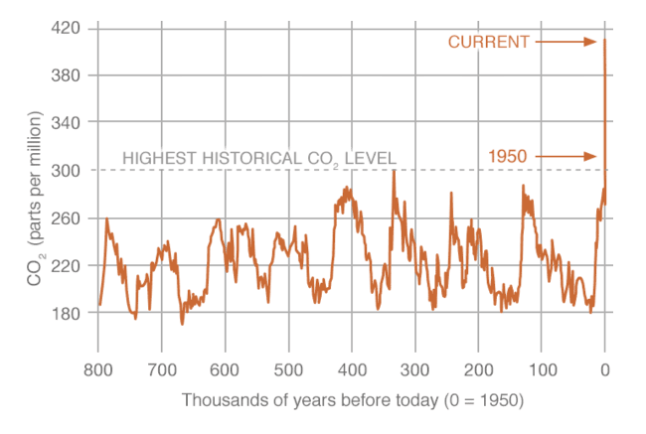
The question of the cause of the recent rapid increase of CO2 has been raised repeatedly and the present scientific consensus is that it is of anthropogenic origin. That conclusion is fully supported by several independent determinations among which it is pertinent to cite: a) isotopic identification of the incremental level of carbon dioxide, i.e., the contribution from artificial sources carries a distinctive isotopic signature signifying that the increase does not stem from natural processes, and b) radically different rate of CO2 increase over the last century as compared to previous history over almost 1 million years. This latter observation is dramatically illustrated by the measured concentrations of this greenhouse gas showing the secular oscillations typically correlated with ice ages and the drastic change in the trend in recent years. See graph below.
The highest ever level of 300 ppm during the last 800,000 years was about 340,000 years ago. This was exceeded just before 1950. In February 2021 the concentration is rising through 415 ppm[2]. On the long term historical record scale shown above, this is represented by an almost vertical line.
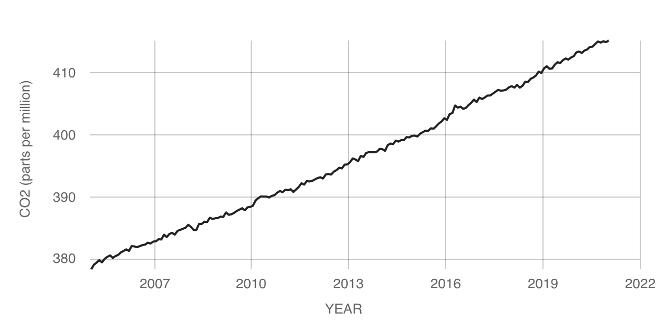
If we then look at the CO2 concentration over just the last 16 years, that vertical line of the first graph resolves into the gradually increasing level
of the subsequent graph. A perspicacious reader may see a small flattening of the curve at the upper end; it may be due to the temporary decrease of carbon dioxide emissions caused by the Covid-19 pandemic. Otherwise, the upward trend is relentless and frightening.
In a future climate change installment I will address the resulting atmospheric temperature increase and how the long term (over hundreds of thousands of years) concentrations are measured.
—————————————————————————————————-
This will be a one subject issue: UFOs. Over the last few weeks we have been exposed to a barrage of news, discussions, announcements, opinions and digressions about UFO (now also called Unidentified Aerial System) sightings and their significance. My own experience with this matter goes back to the 1950s when such purported observations were referred to as those of “flying saucers”. I witnessed a mass hysteria around 1955 when the daylight visibility of the planet Venus was mistaken for one of those objects in the pristine sky of the South American city of Quito. When I tried to enlighten some people about the true nature of the phenomenon I was dismissed contemptuously. I thus learned early on my lesson about human gullibility.
Years later I watched a television program in Madrid where a savant-looking presenter showed a short clip of fuzzy lights approaching a landing strip in the Canary islands as incontrovertible proof of the presence of alien UFOs – the video camera was obviously unfocused and the images were those of landing lights of airplanes at night.
Finally, I can cite an instance where I was participating professionally in a stratospheric air sampling program for the U.S. government that involved very large balloons flying above 100,000 feet. One of these was sighted by people in a small town in South Dakota who became convinced that it was a genuine UFO.
Recent official reports about UFOs have concluded that the vast majority of the purported sightings of UFOs can be explained in terms of optical atmospheric phenomena, the planet Venus, equipment malfunctions and distortions, misinterpretations of aircraft, balloons and other flying devices, etc. A small percentage of sightings, however, remains unexplained and has given rise to outlandish interpretations, i.e., principally that these are proof that we are being visited by “aliens”, advanced extraterrestrial beings. The likelihood of such an explanation is vanishingly small. Katie Mack, an astrophysicist, has commented: “I don’t think it’s completely impossible that hyper-advanced aliens could come to visit us on Earth – being careful for some reason to first evade every sky-monitoring system we have, and leaving no observable trace other than the confusion of a handful of Navy pilots”. Another comment with which I agree was penned by Mick West, an experienced British-American UFO science investigator, in June 2021: “This is not to say there’s nothing for the military to be concerned about. There are real issues regarding unidentified sightings – drones being a major one. A distant drone, even a domestic one, is difficult to identify, and we know foreign adversaries have a strong interest in developing and using novel stealth drones for espionage and probing our defenses.
There are other genuine issues, too – like anomalous radar returns and inexplicable eyewitness sightings – but there’s no evidence of aliens. There isn’t even really any good quality evidence of flying objects displaying amazing technology.
There are, however, many people who want UFOs to be “real” and who feel like promoting the story will make it real. They present weak evidence as strong evidence. Don’t be fooled. I have written an essay on advanced technological extraterrestrial life where I examine both the likelihood of the existence of such life, at least within our galaxy, as well as the obstacle for alien visitation inherent in the enormous distances separating us from other hypothetical abodes of advanced life. Based on these considerations and in the absence of incontrovertible proof to the contrary, I thoroughly dismiss any alien visitation as an explanation for UFOs.
—————————————————————————————————-
In issue #17 of this series, last week, I presented my views about UFOs. In the interim, the long awaited U.S. government report on that matter was published. Most of you have probably seen it by now. In my opinion, it is only remarkable for the dearth of information it provides. Not much can be concluded from this document except that it fails to explain a large number of events, mainly observed by Navy pilots. It will, most probably, be fodder for the conspiracy community which will attribute these observations to visitations by “aliens”. Others will explain that the lack of substantive information proves a government cover up of the true nature of these purported “phenomena”. In any case, please rest assured that none of you will be abducted or raped by little green men with such and other nefarious intentions.
On a more substantive matter, in that preceding issue I alluded to an essay about extraterrestrial life that I penned during the protracted period of Covid-related lock-down. It is entitled “Where Are They?, Are We Alone?”. I did enjoy doing the research and writing it.
—————————————————————————————————-
This issue is about two technological advances of notable import in two entirely different fields that have been achieved within the last few years. The first is the most advanced photolithographic system ever devised for the production of large scale integrated semiconductors, i.e., chips used in electronic devices. The other is the design and construction of the first successful system to detect cosmological gravitational waves.
1. In the 1950s the transistor was invented creating an entirely new approach to electronic processing. In essence, the transistor served mainly as a basic switch in digital circuits (as well as an amplifier in analog circuits). A major breakthrough came with the implementation of large scale integrated circuits wherein a multiplicity of miniaturized transistors were embedded onto a silicon matrix by means of a special process called photolithography. The ever growing demand for increased computing and processing capabilities was matched year after year by ever shrinking circuitry, what became known as Moore’s law, i.e., that the number of transistors in integrated circuits (IC) doubles about every two years. The smallest circuit elements that can be packed into these chips depends on the wavelength of the light source used in the photolithographic process of fabrication. The recent use of extreme ultraviolet light sources with a wavelength of 0.0135 micrometers was achieved by focusing a high-energy laser on microscopic droplets of molten tin. Minimum feature dimensions of less than 0.02 micrometers can thus be achieved on the silicon wafer. The two-ton optical focusing system incorporates mirrors (lenses can not be used for extreme ultraviolet light) with highly specialized coatings that require months for their fabrication. An incredible number of transistors has now been embedded in a single chip: 2.6 trillion!
2. Einstein had postulated (as part of the Generalized Theory of Relativity) the existence of gravitational waves, i.e., ripples in space-time which propagate at the speed of light, resulting from stellar explosions, collisions, etc. Starting in the 1960s, efforts to detect such waves were unsuccessful for half a century. Ever more sensitive systems were built culminating in the so called Advanced LIGO installation, a laser based interferometer with two reflection paths of 2.6 miles in length, at right angles to each other. Two of these systems (separated by several thousand miles) started to operate in 2015 and immediately detected a gravitational wave event caused by the collision of two black holes at a distance from Earth of 1.3 billion lightyears! To achieve this feat, the Advanced LIGO system has to be able to detect a change of less than the size of a proton in the length of one of the two 2.6-mile paths with respect to the other! The overall system is designed to discriminate against any spurious signals associated with earthquakes, human induced vibrations, etc. So far, more than 50 gravitational wave events have been detected. By simultaneous detection of electromagnetic waves originating from the same event it has become possible to obtain detailed characterization of remote collisions of neutron stars, black holes and supernovas.
————————————————————————————————-
The thought of Leonardo da Vinci generally elicits the image of Mona Lisa or perhaps anatomical drawings. But this incredible genius was also the first one to explain the origin of the ashen glow of the Moon that we now call Earthshine and that we can see whenever there is a crescent Moon at sunset. Look between the horns of the crescent for a ghostly image of the full Moon. For thousands of years, humans were puzzled by that glow.
Leonardo figured it out: It is a double reflection effect, light from the Sun bounces off the Earth and illuminates the Moon which then bounces that light back to the Earth. This effect is now called the Da Vinci Glow.
Leonardo was ever the scientific observer: He ascended the Monte Rosa in the Alps and then commented on the fact that the blue sky there appeared darker than at lower altitudes. He correctly explained that effect as being caused by the fact that the atmosphere above the mountain was thinner and that the space beyond the atmosphere was completely dark. He also surmised that the blue color of the sky at daytime was caused by the sun illuminating particles (erroneously, water droplets) in the air.
I find it truly amusing that when Leonardo wrote his resume to the Duke of Milan, for whom he wanted to work, he stated at the end of a long list of accomplishments, as an afterthought: “I also paint”.
————————————————————————————————-
Since we are on the subject of the blue color of the daytime sky, a matter on which I have published a refereed paper, It is worth mentioning that it took until the end of the 19th century for John William Strutt, 3rd Baron Rayleigh (1842 to 1919), to explain why the sky is blue using the newly minted theory of electromagnetic propagation by his contemporaneous scientist James Clerk Maxwell: the shorter wavelengths of sunlight (i.e., blue light) are scattered preferentially by the air molecules (principally nitrogen and oxygen) in the atmosphere meaning that blue is not an intrinsic color of these molecules. If the atmosphere were composed of any other molecules (e.g., pure carbon dioxide) its color would still be blue. Lord Rayleigh was one of the most prolific scientists of the era and listing his accomplishments would require several pages. He obtained the 1904 Nobel physics prize for his discovery of the element argon.
—————————————————————————————————-
This will be a single subject issue: the fraught relationship between science and philosophy. This matter was triggered by reading a seminal paper by a well known mid-century Harvard physicist, Philipp Frank, published in July of 1941 in the Reviews of Modern Physics. It’s title is “Why do Scientists and Philosophers so Often Disagree About the Merits of a New Theory?”
The essence of that paper, based on a lecture Frank gave at a meeting of the American Physical Society, was that when a new scientific theory appears, philosophers may be reluctant to accept it but as time passes, they come to agree with it too completely and, frequently just at this moment the physical theory turns out to be doubtful to the physicist. He then advances a new theory and the whole cycle of disagreement and subsequent agreement begins again.
The philosopher eventually transforms the theory into a dogma which is inimical with the dynamics of scientific knowledge. Two examples are cited by Philipp Frank: At he time Copernicus issued his revolutionary heliocentric theory, the consensus was that, as the then famous Jesuit astronomer Clavius opined that it was a mathematically sound model but philosophically unacceptable because it disagreed with the established Aristotelian centrality of the Earth. A similar view was expressed by Francis Bacon.
Another example of this conflict between science and philosophy is the case of Newtonian physics which was rejected initially even by luminaries such as Newton’s contemporary, Leibniz, who considered the new laws of inertia and gravitation as “philosophically false and even absurd”. By the end of the 18th century, however, Newton’s laws were no longer regarded as absurd; on the contrary, they were considered more and more as self-evident, derivable from pure reason, i.e., philosophically unimpeachable.
Kant, the greatest of German philosophers, claimed to have demonstrated that the law of inertia can be derived from pure reason; he claimed that the recognition of that law is the only assumption under which nature is conceivable to human reason! In fact until the end of the 19th century, questioning any of Newton’s theories was tantamount to philosophical heresy. When Einstein’s theories of relativity first appeared, philosophers rejected them because these theories seemed to disagree with Newtonian physics.
So, as far as I am concerned, beware of philosophers making pronouncements about science. Two more examples come to mind: again Emmanuel Kant affirming that humans will never be able to imitate nature, we will never make even a blade of grass. The other is even more blatant: the French philosopher Auguste Comte (1798 – 1857), founder of positivism, stated around 1820 that we will never know what the stars are made of. In 1823, Fraunhofer obtained the first spectra of stars from which their composition could be determined.
As Frank states: the “disagreement” between scientist and philosophers “arises with necessity, for the established philosophical principles are mostly petrifications of physical theories which are no longer appropriate to embrace the facts of our actual physical experience.”
Science is never to be considered as dogma cast in intellectual concrete. The General Theory of Relativity, for example, which has been tested time and again over the last 100 years, continues to be questioned as to its ultimate applicability although we have never found any observational discrepancy with its predictions. In essence, science provides us with models and approximations of nature but does not pretend to achieve ultimate truth, only philosophers do.
————————————————————————————————-
To latch onto a deer, ticks must first pierce a thick, furry hide. Leaf-cutter ants easily gnaw through tough tropical leaves. And scorpions use their tails to inject venom into cool that adding these metals makes for a more dura prey several times larger than themselves. How do these tiny creatures deliver such an outsized punch? The answer, according to a new study, lies in the very atomic structure of their tools. Scientists already knew that the mandibles, fangs, and stingers of several invertebrate species contain large amounts of heavy metals, such as zinc, copper, and manganese—up to 20 percent by weight in some species. But they didn’t know how the metals related to durable proteins that are also found in these invertebrates’ body parts.
By analyzing the proteins and heavy metals at a molecular level, individual metal atoms are woven into the proteins to create a strong, long-lasting composite material, which they’ve dubbed heavy element biomaterials. “It’s really ble tool,” says Stephanie Crofts, a biologist at the College of the Holy Cross in Massachusetts who wasn’t involved in the paper. “This study is a nice look at how this occurs across a range of organisms, and it may be more common than we think.” It’s also likely, Crofts adds, that such heavy element biomaterials could inspire engineers creating new products, such as smaller mobile phones and more-robust medical devices.
—————————————————————————————————-
A solid majority of U.S. adults now accepts evolution, a shift that researchers attribute to a growth in scientific literacy and a decline in the politicization of the issue. A recent paper shows a steady rise in support since 2007 for the statement “human beings, as we know them today, developed from earlier species of animals”. For the preceding two decades, a series of surveys had revealed a roughly 40% to 40% split, with 20% undecided. But by 2020, that had shifted to 53% in favor and 36% opposed, with 11% agnostic. There are very few politicians who still play the chimpanzee card, however, the U.S. still trails most of the industrialized world where public acceptance of evolution can top 80%.
—————————————————————————————————-
Both historical sources and standard isotope analyses of human remains have offered insights into patterns of food consumption in ancient Rome. However, this research is often not of a sufficiently high resolution to explore variations in diet between sexes, in different occupations, or with more subtle degrees of social status. To address this shortcoming researchers used a combination of stable isotope analysis of bone collagen with Bayesian models of protein synthesis of 17 adults who perished in the 79 CE eruption of Mount Vesuvius. They found that men consumed fish more than women, but in terms of total energy obtained, the diets of both sexes were dominated by cereals, terrestrial animals, olives, and possibly
—————————————————————————————————-
Thirty years ago this month, Europe’s most famous mummy was found lying face-down in the ice, on the edge of a lake nearly two miles high in the Ötztal Alps bordering Austria and Italy. Naturally preserved by more than 5,000 years of sun, wind, and freezing temperatures, the leathery remains of Ötzi the Iceman quickly became a global sensation, the subject of countless books and documentaries and even a feature film reconstructing his life in Neolithic Europe and his violent death.
Today, Ötzi is carefully tended to by researchers at the South Tyrol Museum of Archeology in Bolzano, Italy, where his wizened body is kept in a custom cold chamber maintained at a constant temperature of –21.2 degrees Fahrenheit. Four or five times a year, his remains are sprayed with sterile water to create an icy, protective exoskeleton that ensures he stays a “wet mummy” (one naturally preserved in a wet rather than dry environment).
Ötzi was wiry, short (5’2”), and about 46 years old when he died. He was left-handed and wore a U.S. men’s size 8 shoe. He had brown eyes and dark brown hair, and he had a typical Mediterranean skin tone. The Iceman had type O blood, was lactose intolerant, and had a rare genetic anomaly that prevented his 12th pair of ribs from forming. He suffered from cavities, intestinal parasites, Lyme disease, and sore knees, hips, shoulders, and back. His 61 tattoos map onto the places where his bones and joints show wear and tear (as well as onto modern acupuncture points). Ötzi had broken several ribs and his nose during his lifetime, and horizontal grooves on his fingernails indicate had repeated bouts of physical stress—likely stemming from malnutrition—in the few months before his death. He was genetically predisposed to arteriosclerosis, and a CT scan confirms that his is the oldest known case of heart disease in the world.
Based on carbon dating, Ötzi lived roughly 5,200 years ago (3350–3110 B.C.). Based on his DNA signature, Ötzi was part of the migration of Neolithic farmers that came through Anatolia (modern Turkey) 8,000 to 6,000 years ago, replacing Europe’s Paleolithic hunters and gatherers. His maternal genetic heritage no longer exists in modern populations, but his paternal line lives on in groups found on Mediterranean islands, especially Sardinia. Ötzi was found wearing only a single shoe, but many of his belongings were subsequently recovered around the site where he was found. His leggings and coats—one lighter, one heavier—were pieced together from the hides of local sheep and goats. His shoes were stuffed with wild grass and laced with aurochs leather. His fur hat was from a brown bear. The Iceman trekked through the Ötztal Alps with a wood-frame backpack and a deerskin quiver with 20 arrow shafts, only two of which had arrowheads. His flint dagger was sharpened with a tool fashioned from lime tree wood and a fire-hardened antler tip. A birch bark container, similar to those still made in the region today, held smoldering charcoal wrapped in fresh maple leaves that would’ve allowed him to quickly make a fire. One of the most important objects is Ötzi’s sublime copper axe. Secured to a yew handle with cow leather and birch tar, the blade was cast from a mold and is 99.7 percent pure copper. It was an extraordinarily wealthy item for the time, and its discovery pushed back the beginning of the European Copper Age by a thousand years.
—————————————————————————————————-
Along with Andrea Amati and Andrea Guarneri, Antonio Stradivari dominated the so-called Golden Age of Violins (roughly 1660 to 1750), and the instruments they crafted remain the gold standard today in terms of acoustic quality. World-renowned cellist Yo-Yo Ma has long favored a Stradivarius instrument, as does violinist Joshua Bell. But scientists have been arguing for years about precisely why these instruments have such superior sound. A recent paper published in the journal Angewandte Chemie confirms a theory dating back to 2006: the secret lies in the chemicals used to soak the wood, most notably borax, zinc, copper, alum, and lime water.
The varnish theory dates back to 2006, when Joseph Nagyvary, a professor emeritus of biochemistry at Texas A&M University, made headlines with a paper in Nature claiming that it was the chemicals used to treat the wood—not necessarily the wood itself—that was responsible for the unique sound of a Stradivarius violin. Specifically, it was salts of copper, iron, and chromium, all of which are excellent wood preservers but may also have altered the instruments’ acoustical properties. He based his findings on studies using infrared and nuclear magnetic resonance spectroscopy to study the chemical properties of the backboards of several violins (the backboard is the instrument’s largest resonant component).
In 2008, Berend Stoel from the Leiden University Medical Center in the Netherlands collaborated with a luthier named Terry Borman to take CT scans of several Strads, along with several modern instruments for comparison. The aim was to study the density of the woods used, since differentials in wood density impact vibrational efficiency and thereby the production of sound. Stoel had developed a computer program that non-invasively calculated lung densities in people suffering from emphysema, and he adapted it to study wood densities from CT scans.
There wasn’t much significant difference between the average wood density of the classical and modern violins used in the study. But the density differences between wood grains of early and late-growth wood was significantly smaller in the classical Cremonese violins compared with modern violins. “Our results clearly document basic material property differences between the woods used by the classical Cremonese and contemporary makers,” the authors concluded. 190More evidence in favor of Team Varnish came from a 2016 study by researchers at the Swiss Federal Laboratories for Materials Science and Technology (EMPA). They studied how a varnish’s chemical composition, thickness, and degree of penetration into the wood affected the acoustics of the instrument.
A 2017 study by Taiwanese researchers compared the maple used by Stradivarius with modern, high-quality maple wood. Their analysis showed evidence of chemical treatments in the form of aluminum, calcium, and copper, among other elements. And thanks to the decomposition over time of a wood component called hemicellulose, the Stradivari and Guarneri instruments used in the study had 25 percent less water than modern instruments. This is fundamentally important because the less moisture, the more brilliant the sound.
This latest study analyzes trace chemicals preserved in the maple wood used to make the soundboards of Stradivari and Guarneri instruments. The research involved a rare collection of Cremonese wood samples of spruce and maple used by Stradivari, Guarneri, and Amati, and the results were then compared to modern spruce and maple tone woods, as well as woods from antique Chinese zithers and less exceptional old European violins.
They found traces of borax and several metal sulfates in the wood samples dating between 1600 to 1750. This new study reveals that Stradivari and Guarneri had their own individual proprietary method of wood processing, to which they could have attributed a considerable significance, they could have come to realize that the special salts they used for impregnation of the wood also imparted to it some beneficial mechanical strength and acoustical advantages. These methods were kept secret. There were no patents in those times. How the wood was manipulated with chemicals was impossible to guess by the visual inspection of the finished product.
—————————————————————————————————-
In this issue I am writing about a single subject, a very ambitious project to launch into space an incredibly complex astronomical instrument whose purpose is to replace the Hubble telescope with a far more advanced version.
Earlier this month NASA announced that on December 18, after years of delays, the James Webb Space Telescope will finally leave Earth on a mission to revolutionize astrophysics and cosmology. It will, if successful, be a second generation Hubble telescope, far superior to its predecessor which has already resulted in major advances of our knowledge of the universe.
But before this $10-billion observatory can begin its work, it must survive a daunting commute that includes a voyage at sea, a rocket launch and a 1.5-million-kilometer flight to its destination: Lagrange Point 2, or L2. Far beyond the orbit of the moon (and out of reach of any near-term rescue mission), L2 is a region where the gravitational tugs of Earth and the sun balance out to create a perfect long-term parking place for telescopes.
As Webb leaves our planet and moon behind, it must also deploy key components that were folded up to fit inside its rocket. This high-tension process involves some 178 release mechanisms, each of which must operate flawlessly for the telescope to complete its 40 or so major deployments.
Webb is without question the most advanced space telescope ever built. The spacecraft’s infrared gaze will penetrate cosmic clouds of dust to reveal the hidden details of stellar nurseries and embryonic porto-planets midway through formation. It will also gather the faint photons effused by the first stars and galaxies to form after the big bang—which were initially emitted as visible light but have since been stretched, or “redshifted,” by the expansion of the cosmos. “It’s going to help us unlock some of the mysteries of our universe,” says Greg Robinson, Webb’s program director at NASA. “I want to say it’s going to rewrite the physics books.”
But that assumes all goes according to plan.
Once it is about 10,400 kilometers intoits trip, Webb will detach from the Ariane 5’s second rocket stage (a European heavy-lift space launch vehicle launched from French Guiana), signifying the end of the launch. Nevertheless, the most nerve-racking part of Webb’s journey will have only just begun: a 1.5-million-kilometer cruise to L2, during which the folded telescope will slowly begin to unfurl. Just moments after separating from its rocket, Webb’s solar-power array will unfold to begin supplying electricity to the spacecraft. Although the solar-array deployment is a relatively simple procedure, its success is critical to power all following operations
About 12 hours after launch, the craft’s thrusters will fire for the first time to correct its trajectory. Course corrections must be efficient to preserve the telescope’s fuel and maximize its life span. Confirmation of a successful course correction will not arrive until well after the fact, although subsequent tweaks to Webb’s flight trajectory can be made if needed.
As the telescope nears its third day in space, it will begin to deploy one of its most intricate and prominent instruments: the sunshield. If unspooled without a hitch, a stack of five enormous kite-shaped sheets of polyimide film will block sunlight and heat from reaching the telescope’s infrared sensors, which must remain at extremely low cryogenic temperatures to function properly. The sunshield is crucial for keeping the telescope sufficiently cold so that it can sense the infrared glow of cosmic dawn. But to open the sunshield, around 150 release mechanisms must fire correctly over the course of three days. The complicated deployment involves around 7,000 parts, including 400 pulleys, eight motors and 140 release actuators. The sunshield’s deployment is key to achieving scientists’ wildest dreams for the observatory. But for aerospace engineers, the procedure’s complexity and high number of single-point failures are the stuff of nightmares. It’s a big task: getting these five extremely thin layers that are each the size of a tennis court all stretched out and separated from each other.
And the anxiety will not fade with a nominal sunshield deployment. Six days into the flight, the telescope’s secondary mirror, positioned at the end of three long arms, will lower into place. Despite its name, the secondary mirror is a critical component for Webb’s success. If other deployments do not work out perfectly, there may be work-arounds. If the secondary mirror doesn’t deploy successfully, there is no telescope.
On the seventh day Webb’s 6.5-meter primary mirror, a collection of 18 beryllium-hewn, gold-plated hexagonal segments, will begin to unfurl. First, two “wings” will swing out and lock into place like pieces of a folding table. Then tiny actuators will push or pull each of the mirror segments into a micron-precise alignment, producing the primary mirror’s singular focus. Deploying and aligning the primary mirror will involve 132 actuators and motors, each of which must function properly.
Finally, a month after launch, Webb should reach L2, concluding one of the most audacious spaceflights ever attempted and allowing the world’s astronomers to collectively exhale, hopefully.
—————————————————————————————————-
In the preceding section I described the upcoming mission to launch the James Webb space telescope. I will now provide an update of that ambitious mission.
NASA’s James Webb Space Telescope successfully arrived in French Guiana October 12, 2021, after a 16-day journey at sea. The 5,800-mile voyage took Webb from California through the Panama Canal to Port de Pariacabo on the Kourou River in French Guiana, on the northeastern coast of South America. It is somewhat ironic that French Guiana used to be a notorious penal colony (Devil’s Island).
The world’s largest and most complex space science observatory will now be driven to its launch site, Europe’s Spaceport in Kourou, where it will begin two months of operational preparations before its launch on an Ariane 5 rocket, scheduled for December 18.
Once operational, Webb will reveal insights about all phases of cosmic history – back to just after the big bang – and will help search for signs of potential habitability among the thousands of exoplanets scientists have discovered in recent years. The mission is an international collaboration led by NASA, in partnership with the European and Canadian space agencies.
After completing testing in August at Northrop Grumman’s Space Park in Redondo Beach, California, the Webb team spent nearly a month folding, stowing, and preparing the massive observatory for shipment to South America. Webb was shipped in a custom built shipping container. Late in the evening of Friday, September 24, Webb traveled with a police escort 26 miles through the streets of Los Angeles, from Northrop Grumman’s facility in Redondo Beach to Naval Weapons Station Seal Beach. There, it was loaded onto the MN Colibri, a French-flagged cargo ship that has previously transported satellites and spaceflight hardware to Kourou. The MN Colibri departed Seal Beach Sunday, September 26 and entered the Panama Canal Tuesday, October 5 on its way to Kourou.
The ocean journey represented the final leg of Webb’s long, earthbound travels over the years. The telescope was assembled at NASA’s Goddard Space Flight Center in Greenbelt, Maryland, starting in 2013. In 2017, it was shipped to NASA’s Johnson Space Center in Houston for cryogenic testing at the historic “Chamber A” test facility, famous for its use during the Apollo missions. In 2018, Webb shipped to Space Park in California, where for three years it underwent rigorous testing to ensure its readiness for operations in the environment of space.
Webb has crossed the country and traveled by sea. Now it will take its ultimate journey by rocket one million miles from Earth, to capture stunning images of the first galaxies in the early universe that are certain to transform our understanding of our place in the cosmos.
—————————————————————————————————-
Scott Pio, a Republican candidate for Virginia’s state legislature, may have come up with a solution for climate change that’s so brilliant that the rest of us literally can’t understand it.
What if, Pio speculated on Twitter, we simply got rid of all the boats? “I’m curious,” Pio wrote “Do you think the sea level would lower, if we just took all the boats out of the water? Just a thought, not a statement.” To be fair, it’s unlikely that Pio was actually trying to solve climate change. Besides, if there’s one thing that this year’s trade-halting taught the world, it’s that we no longer have any use for boats and that we might as well get rid of them altogether. Right?
But let’s indulge the idea anyway. Thankfully, comic creator Randall Munroe recently tried to figure how much of a difference it would make on global sea levels if every boat were plucked out of the water. Keep in mind: The oceans are unfathomably huge and, on the scale of planets, even the most enormous shipping vessels are minuscule.
The answer? A whopping six micrometers, according to Munroe’s calculations, which is just about the thickness of a single strand of spider silk. We’re saved! Or maybe not: As Munroe added, the current rate of sea level rise would undo all of that progress in a matter of just 16 hours.
Maybe we should leave the boats where they are and invest in solar or wind power instead.
—————————————————————————————————-
Seville, Spain, recently announced a new program to combat deadly heat. It plans to start naming and ranking its heat waves, similar to tropical storms and hurricanes.
It will be the first city in the world to implement such a system, according to officials speaking at a public announcement yesterday.
The initiative “is very much in line with the profile of Seville, a city that is fighting for sustainability and against climate change, and a city that is helping to adapt to the current climate change effects,” said Seville Mayor Juan Espada. Seville is working in partnership with the Adrienne Arsht-Rockefeller Foundation Resilience Center, an initiative of the Atlantic Council, an international affairs think tank based in Washington. Last year, the center launched its new Extreme Heat Resilience Alliance, aimed at tackling the issue of extreme urban heat.
One of its primary goals is to encourage meteorological organizations worldwide to name heat waves and categorize them by severity. The idea is to raise public awareness about the health risks of extreme heat events and to help communities better prepare for them.
By naming and ranking heat waves, Espadas said, the city can “increase our preparedness both at the citizen level as well as the health care facilities level, the hospitals and other health care centers.”
Extreme heat is a pressing concern for the city, Espadas said. Andalusia, the southernmost region of Spain where Seville is located, is a territory “particularly threatened by climate change,” he said. Earlier this summer, the Andalusian city of Montoro—about 100 miles northeast of Seville—saw temperatures soar to a blistering 117.3 degrees Fahrenheit. It was the hottest temperature ever recorded in Spain. The record-breaker occurred during a prolonged heat wave in southern Europe.
While Seville is the first city to formally launch such a program, others have considered it. After Greece suffered several intense heat waves this summer, some Greek scientists called for a naming system.
—————————————————————————————————-
Astrophysics has become “big science”. Not just that it deals with enormous, humongous distances and objects — billions of light years and gigantic black holes — but because it now requires large budgets and the involvement of numerous researchers belonging to multiple scientific organizations, universities, observatories, science centers, think tanks, etc. I want to share with my readers an extreme – but now not uncommon – study of a new frontier in the study of our universe. In a preceding issue of this science series I mentioned a major observational breakthrough that occurred just 6 years ago: the first detection ever of gravitational waves. This event was in itself monumental. It was the collision between two black holes at a distance of 1.2 billion light years!
To refresh the memory of some of you, gravitational waves are ripples in the fabric of space-time that propagate from such collisions, at the speed of light, and were predicted by Einstein within his Generalized Theory of Relativity. A few days ago, the latest set of 35 gravitational wave events was presented in a scientific paper whose statistics more than substantiate the label of “big science”: The paper (whose unprepossessing title is GWTC-3: Compact Binary Coalescences Observed by LIGO and Virgo During the Second Part of the Third Observing Run) is 82 pages long (nothing earthshaking about that), the contributing authors belong to 297 different research organizations in 22 countries. But here is the truly mind boggling statistic: the total number of authors of this paper is…. over 1,500!
—————————————————————————————————-
Since we are on the subject of the Theory of Relativity, I came across some interesting facts about Einstein’s early years, as described by the famous, recently deceased, astrophysicist Stephen Hawking. Here are his words (from On the Shoulders of Giants): “Albert Einstein was born in Ulm, in the former German state of Württemberg and grew up in Munich. His family considered Albert a slow learner because he had difficulty with language. It is now thought that he may have been dyslexic. Legend has it that when his father asked the headmaster of his son’s school about the best profession for Albert, the man replied, ‘It doesn’t matter, he’ll never make a success at anything’. Einstein did not do well in school. He did not like regimentation, and he suffered from being one of the few Jewish children in a Catholic school. This experience as an outsider was one that would repeat itself many times in his life”.
When Einstein was ten his family enrolled him in the Luitpold Gymnasium. In 1895, he attempted to skip high school by passing an entrance examination at the Federal Polytechnic School in Zurich. He failed the arts portion of the exam and so was denied admission to the polytechnic. His family then sent him to secondary school at Arau, Switzerland and that eventually allowed Albert to enter the Zurich institute from which he graduated in 1900.
Five years later, was a miracle year for Einstein. He managed to handle the demands of fatherhood (he had married in 1903) and a full time job at the Swiss patent office, and still publish four epochal scientific papers, all without the benefit of the resources that an academic appointment might have provided. The rest is history. Thus, beware of early assessments of mental acuity by so-called school authorities!
—————————————————————————————————-
Dinosaurs thrived until an asteroid hit, new fossils suggest. When a massive asteroid struck Earth some 66 million years ago, were dinosaurs around to experience the cataclysm? Two weeks ago, paleontological evidence was presented that added detail to that claim.
Fossils from a site in North Dakota – including stunningly well preserved bones, skin, and footprints from what’s probably a Triceratops – suggest dinosaurs were indeed witnesses to the asteroid impact that ushered them out of existence. The fateful asteroid that struck what is today’s Mexico’s Yucatan peninsula near the town of Chicxulub Pueblo left a crater about 100 miles in diameter. It sent violent shock waves across the globe, kicked up plumes of hot dust and ash, and triggered volcanic eruptions and tsunamis. The apocalyptic spectacle marked the end of the Cretaceous period, during which dinosaurs had dominated the landscape, and the start of the Paleogene era, our era, during which mammals, including homo sapiens, were finally allowed to evolve and thrive.
—————————————————————————————————-
By the latest theoretical analysis of observational evidence, our universe consists of 4.9% ordinary matter, 26.8% dark matter and 68.3% dark energy. Of these three components, the most mysterious and unexplained is dark matter. For several decades evidence has mounted of its existence, after it was first quantified by the astronomer Vera Rubin in the 1980s by observation of the orbital velocity of stars around the center of our Milky Way galaxy. This velocity was at odds with Newtonian gravitation based on observational evidence that indicated that stars near the galaxy’s periphery moved much faster than predicted from the mass distribution of ordinary (i.e., visible) matter. Since then, similar behavior has been observed in many other galaxies, leading to the belief that dark matter is a standard constituent of galaxies. Recently, however, careful analysis of star motion have shown that several galaxies seem to be devoid of dark matter. Thus, not only can we not explain the nature of dark matter but we are equally in the dark about its prevalence and distribution in our universe. Dark matter constitutes, at present, one of the most inscrutable challenges to the global community of cosmologists.
—————————————————————————————————-
Migratory birds are specially adapted to find their way over extreme distances that represent remarkable tests of endurance. Now researchers have discovered an unexpected way that migratory birds keep their cool during such arduous journeys: lighter-colored feathers. “We found across nearly all species of birds, migratory species tend to be lighter colored than non-migratory species,” said Kaspar Delhey of the Max Planck Institute for Ornithology in Germany. “We think that lighter plumage coloration is selected in migratory species because it reduces the risk of overheating when exposed to sunshine. Lighter surfaces absorb less heat than darker ones, as anybody wearing dark clothes on a sunny day can attest. This would be particularly important for long-distance migrants that undertake
extensive flights during which they cannot stop to rest in the shade”. These findings have clear implications for understanding the impacts of global warming and potential adaptive evolutionary responses.
—————————————————————————————————-
The knowledge and understanding of our universe rests on the foundation provided by Einstein’s General Theory of Relativity, now more than one hundred years old. Recent discoveries and the development of new tools to study the cosmos are frequently based on that theory. It is thus incumbent to subject that theory to ever more refined tests to either confirm its validity or to identify possible deviations from it suggesting heretofore unsuspected phenomena. Similarly, relativity had supplanted Newtonian physics at extreme conditions (e.g., velocities approaching that of light, intense gravitation, etc.).
So far, however, Einstein’s crowning edifice has withstood all tests. The most recent one is perhaps the most stringent and also the most esoteric. It is the result of a painstaking 16-year observation of the motion of two pulsars, or neutron stars, orbiting each other at 2,000 light years (relatively close) from the Earth. Einstein’s theory predicts that the rotation of these extremely dense bodies should wind down gradually and that their orbital motion should accelerate (as a result of shrinking of orbital radius) concomitantly as they lose kinetic energy due to the continuous emission of gravitational waves. These waves cannot be detected directly (e.g., as those resulting from the collision of black holes) but can be predicted from the gradual change of the motion of the pulsars. These recently observed losses of rotational energy match what Einstein’s general theory predicts to a level of one part in 10,000 thus passing all these challenges with flying colors.
—————————————————————————————————-
A new Stanford University study shows rising temperatures may enhance the unpredictability of weather in Earth’s midlatitudes. The limit of reliable temperature, wind and rainfall forecasts fails by about a day when the atmosphere warms by even a few degrees Celsius.
Widespread changes in weather patterns and increased frequency and severity of extreme weather events are well documented consequences of global climate change. The new research suggests the window for accurate forecasts in the midlatitudes is several hours shorter with every degree Celsius of warming.This could translate to less time to prepare and mobilize for big storms in balmy winters than in frigid ones.
While global average temperatures have increased by 1.1 C (2 F) since the late 1880s, not all places are warming at the same rate. Some U.S. cities have seen average annual temperatures rise well over 2 C since 1970. Seasonal variations can be even more extreme. According to the authors of the study, this effect appears to be linked to the growth of storms known as eddies in the troposphere, the layer of the atmosphere closest to the Earth’s surface. Past research has shown that when air at the planet’s surface is warmer, changes in the vertical arrangement of heat and cold in the atmosphere fuel faster eddy growth.
—————————————————————————————————-
Since we are on the subject of climate change, here is another aspect worthy of attention. The richest people are releasing vast amounts of carbon dioxide compared with lower-income people, according to a new report. This idea of “emissions inequality” underscores how nations that are contributing to climate change the most are disproportionately affecting regions that produce far less greenhouse gasses. But the report by the World Inequality Lab also shows that the wealthiest citizens of the U.S. and other countries are more responsible for rising temperatures than people who earn less money in those same nations. In North America, the top 10 percent of people by income produce nearly 73 tons of carbon dioxide per person annually. In Europe and East Asia, the top earners release 29 tons and 39 tons, respectively.
At the other end of the income spectrum, however, the bottom 50 percent of North Americans emit 10 tons per person annually. In Europe and East Asia, the same category of earners release 5 tons and 3 tons, respectively. “It is striking that the poorest half of the population in the US has emission levels comparable with the European middle 40 percent, despite being almost twice as poor,” the report states. One reason is because the U.S. energy mix is more carbon intensive and there is a greater reliance on bigger, less efficient vehicles.
The report finds that if total emissions were divided by the global population, each person would release roughly 6.6 tons of carbon dioxide into the atmosphere each year. That’s about twice as much as is required to limit global warming to 2 degrees Celsius by midcentury and well above the 1.1 tons per person needed to hold warming to 1.5 C. Average emissions vary greatly by region. People in sub-Saharan Africa, for example, emitted just 1.6 tons of carbon in 2019 compared with 20.8 tons for each person living in North America.
—————————————————————————————————-
Since the start of the Covid-19 era, now nearly two years old, we have been exposed to and relied upon remote video links: Zoom, FaceTime, Skype, etc. Television interviews, talks, business conferencing, classes, personal contacts, recitals, etc. have made and continue to make use of these video channels. Although these links are now nearly indispensable and relatively easy to use, many of the video sessions suffer from various technological shortcomings. Two of them are the most obvious: momentary “freezes” of the images and speech unintelligibility. I will address the latter in what follows. There are two main causes for such distortions of the spoken transmission: low quality of the audio capture and reproduction components (microphone and associated circuitry), and sound recording environment shortcomings. The latter is the most pervasive and the resulting speech distortion is caused principally by sound reverberation from walls, ceiling and other “hard” surfaces surrounding the speaker.
Crucial to this effect is the relative distance between the speaker (or singer) from the microphone, on one hand, and the distance between the speaker and the surrounding surfaces. In many cases the speaker is too far from the microphone in which case the reverberation level tends to predominate and, hence, the distortion becomes excessive. Since many of these video transmissions are via computers, the speaker or singer tends to be at an excessive distance from the computer microphone (as compared with using a separate microphone) which requires increasing the volume setting and causes the undesirable reverberation component to be enhanced. Why is sound reverberation not a problem when attending a concert recital, opera, etc.? The answer requires us to enter the realm of psychoacoustics that deals with the peculiarities of our hearing/brain system. When the reverberation arrives from all directions and with timing and phase that differs from the primary source of the sound, our hearing system is capable of discriminating against such echoes, effectively screening out the reverberating sounds. When the desired sound and the reverberation components arrive from the same direction and simultaneously, as in the case of sound from a TV set or a computer loudspeaker, we are incapable of discriminating between the two components and the sound becomes garbled. I became acquainted with this interesting psychoacoustic phenomenon when experimenting with music recording at home during my early 20s during my sequestered life in the Andean city of Quito.
—————————————————————————————————-
We all seem to know that the shortest duration of daylight occurs on December 21 in the northern hemisphere, the date of the winter solstice. Most people are unaware, however, that the earliest sunset for the same hemisphere takes place on about December 10 and the latest sunrise on about January 4. This means that although the sun sets later and later after December 10, the sun rises later and later until January 4. Why is that? It is the result of the combined effects of the Earth’s axis tilt which causes the seasons and the fact that the Earth’s orbit around the Sun is not a circle but an ellipse. We know the latter since Johannes Kepler’s publication of his first law of planetary motion in 1609.
—————————————————————————————————-
Is fusion energy to overcome its reputation as a field that promises the stars but never delivers? In an August result that surprised the researchers themselves, the U.S. National Ignition Facility (NIF) produced a fusion reaction that came tantalizingly close to reaching official “breakeven”, the point at which a reaction produces more energy than the laser energy needed to kindle it. Fusion, which powers the sun and all other stars, has long been seen as a solution to Earth’s energy problems. But achieving the pressures and temperatures required — 10 times as hot as the Sun’s core — is notoriously difficult. Many efforts cage a super hot plasma in a magnetic field; NIF uses a pulse from the world’s highest energy laser to compress a peppercorn-size capsule of the hydrogen isotopes deuterium and tritium. Earlier this year, that method generated 170 kilojoules of fusion energy per shot — far short of the laser input of 1.9 megajoules. But in an 8 August shot, that yield surged to 1.35 megajoules.
Now the team is trying to understand the shot’s high yield and figure out how to tweak starting conditions to do even better. As NIF edges toward breakeven, private fusion projects are upping the pace. Several predict they will generate energy long before the gigantic ITER reactor, a $25 billion publicly funded magnetic fusion effort in southern France. This year, Commonwealth Fusion Systems and Tokamak Energy claimed progress with high-temperature superconducting magnets. And General Fusion and TAE Technologies, which use pistons and particle beams, respectively, are planning energy production demonstration power plants they say will switch on in 2025. Whichever approach reaches energy gain first, formidable challenges in materials science and engineering remain before fusion can become a practical power source.
—————————————————————————————————-
I will dedicate this entire issue to the James Webb space telescope because of the timeliness of the launch and deployment of this extremely important scientific mission.
As of the time and date of this writing, the afternoon of Saturday, January 8, 2022, the most complicated deployment steps of this mission have been completed successfully: a) the unfolding and tensioning of the enormous sunshield, b) the unfolding and latching of the secondary mirror of the telescope, and c) the opening and latching of the of the two primary telescope mirror wings. The spacecraft is presently at a distance of 670,000 miles from Earth and 230,000 miles from the final L2 orbit which should be reached in about 2 weeks.
The spacecraft is, at present, slowly coasting (at merely 0.25 miles/sec) to its final location. That final location will be a slow orbit around the Lagrangian No. 2 (L2) point which is located at about 900,000 miles from the Earth, in line in the opposite direction of the Sun around which the spacecraft will orbit slowly in a secondary orbit similar in size to the Moon’s orbit around the Earth. Around the L2 point the spacecraft will always be going at the same speed around the Sun as the Earth although it will be farther from the Sun than the Earth.
Now, why was that particular L2 location in space chosen? Here is the principal reason: it allows the telescope to always point away from the Sun, the Earth and the Moon while always shielding the telescope from the radiation of these bodies by means of the large sunshield. One of the most important functions of the telescope is to detect infrared radiation from stars, galaxies and other cosmic bodies. For that purpose the telescope must always be maintained at extremely low temperatures and that is achieved by that enormous sunshield. On the other hand, the spacecraft will be in an orbit around L2 such that its solar panel always receives solar radiation to power the entire system, avoiding Earth’s shadow.
The next step of this mission is principally the alignment and tuning of each of the mirror segments such that the entire optical assembly behaves as a single mirror. At the same time, the telescope components will cool down until their temperatures are at their minimum level before actual observations are initiated. Presently, the “hot” side of the sun shield facing the Sun is at 131 degrees F while the cold side (the telescope) is already down to -327 degrees F. The final operating temperature of the telescope is expected to be -370 degrees F.
Webb’s position out at L2 also makes it easy to communicate with it. Since it will always remain at the same location relative to Earth, in the midnight sky we can have continuous communications with it as the Earth rotates through the Deep Space Network, using three large antennas located in Australia, Spain and California. During routine operations, Webb will uplink command sequences and downlink data up to twice per day.
The telescope is expected to be fully functional in about 6 months when all components have been tested, calibrated, adjusted and optimized. The program of observations will cover 300 different projects that have been approved among thousands that have been submitted to NASA. These projects will include the study of: the giant black holes at the centers of galaxies, the most distant quasars, the first light after the Big Bang from the first stars and galaxies, the atmospheres surrounding exoplanets, the structures and atmospheres of selected satellites of Jupiter and Saturn that may harbor primitive life, etc.
For those of you who are interested in more details including a short video animation of the space telescope orbit I recommend the following website: https://webb.nasa.gov/content/about/orbit.html
I will provide future updates of this exciting mission as well as eventual observational results of salient interest. All that, of course, assuming and hoping that the project reaches its final operational objectives and that its staggering cost will then be fully justified.
—————————————————————————————————-
I highly recommend watching a recently reissued program on PBS Nature called “Octopus: Making Contact” wherein a marine biologist studies octopus behavior, documenting the evolving relationship between a pet octopus named Heidi, himself and his daughter. The program includes an incredible undersea sequence off Indonesia showing an octopus solving a problem of exposure to predators by collecting and carrying the two halves of a large empty coconut shell that had fallen to the bottom of the ocean. When sensing a potential danger, the octopus then crawled into one half of the shell it was carrying and covered itself with the other half and then appearing as a completely intact coconut. It is stunning evidence of problem solving foresight by a nonhuman and not even mammal. This begs the question about a more inclusive definition of what we call ‘intelligence’. Until a few decades ago, the prevailing thought was that only we, members of the Homo Sapiens species, were endowed with intelligence. However, we have come to realize, in spite of our pervasive tendency to believe in our vast superiority, that many other species of animals are endowed with the capacity to reason, to use tools, and solve certain problems well beyond what was labeled as ‘instinctive behavior’.
—————————————————————————————————-
I had promised to keep you informed about the James Webb Space telescope status. Today is a big day: arrival at and insertion into the Lagrangian 2 final “parking” orbit. The successful operation was just announced by NASA. As all the steps in the deployment of this incredibly complicated space observatory, so far, this critical phase has now been completed faultlessly. In the meantime, over the last few days, the deployment of the 18 hexagonal mirrors that together form the primary mirror of the telescope has been completed. The 18 radius of curvature actuators were moved from their launch position. These actuators individually shape the curvature of each beryllium mirror segment to set the parabolic shape of the overall primary mirror. This will be followed by fine-tuning each mirror by fractions of a micrometer. That entire operation will take months before actual astronomical observations will be initiated.
Because the rocket launch from French Guiana had been performed so flawlessly by the European Space Agency, with a minimum of fuel, it is now expected that the entire mission will extend over a lifetime exceeding 20 years. It should be remembered that the James Webb will be concentrated on observations in the infrared part of the spectrum. Two very important objectives will thus be pursued, among others: a) Characterization of exoplanet atmospheres with emphasis on potential biological byproducts (oxygen, methane, etc.), and b) detection of the earliest stages of star and galaxy formation after the Big Bang whose spectra are shifted into the infrared due to the expansion of space. Let us continue to hope that this extraordinary engineering feat will reach completion without any problems and that the expected observations will live up to expectations.
—————————————————————————————————-
Ticks with Lyme overwinter better. More ticks carrying the bacterium that causes Lyme disease survived the winter in Nova Scotia than did uninfected ones in a new study of 600 of the arachnids kept outside in small vials. Winter conditions may favor the ability of infected ticks to find hosts and continue to spread disease. And infected ticks were more active during fluctuating wintry temperatures in the lab. The finding suggests the variable winter conditions brought on by climate change could boost the odds people will encounter Lyme-infected ticks even during the winter.
—————————————————————————————————-
About a million years ago a small mutation might have unlocked a big advantage for ancient humans. A recent study suggests that a variant of a critical stretch of DNA called the growth hormone receptor gene protected against starvation, in part by limiting body size during periods of resource scarcity. The variant was widespread among Homo Sapiens and their relatives, although it suddenly plummeted in frequency around 40,000 years ago possibly because of the availability of better hunting and fishing
tools.
—————————————————————————————————-
Patches of glassy rocks scattered over a broad swath of the Atacama Desert in northern Chile contain minerals similar to a comet sampled by NASA’s Stardust Mission, new research finds. The rocks may have formed when a comet exploded over the desert and melted sand into glass.
—————————————————————————————————-
Mars rovers have found complex organic molecules in the ancient rocks exposed on the planet’s surface and methane in the modern atmosphere. It is unclear what processes produced these organics, with proposals including both biotic and abiotic sources. Analysis of mineralogy of a Mars meteorite found evidence that organic synthesis occurred during the aqueous alteration of basalt rock by hydrothermal fluids. The results demonstrate that abiotic production of organic molecules operated on Mars 4 billion years ago.
—————————————————————————————————-
In 2022, China is expected to demonstrate the world’s two fastest and most powerful computers, able to carry out more than 1 quintillion calculations per second. Such computers are expected to enable the marriage of artificial intelligence with massive data sets, transforming fields such as personalized medicine and materials discovery and generating more realistic models of climate change and the accelerating expansion of the universe.
—————————————————————————————————-
Fermat’s last theorem, a riddle put forward by one of great mathematicians, had baffled experts for more than 300 years. Then a genius toiled in secret for seven years to solve it. That shy Englishman, Andrew Wiles, made this feat public in the early 1990s. In 2016, he won the Abel prize, math’s top award. Now, a wealthy Texas philanthropist, James M. Vaughn, has recounted how his financial support created a community of Fermat innovators that, over decades, lent moral and mathematical support to Dr. Wiles.
—————————————————————————————————-
Using data from a European Satellite, researchers have identified sites around the world where large amounts of methane are pouring into the air. Most of these “ultra emitters” are part of the petroleum industry, and are in major oil and gas producing basins in the United States, Russia, Central Asia and other regions. Among gases released through human activities, methane is more potent in its effect on warming than carbon dioxide. Although it breaks down in the atmosphere sooner, over 20 years it can result in 80 times the warming of the same amount of CO2.
—————————————————————————————————-
Several satellite “mega-constellations” are planned or are being deployed, increasing the number of artificial objects in the low Earth orbit by orders of magnitude. These satellites reflect sunlight, thus polluting astronomical observations, particularly surveys performed during twilight (such as those used to search for potentially hazardous asteroids). Images from the Zwicky Transient Facility twilight survey have been examined, searching for streaks caused by SpaceX’s Starlink satellites. The rate of contamination increased from 0.5% in November 2019 to 18% in August 2021, as 1667 Starlink satellites were placed into orbit. The investigators calculate that when the 12,000-satellite Starlink constellation is complete, “essentially all” twilight images will contain satellite trails. This will severely impair future astronomical observations from Earth based observatories.
—————————————————————————————————-
I have come across a set of quotations about the evolution of human intelligence by the notable paleontologist and evolutionary biologist Stephen J. Gould which I want to share. Here is sampling:
“We have become, by the power of a glorious evolutionary accident called
intelligence, the stewards of life’s continuity on earth. We did not ask for
this role, but we cannot abjure it. We may not be suited to it, but here we
are.”
“We are here because one odd group of fishes had a peculiar fin anatomy that could transform into legs for terrestrial creatures; because the earth never froze entirely during an ice age; because a small and tenuous species, arising in Africa a quarter of a million years ago, has managed, so far, to survive by hook and by crook. We may yearn for a ‘higher answer’– but none exists”
“People talk about human intelligence as the greatest adaptation in the history of the planet. It is an amazing and marvelous thing, but in evolutionary terms, it is as likely to do us in as to help us along.”
“Homo sapiens [are] a tiny twig on an improbable branch of a contingent limb on a fortunate tree.”
“We are glorious accidents of an unpredictable process with no drive to complexity, not the expected results of evolutionary principles that yearn to produce a creature capable of understanding the mode of its own necessary construction.”
“Alter any event, ever so slightly and without apparent importance at the time, and evolution cascades into a radically different channel.”
“The history of life is a story of massive removal followed by differentiation within a few surviving stocks, not the conventional tale of steadily increasing excellence, complexity, and diversity.”
“Life is a copiously branching bush, continually pruned by the grim reaper of extinction, not a ladder of predictable progress.
“Thus, physics and astronomy relegated our world to a corner of the cosmos, and biology shifted our status from a simulacrum of God to a naked, upright ape.”
“Yes, the world has been different ever since Darwin. But no less exciting, instructing, or uplifting; for if we cannot find purpose in nature, we will have to define it for ourselves.”
“We are, whatever our glories and accomplishments, a momentary cosmic accident that would never arise again if the tree of life could be replanted from seed and regrown under similar conditions.”
—————————————————————————————————-
Usually I deal with science, but to balance things out, here is a bit of the
opposite:
Flat Earth theories vary, but the most popular one states that the planet is a
disc with a high ice wall around its perimeter; the Sun is very small and
hovers only about 3000 miles above Earth, illuminating portions of it like a
spotlight; there is no such thing as outer space; and gravity may not exist.
Adherents believe NASA guards the ice wall and, along with other
governments, puts out misinformation to make people believe that Earth is
a sphere and space travel is possible. Flat Earth theories shared online
may seem innocuous, but can prime users to believe in other
conspiracies.
—————————————————————————————————-
Henceforth I will include, sporadically, brief mentions of notable women scientists with whom I have become acquainted in my readings over the years. I feel that their contributions have all too often been underestimated, ignored, set aside or simply forgotten principally because they were by female scientists and frequently in the shadow of male scientists. The attitude towards women in science in the past is illustrated by the following: Although women excelled in many scientific areas during the eighteenth century, they were discouraged from learning about plant reproduction.
Carl Linnaeus‘ system of plant classification based on sexual characteristics drew attention to botanical licentiousness (!), and people feared that women would learn immoral lessons from nature’s example. Women were often depicted as both innately emotional and incapable of objective reasoning, or as natural mothers reproducing a natural, moral society. Discrimination against women in science persists at present and is further compounded by sexual harassment which probably always existed but was not acknowledged until recently.
Eunice Newton Foote (1819 – 1888) was an American scientist, inventor and women’s rights campaigner. She conducted a series of experiments that demonstrated for the first time the interactions of sunlight on different gases. This may have been the first scientific research to demonstrate the existence of what is now known as greenhouse gases. Working with CO2, Foote theorized that “an atmosphere of that gas would give our earth a high temperature; and if, as some suppose, at one period of its history, the air had mixed with it a larger proportion than at present, an increased temperature from its own action, as well as from increased weight, must have necessarily resulted”. She received a patent in 1860 for a “filling for soles of boots and shoes” made of “one piece of vulcanized India rubber” to “prevent the squeaking of boots and shoes”. Foote’s contributions to science were rediscovered as recently as 2010 by the retired geologist Ray Sorenson.
Émilie du Châtelet (1706 – 1749) was a French natural philosopher and mathematician. Her most recognized achievement is her translation into French of and commentary on Isaac Newton’s Philosophiae Naturalis Principia Mathematica, his crowning oeuvre incorporating the laws of universal gravitation (a most densely written treatise which is still a challenge to navigate). Her philosophical Magnus opus, Foundations of Physics, published in 1740, generated heated debates and was translated into several other languages. She was the only girl amongst six children. At the age of twelve she was fluent in Latin, Italian, Greek and German. As a teenager, short of money for books, she used her mathematical skills to devise highly successful strategies for gambling. She had a prolonged friendship with Voltaire characterized by mutual admiration. She died in childbirth as did so many women of that epoch.
Vera Rubin (1928 – 2016) was an American astronomer who pioneered work on galaxy rotation rates. Her work provided the first evidence for the existence of dark matter. These results were confirmed over subsequent decades. She began her career as the sole undergraduate in astronomy at Vassar College. She spent her life advocating for women in science and mentored aspiring female astronomers. Her parents were Jewish immigrants from Eastern Europe. After graduating Phi Beta Kappa from Vassar with a bachelor degree in astronomy she was barred from a graduate program at Princeton due to her gender. She then enrolled at Cornell University where she obtained her master’s degree. She finally got her Ph.D. at Georgetown University. Throughout her graduate studies, she encountered discouraging sexism. In one incident she was not allowed to meet with her advisor in his office, because women were not permitted in that area of the Catholic university.
—————————————————————————————————-
One of my favorite subjects is the question of extraterrestrial life, especially “intelligent” life, i.e., technological communicating life. I have subscribed to the contention that we may be alone within that category, at the very least within our own galaxy. So far, all attempts to identify either previous or present visitations by aliens, or to detect what are now called technosignatures, i.e., artificially generated electromagnetic signals from such hypothesized aliens, have been totally unsuccessful.
Here, I report the latest of such attempts using the most advanced detection technologies, part of a nine-year search campaign using a radio telescope in Australia. The recently published paper is entitled: “A Search for Technosignatures Toward the Galactic Centre at 150 Mz“. It was a targeted search toward 144 exoplanetary systems and a “blind” search toward in excess of 3 million stars around the galactic center. That target area has the highest concentration of stars and, presumably, planetary systems and it contains the oldest star population of the galaxy. Again, total silence, once more, was observed and I, for one, was not surprised by that result.
—————————————————————————————————-
In keeping with my previous promise, here are three more biographical brief notes about notable women in science whose names are not commonly known but their contributions to science are more than noteworthy:
Jocelyn Bell Burnell (b. 1943). Another blatant case of a woman whose scientific discovery resulted in the award of the Nobel Prize to two male astronomers. Bell Burnell discovered in 1967 the first radio pulsars, also known today as neutron stars. She was born in Northern Ireland and was a postgraduate student at Cambridge University at the time she made her discovery. Her thesis adviser, Antony Hewish, was one of the recipients of the Nobel Prize, the other was astronomer Martin Ryle. Bell Burnell reflected on her first experience returning to the observatory wearing an engagement ring. Though she was proud of her ring and wanted to share the good news with her colleagues, she instead received criticism as, at the time (1968), it was shameful for women to work as it appeared that their partners were incapable of providing for the family. She has received recognition later on, however, and is currently Visiting Professor of Astrophysics at the University of Oxford and was President of the Institute of Physics between 2008 and 2010.
Emmy Noether (1882 – 1935). Was a German Jewish mathematician who made many important contributions to abstract algebra. She discovered Noether’s Theorem which is fundamental in mathematical physics. As one of the leading mathematicians of her time, Albert Einstein, among other scientists, considered her the most important woman in the history of mathematics. She started her studies of mathematics at the University of Erlangen but this was an unconventional decision in the year 1900; two years earlier, the Academic Senate of the university had declared that allowing mixed-sex education would “overthrow all academic order”. One of only two women in a university of 986 students, Noether was allowed only to audit classes rather than participate fully, and required the permission of individual professors whose lectures she wished to attend.
In 1915 the famous mathematician David Hilbert invited Noether to join the Göttingen mathematics department, one of the most important of the time, challenging the views of some of his colleagues that a woman should not be allowed to teach at a university. She eventually lost her position at Göttingen in 1933 as a result of Hitler’s accession to power and she eventually emigrated to the U.S. where she was invited to join the faculty at Bryn Mawr and to lecture at the Institute of Advanced Study in Princeton, however, Noether remarked that she was not welcome at “the men’s university, where nothing female is admitted”.
Laura Maria Caterina Bassi Veratti (1711 – 1778). Laura Bassi was an Italian physicist and academic. She was the first woman to have a doctorate in science, and the second woman in the world to earn the Doctor of Philosophy degree. Working at the University of Bologna she was also the first salaried female teacher at a university. She was also the first female member of any scientific establishment when she was elected to the Academy of Sciences of the Institute of Bologna. Bassi had no formal education and was privately tutored from age five until she was twenty. She was awarded a doctoral degree at age 21 but was not allowed to teach all-male classes. Bassi became the most important popularizer of Newtonian mechanics in Italy and she taught that subject at the university. In her lifetime she was the author of 28 papers on physics and hydraulics. The University, however, still held that women were to lead private lives, so she was more restricted than male teachers from delivering public lectures. Bassi then fought for teaching rights equal to those of men, but to no avail.
At age 27 she married Giuseppe Veratti, a doctor of medicine and fellow lecturer in anatomy at the University of Bologna. They shared a sophisticated working relationship. They had at least eight children and she died from deteriorating health attributed to her many pregnancies and childbirth complications. Bassi’s acceptance in the scientific community of Italy, unusual for that period, may be attributed to her early recognition and support by Prospero Lambertini, the Archbishop of Bologna who became Pope Benedict XIV. While Voltaire was exiled in England he wrote to her: “There is no Bassi in London, and I would be much happier to be added to your Academy of Bologna than that of the English, even though it has produced a Newton”.
Henrietta Swan Leavitt (1868 – 1921). She was an American astronomer. A graduate of Radcliffe College she worked at the Harvard College Observatory as a “computer”, tasked with examining photographic plates in order to measure and catalog the brightness of stars. This work led her to discover the relation between the luminosity and the period of Cepheid variable stars. Leavitt’s discovery provided astronomers with the first “standard candle” with which to measure the distance to faraway galaxies. Her method is still used extensively and has helped in the determination of the age of our universe paving the way for the great advances of modern astronomy. Leavitt was nominated for the Nobel Prize but died of stomach cancer before receiving it. One of her colleagues wrote in her obituary that “she had the happy, joyful, faculty of appreciating all that was worthy and lovable in others, and was possessed of a nature so full of sunshine that, to her, all of life became beautiful and full of meaning”.
Anne Beaumanoir (1923 – 2022). She was a French neurophysiologist. Beaumanoir lead an exceptional life in that she was a freedom fighter against the German occupation of France during World War II during which she saved several Jews from capture by the Nazis. After the war, she studied medicine in Marseille becoming a professor of neurology there before becoming a medical researcher in Paris. Beaumanoir then sided with the Algerian National Liberation Front (FLN) and was arrested in 1959 and sentenced to 10 years of imprisonment. She was initially kept in solitary confinement but was released provisionally after 8 months to give birth. She then escaped to Tunisia serving as a neuropsychiatrist. After the end of the Algerian war of independence in 1962, Beaumanoir worked for the Algerian Minister of Heath. Following a military coup in Algeria, she fled to Switzerland where she became the director of the neurophysiology department of the University Hospital of Geneva. She became a noted specialist in the field of epilepsy in children and published several books on that subject. She died a few days ago at age 98.
Kizzmekia (Kizzy) Shanta Corbett (b. 1986). Dr. Corbett is an American viral immunologist. She is Assistant Professor of Immunology and Infectious Diseases at Harvard T. H. Chan School of Public Health and the Shutzer Assistant Professor at the Harvard Radcliffe Institute. Her fourth grade teacher had stated “I always thought she is going to do something one day. She dotted i’s and crossed t’s. The best in my 30 years of teaching”. In 2014, Corbett received a PhD in microbiology and immunology from the University of North Carolina at Chapel Hill and for her doctoral work she worked in Sri Lanka to study the role of human antibodies in dengue fever pathogenesis. At the onset of the Covid-19 pandemic, Corbett started working on a vaccine to protect people from coronavirus disease. Her prior research suggested that messenger RNA (mRNA) encoding S protein could be used to excite the immune response to produce antibodies against coronavirus in 2019. To manufacture and test the Covid-19 vaccine Corbett’s team partnered with Moderna, a biotechnology company, to rapidly enter animal studies. In December 2020, Dr. Anthony Fauci declared “Kizzy is an African American scientist who is right at the forefront of the development of the vaccine”.
—————————————————————————————————-
James Webb Space Telescope update. As promised, I’m providing the latest status update:
The James Webb Space Telescope is presently at its intended observing spot, the Lagrangian 2 point (actually it circulates around that point) at almost one million miles from Earth, on the opposite side of the Sun.
Following the completion of critical mirror alignment steps, NASA’s James Webb Space Telescope team expects that Webb’s optical performance will be able to meet or exceed the science goals the observatory was built to achieve. On March 11, the Webb team completed the stage of alignment known as “fine phasing.” At this key stage in the commissioning of Webb’s Optical Telescope Element, every optical parameter that has been checked and tested is performing at, or above, expectations. The team also found no critical issues and no measurable contamination or blockages to Webb’s optical path. The observatory is able to successfully gather light from distant objects and deliver it to its instruments without issue. Although there are months to go before Webb ultimately delivers its new view of the cosmos, achieving this milestone means the team is confident that Webb’s first-of-its-kind optical system is working as well as possible. Let’s hope that everything continues as successfully as it has so far.
—————————————————————————————————-
Here are some additional famous but too often ignored women of science:
Rosalind Elsie Franklin (1920 – 1958). She was an English chemist and X-ray crystallographer whose work was central to the discovery of the molecular structures of DNA, RNA, viruses, coal and graphite. Her crucial contributions to the identification of the structure of DNA were largely unrecognized during her short life as her work was carried out in the shadow of Francis Crick, James Watson and Maurice Wilkins who were recipients of the Nobel Prize in Chemistry in 1962. On the day she was to unveil the structure of tobacco mosaic virus at a conference in Brussels, she died of ovarian cancer at the age of 37. One of her team members continued her research, winning the Nobel Prize in Chemistry in 1982. A biographer of Rosalind Franklin wrote that “In 1951…King’s College London… was not distinguished for the welcome that it offered to women…”. She was born in Notting Hill, London, into an affluent and influential British Jewish family who helped settle Jewish refugees from Europe who had escaped the Nazis, particularly those of the Kindertransport.
Caroline Lucretia Herschel (1750 – 1848). Was a German astronomer, whose most significant contributions to astronomy were the discovery of several comets and her steadfast collaboration with her famous older brother William Herschel, the discoverer of the planet Uranus, with whom she worked throughout her career. Caroline Herschel was the first woman to receive a salary as a scientist and the first woman in England to hold a government position. She was also the first woman to publish scientific findings in the Philosophical Transactions of the Royal Society. The King of Prussia presented her with a Gold Medal for Science on the occasion of her 96th birthday. At the age of 10, Caroline was struck with typhus which stunted her growth, such that she never grew taller than 4 feet 3 inches and she lost vision in her left eye. Her family assumed that she would never marry and her mother felt it was best for her to train to be a house servant rather than becoming educated in accordance with her father’s wishes which, in the end, prevailed. With her brother William, she discovered over 2,400 astronomical objects over a period of twenty years. Caroline spent many hours polishing mirrors in order to maximize the amount of light captured and to improve the resolution of the large telescopes that her brother constructed.
Maria Goeppert Mayer (1906 – 1972). She was a German-born American theoretical physicist. In 1924 she entered the prestigious University of Göttingen where she studied mathematics, however, she then became interested in physics and in her doctoral thesis she worked out the theory of two-photon absorption by atoms, a work that was described as “a masterpiece of clarity and concreteness”. In 1941, Goeppert Mayer took up her first paid professional position, teaching science part-time at Sarah Lawrence College. In the spring of 1942, with the United States embroiled in World War II, she joined the Manhattan Project. Later on, she worked at the University of Chicago with Edward Teller on the development of thermonuclear bombs. In 1963, she shared the Nobel Prize in Physics for her contribution to the discovery concerning nuclear shell structure. She was the second female Nobel laureate, after Marie Curie. In 1960, Goeppert Mayer was appointed full professor of physics at the university of California, San Diego.
—————————————————————————————————-
In another sign of global warming’s effect, the Arctic has lost one-third of its winter sea ice volume in the past 20 years, including a large amount of the thick, “multi-year” ice that survives summer melting, a study has found. Although the declining extent of sea ice is easily observed, measuring its thickness is more difficult and requires probing from space by lasers or radar. The new work combined a 3-year record of ice thickness from NASA’s ICESat-2 satellite with older satellite measurements; the decline in volume was driven especially by a replacement of multiyear ice by seasonal ice, which forms in winter and melts the following summer. Climate change is warming the Arctic four times faster than the rest of the world, and most climate scientists expect the region to be free of summer ice by 2050, if not sooner. That will precipitate a further warming runaway because the ice-free open ocean will absorb significantly more solar radiation than the usual ice cover.
—————————————————————————————————-
One side of the moon is littered with far more craters than the other, and researchers finally know why: A massive asteroid that slammed into the moon around 4.3 billion years ago wreaked havoc in the moon’s mantle, according to a new study. More than 9,000 visible craters pockmark the moon, thanks to barrage of impacts from meteors, asteroids and comets over billions of years. However, these craters are not evenly distributed across the lunar surface. The far side of the moon, which people never see from Earth because the Moon is tidally locked (meaning that it takes the same amount of time for the moon to rotate and orbit Earth), has a considerably higher concentration of craters than the visible nearside.
The nearside of the moon has fewer pits because the surface is covered in lunar maria — vast stretches of solid lava that we can see with the naked eye on Earth as dark patches on the moon. These lava fields likely covered up the craters that would otherwise have marked the moon’s nearside. The far side of the moon has almost no lunar maria, which is why its craters are still visible. Scientists have long suspected that lunar maria formed in the wake of a massive collision around 4.3 billion years ago. This collision created the South Pole–Aitken basin (SPA), a huge crater with a maximum width of around 1,600 miles (2,574 kilometers) and a maximum depth of 5.1 miles (8.2 km), which is the largest pit on the moon and the second largest confirmed impact crater in the solar system. However, until now researchers were unable to explain why only the nearside of the moon has lava fields. The new study finds that the SPA impact created a unique phenomenon inside the moon’s mantle, the layer of magma below the crust, that affected only the nearside.
—————————————————————————————————-
The claim that physicists are stumped by the aerodynamic impossibility of bumblebee flight is, of course, just a myth. But there are still mysteries about the flight of other animals. Now, Dibya Raj Adhikari and colleagues at the University of Central Florida consider one such mystery—why some birds angle their wingtips backwards when they execute a “perching” maneuver just before landing. The team finds that this “swept-wing” posture increases the lift generated by the wings, a result that could help engineers design safer aircraft. Typically, as a bird prepares to land, it decelerates while heaving its wings downwards and pitching the front edges upwards.
Physicists have investigated various aspects of this maneuver, but they don’t fully understand what happens when it is combined with a swept-wing posture. To address this problem, Adhikari and his colleagues conducted experiments that involve pushing aluminum plates through a tank of water containing 10 micrometer wide silver-coated glass spheres. In one experiment, they used a rectangular plate (straight wing); in the other they used a tapered plate (swept wing). They moved the plates at a constant speed for a few seconds, then decelerated them while tilting them and shifting them towards the tank wall, a sequence meant to simulate a bird slowing while pitching and heaving its wings as it approaches the ground. Force measurements show that the tapered plate produced more lift than the rectangular plate. Simulations and observations of the glass spheres reveal that this increase came from a lift-enhancing “leading-edge” vortex. This vortex formed on both plates, but for the tapered (swept-wing) plate, a lateral flow towards its tip stabilized the vortex, preventing its decay.
—————————————————————————————————-
Volunteers sometimes spend months trudging through remote terrain to search for lost hikers or crime victims. But a new tool could soon pinpoint forensic evidence from the sky instead. By identifying how traces of blood and other human signs reflect light when found on various natural surfaces, the scientists say searchers will be able to quickly scour large areas for clues about missing persons—dead or alive—using images acquired by drones. Special drone-mounted sensors can record wavelength intensity for the entire electromagnetic spectrum (rather than just the red, green and blue of a typical camera) in each pixel of an image. Geologists routinely use this technology to pinpoint mineral deposits. Mark Krekeler, a mineralogist at Miami University in Ohio, and his colleagues realized that the same approach, supported by the right spectral data library, could potentially detect forensic evidence. To build their tool, the researchers measured how human-related features , including blood, sweaty clothing and skin tones, reflect different wavelengths of light. Customized software mixes the known reflective signatures of various surfaces to reproduce a target of interest. The software estimates whether the target exists in any pixel in an image. It can distinguish between an animal and a human in dense forest, search a cityscape for evidence of a specific person in a blue cotton dress, or determine whether soil is stained by blood or diesel fuel. Within months, officials will be able to download and test the tool. As drones and sensors become more widespread they can transform investigations that are currently costly, labor-intensive or even impossible.
—————————————————————————————————-
The following is my last group of notable women of science in this series.
Cecilia Payne-Gaposchkin (1900 – 1979) was a British-born American astrophysicist who proposed in her 1925 doctoral thesis that stars were composed primarily of hydrogen and helium. Her groundbreaking conclusion was initially rejected but independent observations eventually proved she was correct. She was urged by Gustav Holst, the British composer of The Planets, to pursue a career in music, but she preferred to focus on science. She won a scholarship to Newnham College, Cambridge University, where she attended a lecture by the famous astronomer Arthur Eddington on his expedition to observe a solar eclipse in the Gulf of Guinea off the coast of Africa during which he proved Einstein’s General Theory of Relativity. She said the lecture completely transformed her world view and that she experienced something akin to a nervous breakdown. She completed her studies, but was not awarded a degree because of her sex; Cambridge did not grant degrees to women until 1948. She decided to seek grants that would enable her to move to the U.S.
She was admitted to a graduate program at the Harvard College Observatory and left England in 1923. In 1925 she was the first person to earn a PhD in astronomy from Radcliffe College of Harvard University. In her autobiography Payne tells that while in school she created an experiment on the efficacy of prayer by dividing her exams in two groups, praying for success only in one, the other being a control group. She achieved the higher marks in the latter group. She became an agnostic, later on. She married Russian-borne astrophysicist Sergei Kaposchkin whom she met in Germany in 1935, and with whom she then lived in Lexington, Massachusetts.
Rita Levi-Montalcini (1909 – 2012) was an Italian Nobel laureate honored for her work in neurobiology. From 2001 until her death she also served in the Italian Senate as a Senator for Life, an honor given due to her significant scientific contributions. She became the first Nobel laureate to reach the age of 100 and the event was feted with a party at Rome’s City Hall. She was born in Turin to Italian Jewish parents with roots dating back to the Roman Empire. In her teenage years, she considered becoming a writer but after seeing a close family friend die of stomach cancer she decided to attend the University of Turin Medical School.
Her father discouraged his daughters from attending college, as he feared it would disrupt their potential lives as wives and mothers, but eventually supported her aspirations to become a doctor. After graduating summa cum laude M. D. in 1936, Montalcini remained at the university but her career was cut short by Mussolini’s 1938 Manifesto of Race and the subsequent introduction of laws barring Jews from academic and professional careers.
During World War II, she set up a laboratory in her bedroom in Turin and studied the growth of nerve fibers in chicken embryos, discovering that nerve cells die when they lack targets, and laying the groundwork for much of her later research. When the Germans invaded Italy in September 1943, her family fled south to Florence where they survived the Holocaust, under false identities, protected by non-Jewish friends.
After the liberation of Florence she volunteered her medical expertise for the Allied health service. After the war, Levi-Montalcini was granted a one-semester research fellowship at Washington University in St. Louis on the basis of her foreign scientific publications. She was then offered the position of research associate which she held for 30 years. It was there that she did her most important work in nerve cell growth. She was made full professor in 1958, and in 1962 she established a second laboratory in Rome. Among many other positions she held thereafter, Levi-Montalcini founded the European Brain Research Institute and then served as its president. She earned a Nobel Prize along with Stanley Cohen in 1986 in the physiology of medicine category. The two obtained their Nobel Prizes for their research into the nerve growth factor, the protein that causes cell growth due to stimulated nerve tissue.
Irène Joliot Curie (1897 – 1956) was a French chemist, physicist and politician. Jointly with husband, she was awarded the Nobel Prize in Chemistry in 1935 for their discovery of artificial radioactivity. Her parents had also obtained the Nobel prize, which made the Curies the family with the most Nobel laureates to date. She was also one of the first women to be a member of the French government, becoming the undersecretary for Scientific Research in 1936 and in 1945 she was a commissioner of the French Alternative Energies and Atomic Energy Commission. She went to Faculty of Science at the Sorbonne until 1916 when her studies were interrupted by World War I. She began her work as a nurse radiographer on the battlefield alongside her mother. She taught doctors how to locate shrapnel in bodies using radiology and taught herself to repair the equipment. She received a military medal for her assistance in X-ray facilities in France and Belgium.
After the war Irène returned to the Sorbonne and became a Doctor of Science in 1925 with a thesis on the alpha decay of polonium, the element discovered by her parents. Joliot-Curie and her husband, Frédéric, were the first to calculate the accurate mass of the neutron. In 1934, the Joliot-Curies made the discovery that sealed their place in scientific history: they achieved the alchemist’s dream of transmuting one element into another. By then, the application of radioactive materials for use in medicine was growing and this discovery allowed such substances to be create quickly, cheaply and plentifully.
The Nobel Prize for chemistry in 1935 brought with it fame and recognition from the scientific community and Irène was awarded a professorship at the Faculty of Science. In 1948, using work on nuclear fission, the Joliot-Curies and other scientists created the first French nuclear reactor. During World War II, she contracted tuberculosis and spent time convalescing in Switzerland. Her husband was active in the resistance against the Nazis.
She was a passionate member of the feminist movement and applied continually to the French Academy of Sciences, an elite scientific organization, knowing that she would be denied admission. Years of working so closely with radioactive materials finally caught up with Irène and she was diagnosed with leukemia. She had been accidentally exposed to polonium when a sealed capsule of the element exploded on her laboratory bench in 1946. She died in 1956. Joliot-Curie was an atheist and anti-war. When the French government held a national funeral in her honor, the religious and military portions of the funeral were omitted at the request of her family.
—————————————————————————————————-
This issue will be dedicated to a primer on the subject of astronomical observatories in general – what we can observe from Earth, what are radio-telescopes for, why we need space telescopes, what are gravitational wave telescopes for, etc.?
Until the 1960s, there was only one type of telescope for astronomical observations, the so-called optical telescope, based on the same principle as those used for the first time by Galileo in 1609. This type of telescope covered a tiny fraction of the electromagnetic spectrum, i.e., the visible band, defined by the spectral response of the human eye. That narrow spectral band coincides with a “window” of the Earth’s atmosphere, i.e., electromagnetic radiation of that band passes the atmosphere essentially unhindered. The human eye evolved to match that window which also coincides with the spectral peak of solar irradiation.
This points to a problem. A large fraction of the electromagnetic spectrum is blocked by our atmosphere. So, infrared, ultraviolet, x-ray, and gamma radiation from outer space does not reach us and all the information contained in those bands is lost to ground-based observations. There is one more band unobstructed by the atmosphere: microwave radio waves, and ground based radio telescopes began to be used once that method had evolved sufficiently in the 1960s, based on radar technology developed during WWII.
The earth’s atmosphere presents another problem to the astronomer: turbulent instability resulting in image blurring of optical observations. That problem was largely resolved by a high technology solution called adaptive optics used since the 1990s. This method corrects the image distortions induced by atmospheric instability by using a deformable primary mirror whose shape is modulated in real time to compensate for the atmospheric fluctuations.
Hence, the main reason for a space telescope, i.e., a telescope outside our atmosphere, is to observe those spectral bands that are blocked by the atmosphere. But there is another advantage gained by a space telescope: it does not depend on weather conditions.
The newly minted James Webb space telescope which will be in operation starting this month, and will be dedicated – but not exclusively – to observations in the infrared band which can not be performed from the ground. Its elaborate sunshield is specifically designed to keep it cooled down to near absolute zero temperatures so that the faint infrared signals from outer space can be observed without interference from any heat emanating from telescope components.
An interesting consideration is that the very radiation blocking properties of our atmosphere that impede astronomical observations at many spectral bands, as discussed above, however, confers humanity and the entire Earth’s biota a vital shielding from harmful radiation from outer space: charged particle bombardment and ultraviolet radiation from the Sun, and x-ray and gamma ray radiation from cosmic sources. In addition, the Earth’s atmosphere also shields us from the vast majority of meteorite impacts, with the exception of the very large ones. It is, nevertheless, paradoxical to reflect that such impact by the very largest meteorite, 66 million years ago, by obliterating the non-avian dinosaurs, allowed the evolution of mammals and, consequently, resulted in the appearance of homo sapiens.
So, what do we gain by being able to detect and observe using, for example, infrared radiation, as the James Webb space telescope will be able to do? One of the peculiarities of the universe is the pervasive presence of clouds of dust particles which obscure and block observations by ground based telescopes. Infrared radiation, however, passes through such cosmic dust clouds. This allows the detailed observation and photography of, for example, the cores of galaxies which are frequently surrounded by streams of dust. The visual appearance of the Milky Way shows those dark streaks caused by dust alleys resulting in its characteristically splotchy appearance. Observed in the infrared spectral band, from outside our atmosphere, the Milky Way would appear as a smooth avenue of light. Electromagnetic radiation originating from the first periods of formation of our universe, i.e., shortly after the Big Bang, is also blocked by dust and will thus be observable by the James Webb space telescope.
Finally, I mentioned gravitational waves which have now (since 2015) become a new tool in the astrophysicists armament. These are not electromagnetic waves and pass unaffected through our atmosphere. Thus, gravitational wave observatories, which do not resemble normal telescopes at all, are situated on the ground. These rather esoteric waves, predicted by Einstein within his generalized Theory of Relativity, provide detailed information about cosmic catastrophic events, such as the collision between black holes and neutron stars, giving us a new window to the most remote and extreme processes of our universe.
—————————————————————————————————-
Here is a special issue elicited by the momentous initiation of observations by the James Webb Space Telescope. A lot of information has been published and displayed about that stunning instrument and so I will not endeavor to emulate those details but to give you a different perspective of some of the basic phenomena underlying the reported observations.
Look at this photo recently taken by the James Webb Space Telescope. All of the little specks on it are individual galaxies, each containing, typically, about 100,000,000,000 stars. The farthest one of all these galaxies is shown as several, nearly concentric, streaks of light. These little segments are the result of a phenomenon predicted by Einstein’s General Theory of Relativity, called gravitational lensing. This effect creates, in fact, a gigantic natural telescope that focuses – rather imperfectly – the light from a background galaxy that is not even visible on this image. It is the foreground galaxies of that image that bend the light around them producing this humongous natural space lens.
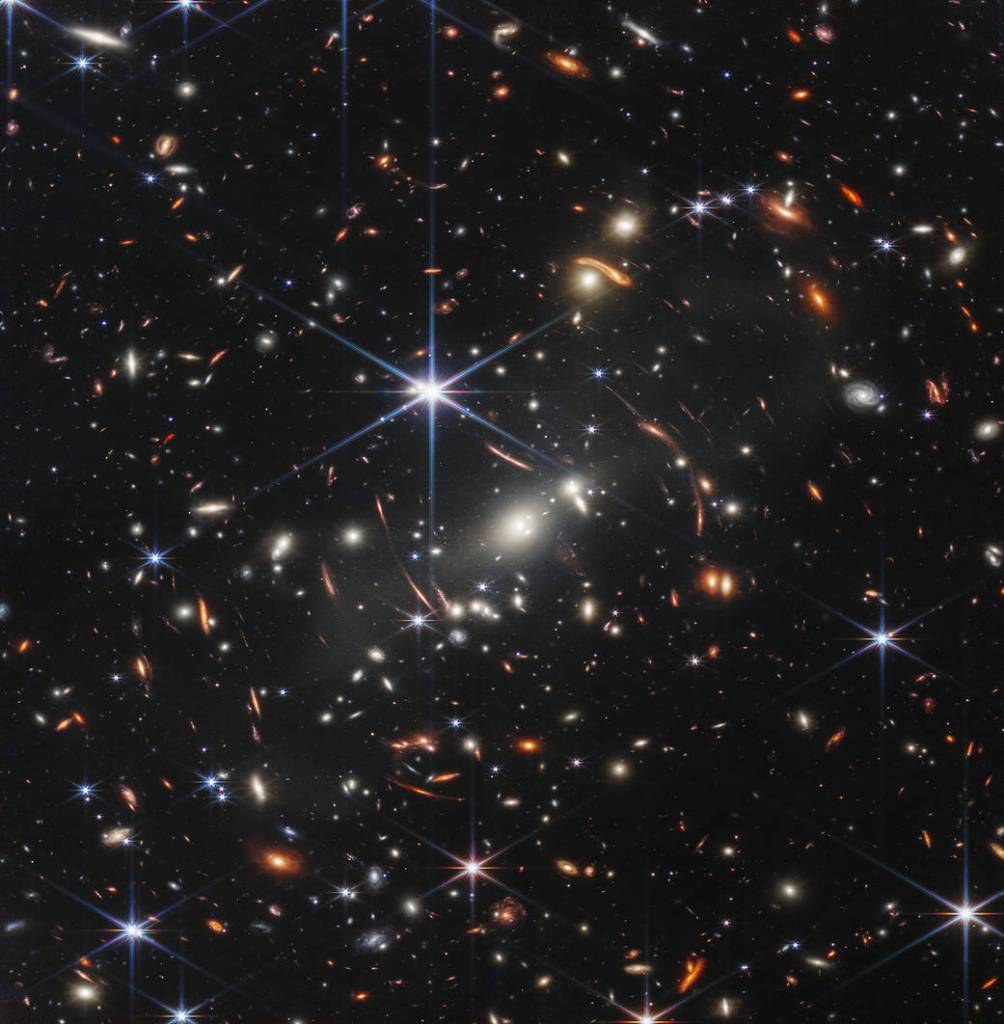
The outer ring-like segments arrive here later than the inner segments, having taken a longer path to get to us. That allows us to obtain information about the changes in time that may have occurred in that far away galaxy.
Let us now imagine traveling with one of the trillions and trillions of photons having been emitted by that galaxy. It may have been a hot churning atom of primeval hydrogen which, in the process of transmuting into helium, has thrown out a photon of light. This little packet of energy now gets underway traveling at 186,000 miles per second and will do so for the next 13.5 billion years. As it starts its incredible journey, neither the Sun nor the Earth exist as yet and will not exist for another 9 billion years.
Our heroic photon eventually passes through clouds of dust and continues its travel at that same breakneck speed, mostly in a straight line.
Eventually, perhaps after having traveled for some 10 billion years, it passes by a group of big galaxies several hundred lightyears to the side of its path and as it goes by, our intrepid photon feels a strong sideways tug, deflecting its path as it continues beyond. It has been subjected to that gravitational lensing effect that a wise long-haired human genius will predict a few billion years hence, on a small speck of a planet in a faraway galaxy.
Our photon, still going otherwise unperturbed, at 186,000 miles per second, continues for another 3.5 billion years. Streaking along, eventually it enters a large galaxy, our Milky Way galaxy; passes through more dust and gas clouds, bumping into a few particles and molecules. Then, a few thousand years later, half way into the galaxy, it traverses a planetary system, our Solar system, in just a few hours, the last few hours of its incredibly long life of 13.5 billion years.
Suddenly, it hits one of the beryllium mirrors of a multi-segmented primary mirror of a telescope orbiting the Sun at one million miles from planet Earth. It bounces off that mirror segment backwards to another smaller mirror, from where it ricochets into a short tube and, finally, our heroic photon dies, after its incredibly long life, smashing into an infrared detector engendering an electron that then travels through a wire to circuitry that then transmits a signal to the Earth, together with trillions of its travel partners that just arrived and continue to arrive at the telescope, sharing their fate with that of our photon. Many more accompanying photons miss the mirrors and continue their journey, eventually leaving our galaxy, going to an unfathomable beyond.
[1] Year 2020.
[2] Carbon dioxide concentration in March 2024: 420 ppm.
 Pedro Lilienfeld
Leave a comment