I will now address the thorny issue of the German culpability in carrying out the Holocaust. I had been reluctant to do so within my autobiography because that subject is both painful and quite complex. Furthermore, much has been written about this matter and my contribution may be more than redundant. And yet I feel that I need to express my own thoughts, based on our family’s experience and my personal attempts at understanding that, mostly incomprehensible, inhuman catastrophe.
When I first became acquainted with the horrors and the magnitude of the Holocaust, perhaps during my teenage years, in the late 1940s, I had hoped that this terrible phenomenon was going to be studied on a large scale to uncover its origins and to reach sweeping conclusions on ways to prevent a repetition of such a singularly unfathomable catastrophe. I expected that humanity at large would engage in such essential self-analysis. This desideratum was naively unrealistic as repeated worldwide genocides that succeeded the Nazi massacres so painfully proved.
As to the German phenomenon, I began to flesh out in my own mind its historical, sociological and religious background which led me to a better understanding of some of the reasons that could have enabled that nation to engage in such a horrendous collective crime.
One of the first elements of my gradual enlightenment on this phenomenon was the reading of Thomas Mann’s novel Doktor Faustus, published in 1947. I read it in Spanish translation as I was living in Quito. Not only did it acquaint me with the magnificence of Mann’s writing but it was profoundly revelatory about a, to me, unexpected facet of the German psyche: the obscurantist streak permeating the small-town countryside people of Germany. The unquestioned belief in dark forces, witchcraft and evil spirits by that population in the early 20th century were a shock to me as I had only viewed that country’s through the lenses of its remarkable cultural achievements. I was familiar only with such admirable giants as Beethoven, Kant, Humboldt, Goethe, etc. That other darker facet of its mentality had been unknown to me and if I had any inklings at all, they were perhaps only through historically remote descriptions of medieval mentalities.
That medieval background then became in my mind a major contributor to the evolution of antisemitism in Germany. I thus became acquainted with the long and painful history of the repeated persecutions, pogroms and massacres perpetrated by the German Christians. I learned that, although even earlier outrages had been committed, before the turn of the first millennium, these had been sporadic and relatively infrequent. The first large scale and more systematic genocidal undertaking was what is now called the Rhineland Massacres. These were perpetrated by the mob of the Peoples Crusade, the first crusade, in the year 1096, as it went pillaging through Germany and Central Europe. The predominant theme of these killings was to rid the countryside from the Christ Killers, as Jews were being labelled. This was a predominantly religiously driven persecution which, officially, was condemned by most Catholic ecclesiastical authorities, including the Pope. These authorities in many cases tried to protect the Jews from these outrages although with little success. This apparent official benevolence towards the Jews was motivated principally by pragmatic reasons: the Church often depended on Jews to provide it with essential monetary income.
It is rather obvious to me that the sanctimonious attitude of Church authorities towards the outrages of the crusading rabbles against the Jewish population had nothing to do with religious toleration. The mob did not invent the Christ Killer’s motivation. It came from many years of Church teachings of the Gospel. The Gospel of John has Jesus call the Jews “sons of the devil”. Toward the end of the 4th century, much publicized sermons of the Church father John Chrysostom (347 – 407) combined Christian anti-Jewish elements derived from the New testament with earlier pagan ones, and these themes were gradually incorporated into the anti-Jewish discourse of the Church. Equally, Cyprian (210 – 258), another even earlier Church father, issued strongly anti-Jewish testimonies. The Code of Theodosius II, in 438, established Christianity as the only legal religion in the Roman Empire, followed a century later by the Justinian Code that specifically stripped Jews of many of their rights. This antisemitic trend continued unabated during the early Middle Ages, culminating with the policy, enacted at the 12th Council of Toledo in 681, of forced conversion of all Jews when thousands fled or others converted to Roman Catholicism.
I have discussed briefly the issue of the spurious accusation of Christ Killers against the Jews in my autobiography. I will mention some of these arguments here again and in the present context. First of all, Jesus was a Jew living in Judea thus it was not likely that, for example, Persians or Chinese would have wanted his execution. Second, his actual execution by crucifixion was carried out by Romans and not by the Jews. I find it very difficult to imagine the Romans taking orders from their oppressed subjects, the Jews. Thirdly, I have mentioned my dismissal of the whole mythology surrounding the crucifixion of Christ. If he had to die to redeem humanity, as it is claimed by the Catholic Church, then someone had to kill him – unless he chose to commit suicide which Christians consider a sin. If nobody had been willing to kill the Savior, Christianity could not have come into existence, What a disaster! The Roman administration of Judea and perhaps some Jews should thus be thanked by the Christians for having disposed of Christ for the purported good of humanity.
This utter nonsense thus became the raison d’être for the persecution and killing of tens of thousands, or more, Jews especially throughout the 2nd millennium of the Christian Era. This killing theme was reenacted time and again for a thousand years and provided, for example, the inspiration for massacres such as in Sevilla, Spain, in 1391, incited by the archdeacon of Écija in Andalusia, Ferrand Martínez, during which more than 4,000 Jews were murdered, followed by the outrages of the Spanish Inquisition after its establishment by the Catholic Monarchs in 1478 that resulted in the infamous auto-da-fé trials that would frequently culminate in burnings at the stake.
Passion plays were – and still are – dramatic stagings representing the trial and death of Jesus that have historically blamed the Jews for the crucifixion of Jesus. Blood libels which are false accusations that Jews use Christian children’s blood, persisted from the 12th century through the present.
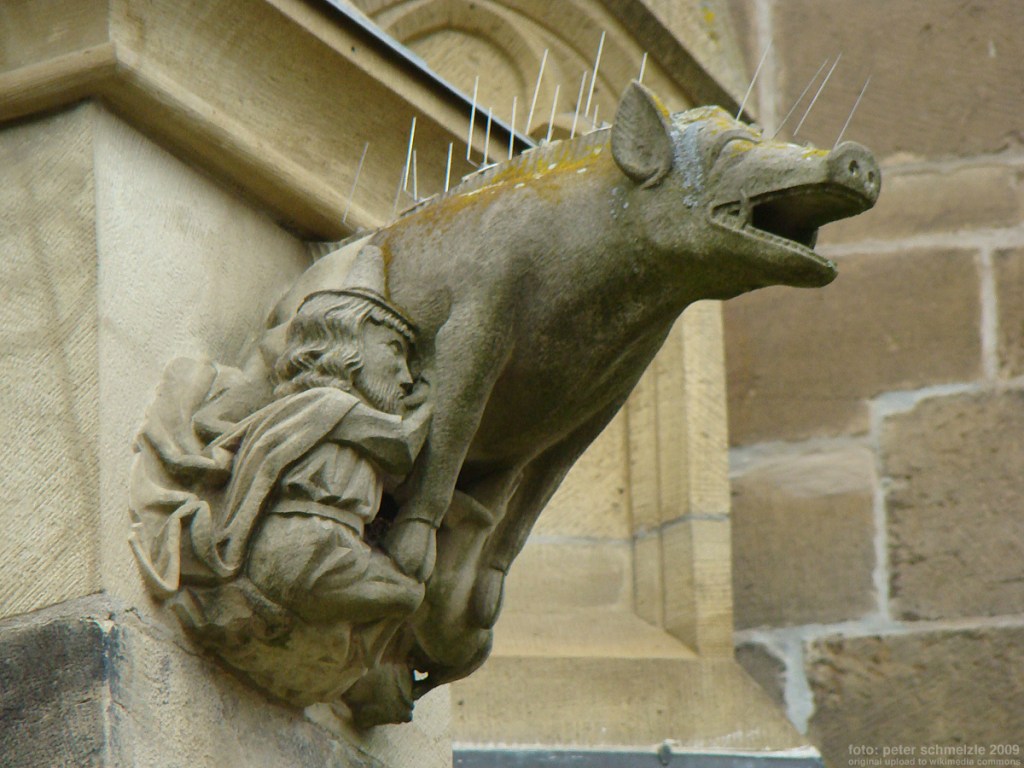
Judensau, German for “Jews sow”, was the derogatory and dehumanizing imagery of Jews that appeared around 13th century. Its popularity lasted for over 600 years and was revived by the Nazis. The Jews, typically portrayed in obscene contact with unclean animals such as pigs or owls representing a devil, appeared on cathedral and church ceilings, pillars, utensils, etchings, etc. (see gargoyle above). Often, the images combined several antisemitic motifs and included derisive prose or poetry.
The protestant Reformation in the 16th century only exacerbated the vituperations against the Jews, especially in Germany, as Martin Luther, towards the end of his life turned viciously against them, ostensibly because they refused to convert to Christianity.
In 1543 Luther published Von den Juden und ihren Lügen (On the Jews and Their Lies) in which he affirms that the Jews are a “base, whoring people, that is, no people of God, and their boast of lineage, circumcision, and law must be accounted as filth. They are full of the devil’s feces … which they wallow in like swine.” The synagogue was a “defiled bride, yes, an incorrigible whore and an evil slut …” He argues that their synagogues and schools be set on fire, their prayer books destroyed, rabbis forbidden to preach, homes razed, and property and money confiscated. They should be shown no mercy or kindness, afforded no legal protection, and these “poisonous envenomed worms” should be drafted into forced labor or expelled for all time. Luther claims that Jewish history was “assailed by much heresy“, and that Christ swept away the Jewish heresy and goes on to do so, “as it still does daily before our eyes.” He stigmatizes Jewish Prayer as being “blasphemous” and a lie, and vilifies Jews in general as being spiritually “blind” and “surely possessed by all devils.” And finally, Martin Luther actually advocated that Jews be killed in On the Jews and Their Lies, as follows:
“So we are even at fault in not avenging all this innocent blood of our Lord and of the Christians which they shed for three hundred years after the destruction of Jerusalem, and the blood of the children they have shed since then (which still shines forth from their eyes and their skin). We are at fault in not slaying them” [my emphasis].
Can there be a more blatant call for the Nazi Final Solution, issued 400 years before, by the foremost Protestant in history? Can we even be surprised that the Holocaust eventually ensued in Germany? Luther’s rantings already contain the seeds for the morphing from religious to genetic motivation for antisemitic hatred. And yet this obvious connection that implicates Luther in this unspeakable crime is still, to this date, being debated and questioned.
Even during the 18th century “the unfavorable image of the Jews was further reinforced by the lingering theological notion of their damnation for deicide…” as mentioned by David Sorkin in his treatise The Transformation of German Jewry 1780 – 1840.
Throughout the 19th century and into the 20th, the Roman Catholic Church still incorporated strong antisemitic elements. Pope Pius VII (1800 – 1823), had the walls of the Jewish Ghetto in Rome rebuilt after the Jews had been released by Napoleon, and Jews were then confined back into the Ghetto until the end of the Papal States in 1870, as a result of the Italian unification.
Additionally, official organizations such as the Jesuits banned candidates “who are descended from the Jewish race unless it is clear that their father, grandfather, and great-grandfather have belonged to the Catholic Church”, until 1946.
I will not attempt to include herein the innumerable additional pogroms, especially in Germany, inflicted on Jewish populations during the last 1,000 years. That would require a compendium well beyond the scope of this assessment. However, this will lead me to the culmination of this infamy: the Holocaust perpetrated on the Jews by Nazi Germany. I contend that it was the outcome of the subconscious brainwashing implanted by the relentless Christian teaching of the purported culpability of the Jews in the execution of Christ. This religiously motivated fiction slowly morphed into a racial hatred, i.e., the fictionthat the Jewish people were inherently flawed, an assumed genetic trait that could not be extirpated except by killing the “accursed”.
Thomas Mann had identified the obscurantism and the belief in evil spirits in the German countryside that provided fertile grounds for the blind acceptance of the Final Solution meted out to the purported killers of the Savior. The Nazi government was able to tap into that subconscious and redirect the religious hatred into a racial/genetic one that precluded any “conversion” from Judaism and made it into an inbred trait that dictated the extermination of the Jewish “race”. Whereas the Inquisition had encouraged religious conversion to escape death, the Nazis shut the door to such “pardon”. Once you were labelled as descendant of Jews you had to be eliminated.
It is thus that I feel justified in issuing a J’accuse…![1] aimed at the Christian – whether Catholic or Protestant – Church of having created over the centuries the criminally distorted mind set that led to the Jewish Holocaust of the 20th century, the most egregious crime against humanity ever committed.
I would be remiss, however, if I did not mention another very important pretext for antisemitism that surfaced during the 19th century: the purported power hungry and devious Jewish cabal to control the world. The first impression when considering this strange but pervasive attribution of widespread evil scheming by Jews is that it does not seem related to the ancient Christ killers accusation. But on further analysis there is a possible common denominator, namely that the killing of Christ was an early and more overt embodiment of the exercise of the power and domination that Jews later on were to purportedly pursue underground. That sinister attribution was the basis of the anti-Dreyfusard hysteria in France and the subsequent German Nazi hatred and persecution of all Jews. This aspect of antisemitism appears to be on the rise again with an added coloring of racial contamination.
Other spurious and contradictory accusations against Jews were of fomenting and supporting communism (e.g., in the U.S.) or, undermining communism (e.g., in the Soviet Union), spreading “cosmopolitanism”, and advocating world government (e.g., as Einstein was accused of). The list is interminable.
One, often conveniently forgotten, early contribution to the evolution of the Nazi methodologies to be applied to the persecution of Jews was the example of the treatment of African-Americans in the U.S., perpetrated during the early decades of the 20th century, i.e., the Jim Crow outrages including forced segregation, lynchings, home burnings, etc. These atrocities and affronts were studied assiduously by the German “Arian” white supremacists of that pre-1933 period of the Nazi gestation as to their applicability to the suppression of the Jews of Europe (see Hitler’s American Model: The United States and the Making of Nazi Race Law by James Q. Whitman).
In this context, a recent public spat that illustrates the ignorance surrounding the Holocaust and antisemitism in the U.S. brought out the erroneous characterization of racism as a problem that applies exclusively to African-Americans. The fact that antisemitism in its modern incarnation is just as racist seems to have escaped many, especially blacks, in this country. The airing of this educational shortcoming elicited calls for improved public enlightenment on the general subject and to inform the masses about the causes and origins of antisemitism. However, if this laudable objective were to be truly and thoroughly pursued, the entire horrendous contents of a veritable Pandora’s box would have to be contended with: my conclusion that ultimately Christianity’s teachings were the historic root causes of the prejudices leading to the Holocaust. I can only guess at the universal outrage and vituperation that such revelation would elicit among the Christians.
As to the question of the collective guilt of the German people in actually committing the Holocaust, I have no doubts about it. The question, however, is one of individual degree. I believe that the attitude of Germans under the Nazi regimen could be classified into four general categories: a) those who were active participants in the killings, b) those who were sympathizers and enablers of the crimes, c) the “don’t know – don’t speak” cohort, and d) the opponents of Nazism.
The challenge about this grouping is to assign any quantitative distribution, i.e., what fraction of the German population to be assigned to each of the categories. I can only venture guesses. These will be based on readings about the war and the years leading to it.
As to category a) listed above, probably all members of the SS (Schutzstaffel or Protection Squadron) were active and willing participants. These were subdivided according to duties, e.g., combat units, enforcers of racial policies, those who ran concentration camps, the secret police, etc. Altogether, the SS may have consisted of at least 2 million members. One may easily add another million among the Wehrmacht, the armed forces, and miscellaneous participants in atrocities.
I estimate that the second category of Germans, the sympathizers/ enablers, could be estimated to be of a similar number. If we discount category d), the opponents of Nazism, who may have numbered below one million, if that many, we are left with a “silent majority” of tens of millions of “ostriches”, those who either pretended to be unaware of the atrocities or those who were in denial about the systematic slaughter of human beings perpetrated as ordered by their government.
Thus, the collective guilt of the German people, in my opinion, can not be denied. Perhaps, as the notable post-war German writer W. G. Sebald mentions in On the Natural History of Destruction, there was a glaring absence in postwar German writing of any real reaction to the wartime bombing and destruction of their cities, that reflected an acknowledgment of that collective guilt for which the German people had to atone.
During the first decades after the end of the war, Germans, by and large, were in denial and preferred to see themselves as victims rather than perpetrators. Whatever suffering they had to endure in the difficult years after Germany’s surrender in 1945 gave them justification for this escape from guilt (see Aftermath: Life in the Fallout of the Third Reich 1945-1955 by Harald Jähner). Here are some particularly pertinent paragraphs from that recent analysis:
“There was only one subject that the outpouring of speech within Germany persistently excluded, and that was the central one: the murder of the European Jews… there was hardly so much as a word about the Holocaust. Discussion of the Jews was also out of bounds… Not many people were prepared to lay themselves bare. One was loquacious or one was silent. Very few found the appropriate words. The right words were a sheer impossibility. The murder of the European Jews represents a crime whose monstrousness affected the subsequent life of every German and plunged them into the undertow of the unsayable as soon as they thought about it…. In discussing the past many means of evasion were opened up to avoid responsibility. One of the most common of these lay in the conviction that people had fallen victim to National Socialism as if to an intoxicating drug. They themselves becoming its victims. Nazism appeared to the post-war Germans as a drug that had turned them into willing tools….Most of the time Hitler had little need to resort to the coercion of his own people, since he was able to rely on the loyalty of the broad majority. It was not until the endgame that the cohort of leading Nazis melted down into a zealous hard core who wreaked terror on their own people and disgustedly rejected the majority of the population, who now recognized the remaining fanatical defenders of the system as torturers and devils. The tyrannical exercise of terror by the Nazi elite during the last few months of the war had been enough for the bulk of former Party supporters to see themselves as Hitler’s victims…. The collective agreement of most Germans to count themselves among Hitler’s victims amounts to an intolerable insolence. Seen from the perspective of historical justice this kind of excuse – like the overwhelmingly lenient treatment of the perpetrators – is infuriating….The fate of victimhood that people volubly assigned to one another-known in sociology as “self-victimisation” -stripped most Germans of any obligation they might otherwise have felt to engage with the Nazi crimes committed in their name.”
However, when Evelyn and I visited Berlin in 1986, where I attended a conference, we were made aware of manifestations of guilt or, at least, a need to express a mixture of remorse and friendship to both of us. I want to believe that these gestures were genuine and reflected the attitude of the newer generations of Germans.
All of the preceding attempts at an analysis of the background factors leading to the Holocaust may help us understand that horrendous chapter in history and yet, when witnessing documentaries and reading descriptions of the atrocities committed by the Germans and their acolytes I, for one, still find it incomprehensible that any humans could be as inhumane, especially those who had the cultural pretensions of “civilized” Europeans. This unspeakable phenomenon remains frightening to me as it implies that there must be a latent potential for such barbarity in all of humanity.
And now I have reached a point in these musings that I never foresaw. I could simply not comprehend the profound debasing of a “civilized” people even considering the insidious conditioning that it underwent over the centuries, as I argued above. Could this happen again and perhaps elsewhere? And then it struck me. I suddenly understood that a connexion with the current (second and third decades of the 21st century) state of affairs in the U.S. is revelatory to my understanding of the phenomenon of Nazism. Repeatedly, the riot of January 6, 2021 and the surrounding circumstances in this country have been compared with the unrest and aftermath of the early 1930s in Germany that culminated with the rise of Adolf Hitler. I want to reverse that narrative. The extremism, fanaticism, irresponsibility, immorality, obfuscation and irrationality that the majority of Republicans in this country have manifested prior, during and after the 2020 presidential elections are to me as inexplicable as the rise of Nazism in Germany. And yet if that collective irrationality has proven to be possible in 21st century U.S. – after all, more millions of morally and intellectually challenged individuals opted to vote for Trump in 2020 than in the 2016 elections – then I begin to understand how an Austrian maniac could draw the masses of Germans to acquiesce to his rantings and eventually follow him on his murderous rampage against the Jews. In other words, the Trumpian disaster helps me to understand the Hitlerian catastrophe.
What a legacy the U.S. has left to the “edification” of humanity over the last 100 years!: a) Jim Crow methodologies to guide the rise and implementation of Nazi German ideology; b) obstruction of Jewish immigration during WWII contributing to – if not actually causing – the deaths of at least 100,000; c) Support of the French Vichy – Nazi controlled – regime by the FDR administration; and d) The recent official endorsement, under the Trump administration, of white supremacist mentality.
I had my own brushes with antisemitism, albeit mostly indirect ones and, fortunately, far between. The first was in Nantucket, when I overheard a real estate agent, talking on the phone with another agent, referring to us with: “but you know, they are Jewish”. The second encounter with antisemitism was in Spain when Evelyn and I were visiting the Catalonian monastery of Poblet in the 1980s, an old monk befriended us obviously believing we were good Catholics and bemoaned the nefarious influence of “masons and Jews” on people’s morality. More recently, in 2014, when we travelled trough Morocco, when talking about 9/11 with our kind guide, he volunteered that “no Jews were killed then”, implying that the terrorist act had been engineered by the Jews; I had to straighten him out informing him that about 400 Jews had, indeed, died at that disaster. This conspiracy falsehood was being circulated in the Moslem world.
[1] Inspired by the French writer Emile Zola’s exoneration of the falsely accused Jewish officer
Alfred Dreyfus in 1898.
 Pedro Lilienfeld

Leave a comment