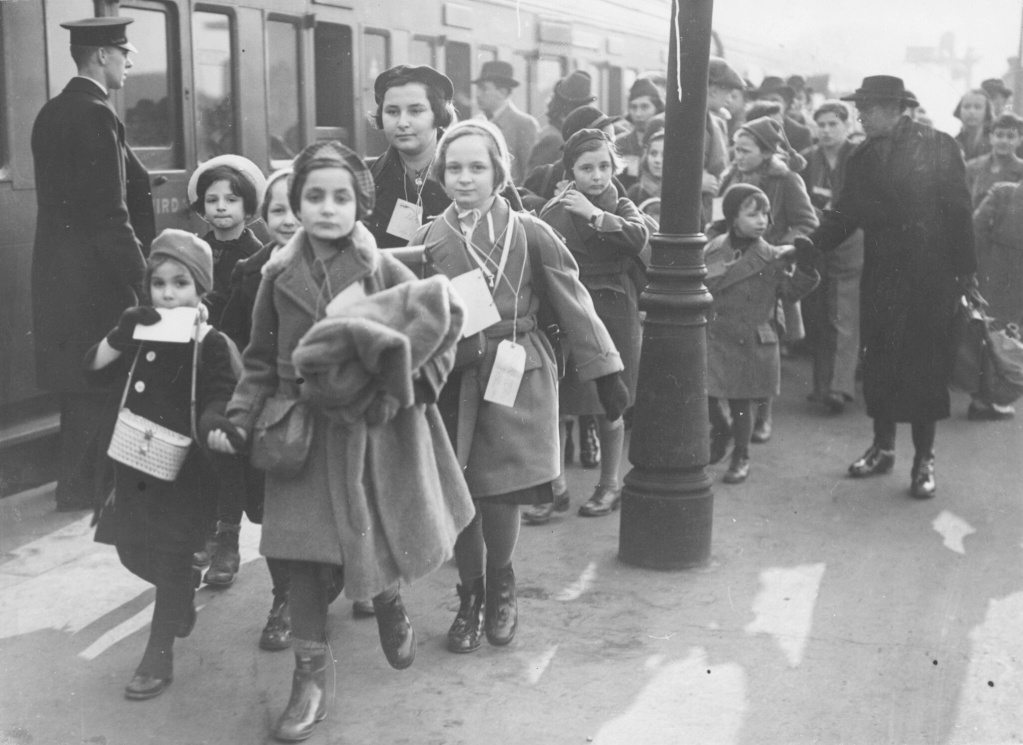
Recently, I was reminded of the Kindertransport by a far removed cousin, George Fogelson, who is doing research on the Anker family[1] and its ancestry. His mother, as a young girl, was saved from the Holocaust by that operation. One of my best high school friends in Quito, Ivan Schön, equally survived through that rescue. His parents, however, perished. As I was trying to learn more about that operation I came across a very disturbing fact, the role the U.S. played or, rather, did not play.
The Kindertransport (German for “children’s transport”) was an organized rescue effort of children (but not their parents) from Nazi-controlled territory that took place in 1938–1939 during the nine months prior to the outbreak of the Second World War. The United Kingdom took in nearly 10,000 children, most of them from Germany, Austria, Czechoslovakia, Poland, and the Free City of Danzig. The children were placed in British foster homes, hostels, schools, and farms. Often they were the only members of their families who survived the Holocaust. The program was supported, publicized, and encouraged by the British government, which waived the visa immigration requirements that were not within the ability of the British Jewish community to fulfill. The British government placed no numerical limit on the program; it was the start of the Second World War that brought it to an end, by which time about 10,000 Kindertransport children had been brought to the country.
Smaller numbers of children were also taken in via the program by the Netherlands, Belgium, France, Sweden, and Switzerland (my friend Ivan was taken to Sweden). The term “Kindertransport” may also be applied to the rescue of mainly Jewish children from Nazi German territory to the Netherlands, Belgium, and France. An example is the 1,000 Chateau de La Hille children who went to Belgium. However, most often the term is restricted to the organized program of the United Kingdom.
The Central British Fund for German Jewry (now World Jewish Relief) was established in 1933 to support in whatever way possible the needs of Jews in Germany and Austria.
In the United States, the Wagner–Rogers Bill was introduced in Congress, but due to opposition from Senator Robert Rice Reynolds, it never left the committee stage.
In 1939 Senator Robert F. Wagner and Rep. Edith Rogers proposed the Wagner-Rogers Bill in the United States Congress. The Wagner–Rogers Bill was a proposed United States legislation which would have increased the quota of immigrants by bringing a total of 20,000 Jewish children (there were no sectarian criteria) under the age of 14 (10,000 in 1939, and another 10,000 in 1940) to the United States from Nazi Germany.
The bill was sponsored by Senator Robert F. Wagner (D-N.Y.) and Rep. Edith Rogers (R-Mass.) in the wake of the 1938 Kristallnacht attacks on Jews in Germany. The bill was introduced to Congress on February 9, 1939. However, this bill failed to get Congressional approval.
The bill had widespread support among religious and labor groups, but was opposed by nationalist organizations and Senator Robert Rice Reynolds threatened to filibuster against it. President Franklin D. Roosevelt supported the bill, but believed that he lacked the wherewithal to overcome congressional resistance. His wife, Eleanor Roosevelt, also expressed support for the bill.
A poll by the American Friends Service Committee found that thirty-five senators were “in favor” of the bill and thirty-four “probably in favor”. These votes may have sufficed for the bill to pass, but a filibuster would have likely caused problems. Nevertheless, the House Immigration Committee never reported the bill out; eleven of its members were said to be opposed and eight in favor. Historian Richard Breitman argues that, in addition to general anti-immigration sentiment, anti-semitism also played a substantial role in the bill’s defeat.
In contrast to the Kindertransport, where the British Government waived immigration visa requirements, these children received no United States government visa immigration assistance. Furthermore, it is documented that the State Department deliberately made it very difficult for any Jewish refugee to get an entrance visa. My family was made well aware of that obstacle whose consequence was our emigration to Ecuador.
Robert Rice Reynolds (June 18, 1884 – February 13, 1963) was an American politician who served as a Democratic US senator from North Carolina from 1932 to 1945. Almost from the outset of his Senate career, “Our Bob,” as he was known among his local supporters, acquired distinction as a passionate isolationist and increasing notoriety as an apologist for Nazi aggression in Europe. Even after America’s entry into World War II, according to a contemporary study of subversive elements in America, he “publicly endorsed the propaganda efforts of Gerald L. K. Smith,” whose scurrilous publication The Cross and the Flag “violently assailed the United States war effort and America’s allies.” One of the nation’s most influential fascists, Smith likewise collaborated with Reynolds on The Defender, an antisemitic newspaper that was partly owned by Reynolds.
An advocate of immigration restriction, Reynolds spoke out against the Wagner–Rogers Bill that aimed to accept 20,000 Jewish refugee children into the United States from Nazi Germany. He elicited the praise of the magazine “Social Justice,” organized by demagogue and radio priest Charles Coughlin.
In 1939, less than three months before the beginning of World War II, Reynolds, described by the leftist newspaper PM as “the Senate’s No. 1 alien-baiter,” called for a 10-year ban on all immigration to the United States and said that “the time has come for changing the tradition that the U.S.A. is an asylum for the oppressed.” He also demanded that newly-arrived immigrants, “millions of foreigners who are about to begin the rape of this country,” should be deported or detained in concentration camps. Does this attitude sound familiar now (2024)? Plus ça change, plus c’est la même chose!
[1] My mother’s family.
 Pedro Lilienfeld
Leave a comment