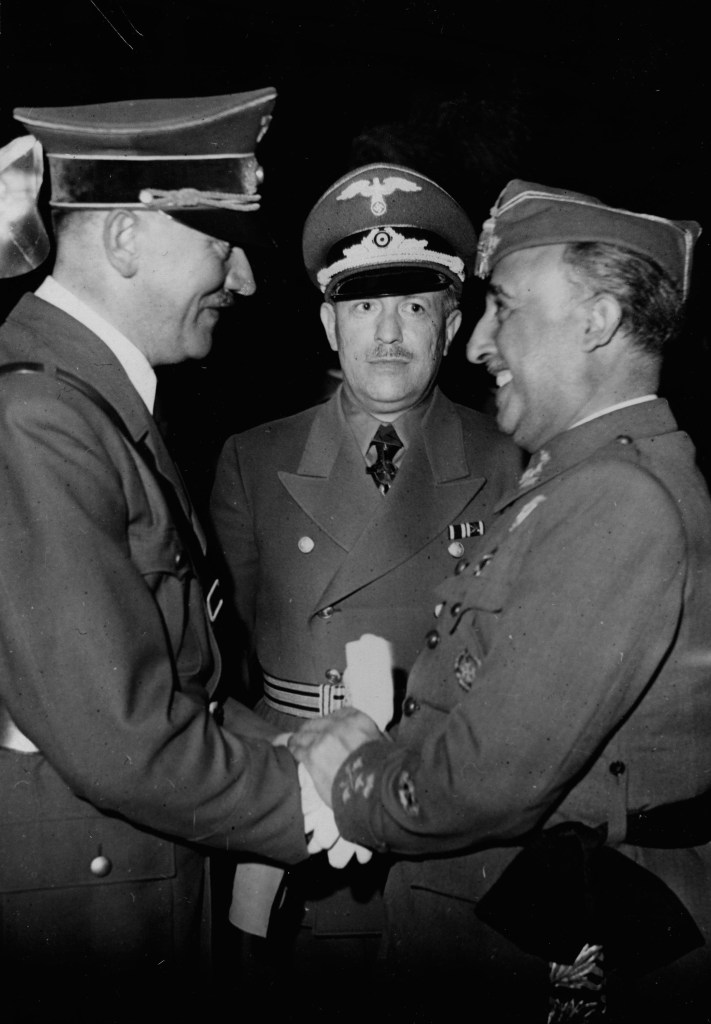
I mentioned in my autobiography a hidden pro-Jewish agenda of Spain’s Generalísimo Francisco Franco stemming from a purported belated recognition of the cultural debt owed to the Sephardic Jews expelled from Spain in 1492. The ambivalence of Franco on this matter, however, can now be deduced from information that surfaced in the 21st century that indicates that the Spanish dictator ordered his officials to draw up a list of some 6,000 Jews living in Spain and hand it over to the German SS chief Heinrich Himmler. Provincial governors were instructed in May 1941 to especially seek out for this list Sephardic Jews, descendants of those originally expelled from Spain, because they would have remained unnoticed and could carry out attempts at subversion. At he same time the list does not seem to have included those Jews, like us, who had fled from Vichy France.
The majority of Jews who escaped from Vichy France ahead of the full occupation of the country by the Germans in November 1942, however, did so by passing through Spain on their way to Portugal from where they usually continued to other countries outside of Europe or to the UK. Many of those who crossed illegally from France, did so without visas, over the Pyrenees, and guided by smugglers. Our legal case was, apparently, rather exceptional in that we had bona fide entry visas – not the more common transit visas – allowing us to remain in Spain whose government then issued my family special temporary residence passports.
The attitude of Franco towards the Jews thus appeared to have varied according to what was most expedient and useful to his foreign policy. While the Nazis had the upper-hand, he kowtowed to them. After they started to be on the losing side of the war, Franco attempted to ingratiate himself with the Allies pretending that he had always wanted to protect the Jews. My family was most probably justified to mistrust his intentions had we remained in Spain in 1942, especially if the war had not soon after turned against the Nazis. We were thus to leave for good that powder keg and head for our distant and unknown haven in Ecuador.
In a recent biography of De Gaulle I came across a curious reference to the school where I attended second grade in Madrid during the school year of 1941 to 1942, i.e., the French Lycée. Apparently, in 1944, you could graduate there with one of two types of baccalaureates: either Vichy or De Gaulle inspired, a typical leftover of Franco’s opportunistic duplicity. After all, his government and the Catholic Church had complete control of all aspects of education in Spain at that time. Probably that scheme had already been implemented during my presence at the Lycée.
On the subject of our departure from Spain to Ecuador in May of 1942, I have repeatedly dwelt in my autobiography on the multiple rejections to our requests to immigrate into the U.S. that culminated with the final refusal by the embassy in Madrid to further consider our case. I have tried to find a satisfactory explanation for that arbitrary decision and in doing so I have converged on the name of the likely responsible American authority: Samuel Miller Breckenridge Long (1881 – 1958), personal friend of Franklin Delano Roosevelt, and assistant secretary of state from 1940 to 1944.
During that period he was responsible for enacting the regulations for the approval of applications for visas to immigrate to the U.S. Long was a member of a family that has been described as “practically Confederate aristocracy”. To reward Long for his generous support of FDR’s 1932 Presidential campaign, he had been granted the ambassadorship of the U.S. to Mussolini’s Italy. Breckenridge Long, an extreme nativist, is now largely remembered for his obstructionist roles as the official responsible for granting refugee visas during World War II.
There is an all encompassing aspect to the antisemitism permeating the interbellum period. It is the identification of Jews with communism. It goes back to the Russian Revolution that toppled the Tsars at the end of WWI. The Germans, very soon after, and encouraged by the so-called White Russians who had fled from Russia to Germany, attributed the Russian Revolution to an alleged Jewish Bolshevism, an anti-communist conspiracy theory. It purported that that revolt was a plot to destroy Western civilization and, eventually, served the Nazis as an ideological justification for the invasion of the USSR and the Holocaust.
That canard then also fed the ideology of the German American Bund in the U.S. It provided the basis for the antisemitism of the American State Department and the politics embraced by high level functionaries, such as Breckenridge Long, of barring Jews from accessing the U.S. during WWII.
I am suggesting that the rejections for immigration to the U.S. suffered by my family, especially at the embassy in Madrid in 1941, were elicited by that spurious identification of Jewishness with a concomitant purported Communist allegiance.
My father, Erich had a distinctly, so-called, Jewish physiognomy. He was somewhat swarthy, with dark eyes, and had an aquiline nose. I can well surmise the American embassy functionary, with whom Erich had to deal, reacting with a distorted identification of a highly educated German Jewish fugitive from the Nazis, with that of a Communist, and possibly even a Bolshevik agent.
So, we as Jews, had to face a double jeopardy: German persecution and American anti Communist-driven antisemitism.
Ultimately, it is estimated that the effect of the immigration policies set by Long and the U.S. State Department may have been the death of at least 190,000 human beings, most of them Jews. Fortunately, our family was saved notwithstanding our inability to access the U.S. when we needed it most, as described in the autobiography.
 Pedro Lilienfeld
Leave a comment