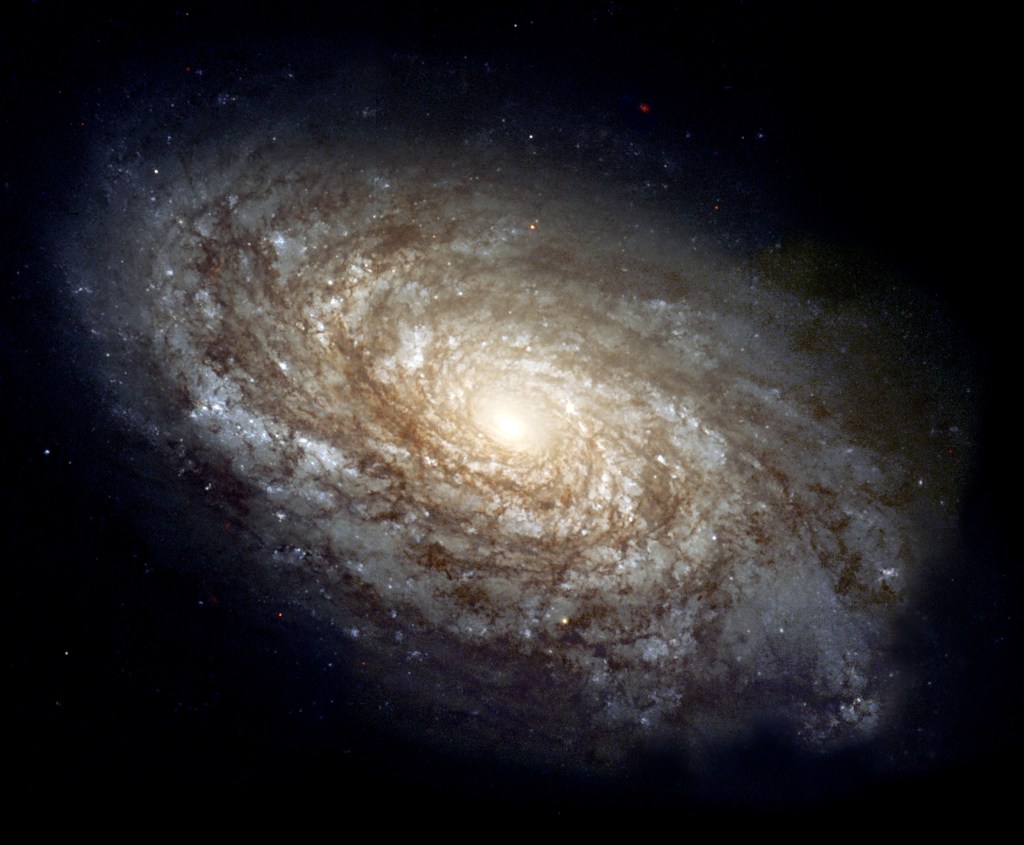
To me, the most spectacular manifestation of the awesomeness of our Universe is the photographic view of a galaxy, of almost every galaxy.
There is an inherent beauty in its majesty, its largely symmetrical shape, its brilliance and, foremost, the implicit realization that its apparent fuzzy glow represents billions of suns sending us a stream of their collective photons.
Until the 1920s, these fuzzy telescopic images of galaxies were largely mistaken as “nebulae”, gaseous clouds embedded in our Milky Way assembly of stars which, in itself, was considered as the totality of the Universe.
There had been some notable previous exceptions to that perception. The most often quoted one is that of the “island universes”expounded by the famous German philosopher Immanuel Kant (1724 – 1804) in his anonymous publication entitled Universal Natural History and Theory of the Heavens, wherein he theorizes that those nebulae are enormous assemblies of stars like the Milky Way. Kant, in turn, mentions the French mathematician and philosopher Pierre Louis Moreau de Maupertuis (1698 – 1759) as precursor of that idea.
It is of particular interest that even in the early 20th century, this hypothesis was hotly contested. The Great Debate, also called the Shapley–Curtis Debate, was held on 26 April 1920 at the Smithsonian Museum of Natural History, between the astronomers Harlow Shapley and Heber Curtis. It concerned the nature of so-called spiral nebulae and the size of the universe. Shapley believed that these nebulae were relatively small and lay within the outskirts of the Milky Way galaxy (then thought to be the entire universe), while Curtis held that they were in fact independent galaxies, implying that they were exceedingly large and distant assemblies of stars.
A short time later in the 1920s, Edwin Hubble showed that the Andromeda galaxy was far outside the Milky Way by measuring Cepheid variable stars, proving that Curtis was correct.
It is ironic that on another astronomical disagreement, Shapley was correct while Curtis was not. The latter believed that our solar system was at the center of the Milky Way galaxy whereas Shapley correctly supported the idea that the Sun is located farther out.
A similar controversy occurred in the 1960s about the nature of quasars. These quasi-stellar objects were, as some astronomers believed, located nearby within our Milky Way galaxy but were subsequently identified as active nuclei of very distant galaxies.
The Andromeda galaxy is the closest galaxy of a size — although somewhat larger — and structure similar to the Milky Way. It is at a distance of 2.5 million light years from us and is also the farthest object that can be seen with the unaided eye. It appears, on a clear un-light-polluted night, resembling a faint fuzzy star. We are gravitationally bound to the Andromeda galaxy and on a collision course with that neighbor. That encounter is estimated to take place in about 4 billion years.
The magnificent photographs of galaxies that we enjoy and admire at present are the result of extended telescope mediated exposures that can, in some cases, require several hours.
There are various types of galaxies, among them the most common are elliptical and spiral, the Milky Way belonging to the latter category. The image above is that of a distant spiral galaxy not unlike our Milky Way. The reddish color is usually associated with older, colder stars, whereas the bluish streams are produced by newer and hotter ones which are frequently located in the outer regions of the galaxy, as shown above.
Galaxies are gigantic assemblages of stars, typically in the range of about 100 to 500 billion suns. Galactic diameters are of the order of 100,000 light years. Most of them recede from us due to the expansion of our Universe.
Extrapolating from the latest observations it is believed that, generally, most stars of a galaxy are accompanied by, at the very least, one exoplanet and in the majority of cases, by several such planets. Thus, our Milky Way may contain at least one trillion exoplanets.
Our solar system is located 26,000 light years, about half way, from the center of our galaxy and it takes approximate 250 million years for the Sun and its planets to rotate once around the center of the galaxy. It is believed that this rotational speed is affected by large amounts of dark matter permeating the galaxy. The nature of that dark matter is unknown at this time.
At the nucleus of the Milky Way galaxy there is an enormous black hole with a mass equivalent to 4 million Suns. It is believed that nearly every galaxy has a black hole at its center and some of these can be even much more massive than that of our galaxy.
Galaxies are not evenly distributed throughout our Universe. There are groups of them and clusters of such groups. Mergers or collisions between neighboring galaxies are believed to have occurred quite frequently.
At present (2024), it is estimated that our universe contains of the order of one trillion galaxies, although that number may be subject to revision in the future.
 Pedro Lilienfeld
.jpg)
Leave a comment