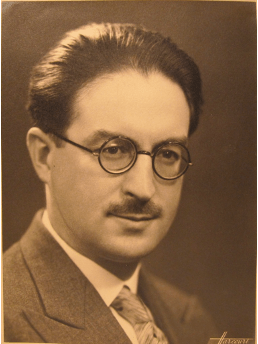
In my joint autobiography, Pétain’s Praise and Other Incongruities, I frequently mentioned and cited Louis Fourestier, the second husband of my paternal grandmother, Julia, alias Dola. I first met Fourestier in 1936 on my arrival in Paris as a two-year old child and then, repeatedly, over the years, as an adult. He was, obviously, the most famous of the members of my family as the principal conductor of the Paris Opera. He was recognized as a highly talented musician while always remaining a warm, unassuming and accessible human being.
Recently (2024), I came across a publication in French that includes the chapter Louis Fourestier en Grande Guerre, 1914-1925, about the participation of my step-grandfather in World War I.
The following is the partial chapter by David Mastin, University of Paris West Nanterre la Défense in The Great War in Music — Life and musical creations in France during the First World War. My translation from the French follows of the first and last sections of this chapter which I considered of particular interest.
To the question asked by a Belgian journalist in 1963, the discrete Fourestier (1892-1976) responded:
It is difficult to identify the greatest moment of a life. Success does not fall on you from one day to the next. One is always the builder of one’s life, and can prepare for anything to happen. I have the impression that if asked all my contemporaries to speak about their “great” moment, they would have but one answer: The war of 14-18.It is our destiny to always remember the horizon-blue greatcoats, even during the era of Gagarin.
If Fourestier does not detail which are exactly his memories, he certainly makes his war experiences — experiences both individual as well as collective — the starting point of his carrier: “The rest was just a sequence” he avers.
Fourestier had endured a particularly long war. Having enlisted, in 1912, for a period of three years, he remains in uniform until the end of August 1919. In 1921, he relocates to the Saarland, under French occupation, to pursue his musical war. He leaves, finally, to travel to Rome after he obtains his first great prize.
This long combat and musical enlistment period spawned a composer and, above all, an orchestral conductor. What follows herein is an attempt to show how the “warrior” became the musician and, maybe, the reverse, as well. Obviously, the available documentation precludes having a clear day by day view of Fourestier’s activities during the war. Nevertheless, it permits to characterize the achievements of an artist who builds, on one hand, a network of relationships and on the other, a musical project. What is most surprising is that Fourestier does not give in to military dereliction
while he builds his future. The epistolary links but also the personal encounters made at the front places the 22nd Artillery Field Regiment stretcher-bearer at the core of a network of young musicians who, at wartime and subsequently, brought their combatant musician culture into the musical world.
A student of the Conservatory
Louis Forester was born in 1892 in Montpellier. He studies the cello there and “a bit of harmony”. Recipient of his first cello prize, he moves to Paris in 1908, at the age of sixteen.
Fourestier is not registered at the Conservatory of Paris before October 1909. One could assume that he audited some courses and/or took private lessons that could have facilitated his admission to the harmony class of Xavier Leroux. He becomes the youngest of the twelve students of that class. Whatever the manner of expression of opinion of individual pedagogues, after three months of teaching, Fourestier is characterized as possessing a “refined and of his own nature”. That expression by Xavier Leroux is equivalent to that of an independent mind. After being granted the first prize in harmony at the completion of the second year, he participates in the counterpoint class of André Gedalge (1911-1912) who considers him “a somewhat good musician” and authorizes him to compete despite a rather reticent note: “he works well but without thought”. At the end of the competition, wherein he obtains the first prize, Fourestier signs up for a three year enlistment at Versailles, on 31 August 1912. He joins the 11th Artillery Regiment stationed in Rouen, on 2 September.
Conclusion
At the moment when nationalism in esthetic matters reaches its peak, the Great War is, for Fourestier, as well as for others, the opportunity to express his appreciation for German art while realizing his dreams of conducting. Both depend on his condition of combatant. As for others, he gains from the institutionalism of musical propaganda. No doubt that he appreciates his German stays[1] as he departs the trenches and the new responsibilities as conductor that are then conferred on him. His pride to serve his three realms, music, his comrades, France, can be understood if one considers that he had been capable, at the front, not to deny his embrace of Wagnerian and German music to which he had been exposed, before the war, as he had grown up in Paris and attended concerts at the Colonne orchestra. His non-exclusionary and generous patriotism, antithesis of the narrow-mindedness of the “puritans of nationalism”, his taste for modern works, so misunderstood by Théodore Dubois, but so appreciated by Koechlin, triumphs at war’s end and opens to him the doors of a brilliant national and international carrier. But, nevertheless, the Great War continues to cast its shadow: in May 1938, as he launches his candidature for conductor of the Orchestra of the Conservatory Society, after the resignation of Philippe Gaubert, he thus concludes his curriculum vitae:
Finally, to end with the various references, I add that I am French, born French; that I had been under its banner for seven years, that during the entire war I was in the armed forces as stretcher carrier of the battery of the 22nd Field Artillery Regiment. Croix de guerre (Military Cross) in 1916 at Verdun.
Then, while during the war, to hush up his bravery went without saying, in order to support the artist, the tense politics of 1938 takes Fourestier back to Verdun, place of memory par excellence, as if the valor of artist had been achieved by that of warrior.
[1] He marries, in July 1929, Ida Berl, German Wagnerian singer, his elder by seventeen years. The Judaism of his spouse, as well as her infirmities are one of two arguments, perhaps the most decisive, that spares Fourestier any sanction at the time of purging. He had been reproached of having conducted the Colonne orchestra, and that of the Opera for more than hundred broadcasts of Radio-Paris, among others. In his defense, he minimizes his power to decide at various levels: refusals could have endangered his wife. Anyway, did he really have choice? The essence of his defense consisted in demonstrate that he was a simple executor: “A conductor of a group isn’t but a conductor by a baton in hand. The conductor of an orchestra cannot be considered to be socially responsible. he should even less be considered a scapegoat. He is more precisely, the ‘underling’, meaning the agent of execution, brought, lead, to participation an exclusively technical activity, to performances of which others(general assembly, commissions or orchestral committees) haven the initiative incurred the responsibility”. This statement illustrates the practical and/or juridical ambiguity of the status of conductor of an orchestra (National Archives, F21 8109, D2. Typescript constituting the defense of Louis Fourestier).
 Pedro Lilienfeld
Leave a comment